 微物联研究院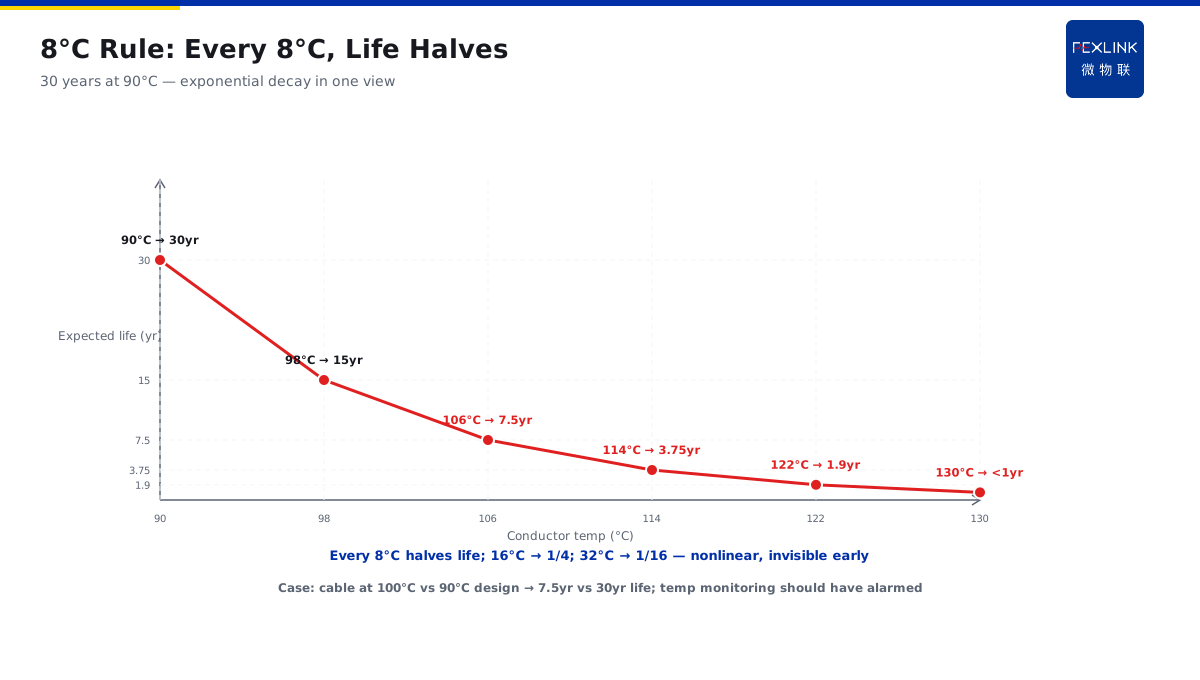
Direct Answer
A cable's life is not determined by "how many years it has been used," but by "how high a temperature it has experienced."
Cable insulation material (XLPE, cross-linked polyethylene) ages at an exponential rate with operating temperature:
- At 90°C long-term operating temperature: design life 30 years;
- Every 8°C over temperature: aging speed doubles;
- At 100°C: life is only 1/4 of original;
- At 110°C: life is only 1/16 of original.
Key insight: ampacity determines temperature rise, temperature rise determines aging speed, aging speed determines life. It is not that a cable used 20 years should be replaced, but that a cable running hot for 20 years has already aged to replacement point.
At one industrial park, a batch of 10kV cables had been in service 15 years. The owner wanted to know if they should be replaced wholesale. Infrared thermography found: cable joint temperature was long-term 95°C, 65°C above ambient — meaning joint aging speed was 4x normal. At this rate, the batch would reach end of life in 5 more years. Later dielectric loss test confirmed: joint tanδ was 3x normal — joints are indeed the weakest point of any cable.
1. Temperature Dependence of Cable Thermal Aging
Many people think cable life is "use X years then replace," but it is not.
Cable insulation aging is essentially polymer degradation under heat, electricity, and oxygen. The speed of this process has an exponential relationship with temperature — this is the famous "8°C rule":
Insulation material operating temperature every 8°C higher, aging speed roughly doubles, life halves.
Example:
- 90°C long-term operating temp: design life 30 years;
- 98°C: life 15 years;
- 106°C: life 7.5 years;
- 114°C: life 3.75 years.
This is why cable temperature monitoring matters so much — not because you fear it will burn, but because you fear long-term overheating and accelerated aging.
2. Ampacity-Temperature-Aging Chain
Why does ampacity relate to life? Because ampacity determines temperature rise.
The chain works like this:
- Load current flows through cable conductor;
- Conductor has resistance, current generates heat (I²R);
- Heat conducts from conductor to insulation, to sheath, to surroundings;
- If cooling is poor, heat cannot escape, conductor temperature rises;
- Conductor temperature rises, insulation temperature rises too;
- Insulation temperature rises, aging accelerates, life shortens.
Simple rule: high current → more heat → high temp → fast aging → short life.
This is why "overload" hurts cable life so much — overload is not just "burned out," long-term overload running, the cable is aging fast.
3. Cooling Difference by Installation Method
Same cable, same current, different installation method, very different temperature rise:
Direct Burial
- Best cooling (soil conduction);
- Highest ampacity;
- Lowest temp, slowest aging.
Cable Tray
- Medium cooling (air convection);
- Medium ampacity;
- Medium temp, medium aging.
Conduit
- Worst cooling (stagnant air inside pipe);
- Lowest ampacity;
- Highest temp, fastest aging.
Key: same cable, conduit installation temperature rise can be 2x of direct burial. This is why conduit sections always fail first — not bad cable quality, bad cooling.
4. Why Joints Are the Weakest Point
The whole cable, the most likely failure point is not the cable body, but the joints.
Why? Because:
- Joint contact resistance is higher, generates more heat than body;
- Joint insulation structure is complex, uneven electric field;
- Joint workmanship varies;
- Joint cooling is poor (wrapped in joint box).
Data: over 70% of cable failures occur at joints.
This is why FEXLINK EST-22920-R multi-channel temperature controller focuses on cable joint temperature — not cable body temperature. Joint temperature rising = accelerated aging signal.
5. What Data Is Needed for Remaining Life Assessment
To know how much longer a cable can run, you cannot just look at "how many years used." You need three types of data:
1. Temperature data
- Joint long-term operating temperature;
- Any long-term over-temperature running;
- How long over-temperature lasted.
2. Electrical test data
- Insulation resistance;
- Dielectric loss tanδ;
- Withstand test.
3. Operating history data
- Load rate changes;
- Any short circuit events;
- Any lightning strikes.
Three types of data combined, only then can you judge remaining life. Looking at "years used" alone is the least reliable method.
6. A Real Case
One industrial park, 10kV cables in service 18 years:
- Owner wanted to know if wholesale replacement needed;
- Infrared thermography: cable mid-joint temperature 92°C (ambient 28°C, rise 64°C);
- Dielectric loss test: joint tanδ = 1.8% (normal section 0.5%);
- Judgment: joint aging severe, estimated remaining life 3-5 years.
Later did local replacement — only replaced the high-temperature joint sections, not the whole batch. Saved 70% of cost, solved the risk.
This is data-driven decision — not "used 20 years then replace all," but "where aging fast, replace there."
7. Three Common On-Site Mistakes
Mistake 1: used 20 years then wholesale replace. Many cables used 20 years, temperature always normal, tanδ normal — no need to replace. Wholesale replacement is waste of money.
Mistake 2: only watching cable body temperature, not joint temperature. Cable body temp normal does not mean joint temp normal. Joints are the weakest point.
Mistake 3: infrared thermography only once. Infrared measures "right now" temperature. Need long-term monitoring to know if there is long-term over-temperature. FEXLINK EST-22920-R monitors joint temperature 24/7.
8. One Sentence to Remember
Cable life is measured in temperature, not in years. Ampacity determines temp rise, temp rise determines aging, aging determines life.
Measure temperature and dielectric loss first, then decide where to replace — do not blindly replace everything.
9. Common Questions
Q: How do I know if my cable has long-term over-temperature? A: Install online temperature monitoring. Infrared only measures once, online monitoring shows trends. FEXLINK EST-22920-R multi-channel temperature controller monitors cable joint temperature 24/7, auto-alerts on over-temperature.
Q: What is normal cable dielectric loss? A: XLPE cable normal tanδ < 0.5%. 0.5%-1.0% is normal aging. > 1.0% is clear aging, pay attention. > 2.0% recommend scheduling replacement.
10. Why This Is Becoming More Important
Factories used to run cables until they failed, then replace. Now more and more owners are doing remaining life assessment — because cable replacement costs a lot, wholesale replacement runs into millions.
Data-driven decisions help you save that money: replace where aging fast, do not blindly replace everything. This is the value of online temperature monitoring — not just for alerts, but to help you make smarter decisions.
Stay safe. Stay professional. Stay curious.
11. Quick Checklist
Before you decide to replace a whole cable batch, run through this checklist:
- Have you measured joint temperature in the last 12 months?
- Do you know if any section runs hot for long periods?
- Have you done dielectric loss testing on representative joints?
- Do you know which installation method (buried / tray / conduit) each section uses?
- Have you compared current joint temp to last year's?
If you answered "no" to most of these questions, you are not ready to make a replacement decision. You are guessing. And guessing on multi-million dollar asset decisions is expensive.
The EST-22920-R gives you most of this data automatically. It sits at your critical cable joints, samples temperature every second, and stores history for years. You can see trends, compare seasons, and spot the slow overheating that destroys cable life.
12. How to Build a Routine
A good cable asset management routine is not about replacing everything on a schedule. It is about monitoring continuously and replacing selectively. Install temperature monitoring on the most critical joints first. Set thresholds based on manufacturer ratings. Let the platform watch 24/7.
When joint temperature starts trending up, you get an alert. You schedule a dielectric loss test. You compare to baseline. If the joint is aging fast, you plan a targeted replacement. If not, you keep monitoring.
This is condition-based cable management. It saves money, reduces risk, and avoids the panic of "we used 20 years, must replace everything."
Start today. Identify your top 10 most critical cable joints. Install monitoring. Build your baseline. Then you can make smart decisions, not expensive guesses.
Final Thoughts
Cables are invisible assets. They run underground, in trays, in conduits. You cannot see them. You cannot hear them. You cannot smell them until something is already very wrong.
That is why monitoring matters. It turns invisible assets into visible data. It turns guesswork into decisions. It turns "when did this cable start aging?" into "right now, and here is the trend."
Do it smart. Do it early. Do it with data.
Your cables will thank you. Your budget will thank you. Your team will thank you. Stay safe, and keep monitoring.
See you in the next article. Take care, and remember: temperature is the single most important number for cable life.
Goodbye for now. Stay safe.
Bye bye now.
See you soon.
Bye now.