 微物联研究院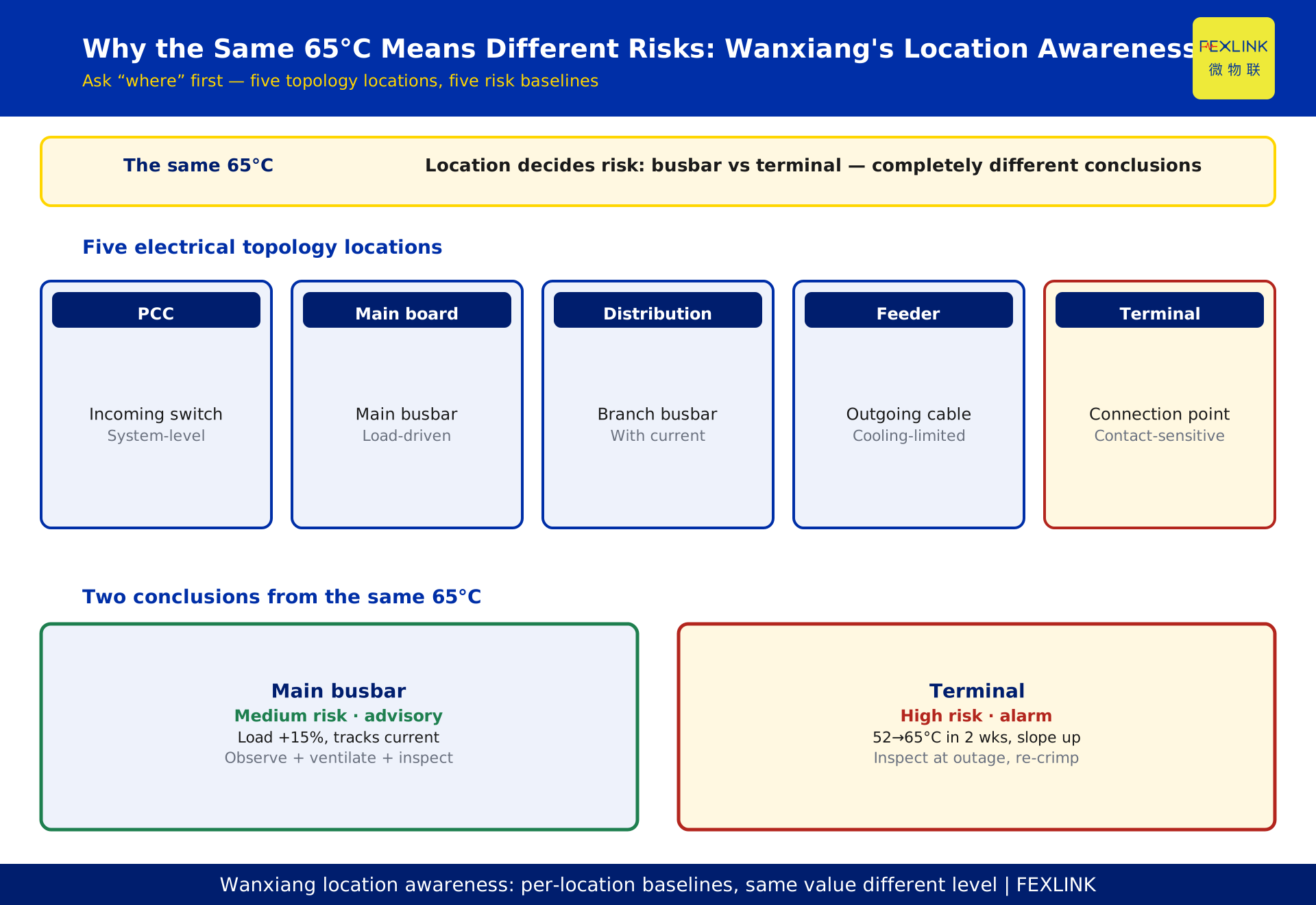
Direct Answer
The same 65 °C is medium risk at a main busbar but high risk at a terminal — because risk is not decided by the temperature number alone but by "which location in the electrical system this temperature appears at." The Wanxiang engine maps measurement points to five electrical topology locations: point of common coupling, main distribution board, distribution board, feeder circuit, and load terminal. Each location maintains its own temperature baseline and risk model; the same temperature corresponds to completely different insulation-aging rates, contact-degradation possibilities, and fire risk depending on location. That is location awareness: ask "where" first, then draw conclusions.
1. Why a Single Temperature Threshold Fails
Many electrical monitoring systems use one temperature threshold for all points: alarm above 70 °C, one standard everywhere. This worked in the era of "one standard for one workshop," but it inevitably fails in complex distribution systems.
First, normal temperatures differ by location. A main busbar carries high current with good heat dissipation and may run at 50 °C normally; a terminal, with higher contact resistance and poorer heat dissipation, may normally sit at 40–45 °C. The same 65 °C: elevated but observable at the busbar, already near the danger zone at the terminal.
Second, the same temperature reflects different physical states. Temperature is only a result; behind the same number can be different causes and different evolution speeds. 65 °C at a terminal usually means contact resistance is already degrading, and contact degradation is a positive feedback loop — hotter means higher resistance, higher resistance means hotter — leaving a very short handling window. 65 °C at a main busbar may simply mean heavy load, with many effective cooling options (load reduction, better ventilation) and slower risk evolution.
Third, one threshold inevitably trades one side for the other. Set it low, normal locations false-alarm daily; set it high, dangerous locations miss. One number cannot serve five different physical scenarios.
2. Five Locations, Five Risk Baselines
The Wanxiang engine classifies measurement points into five topology locations, each maintaining its own risk baseline:
| Location | Typical objects | Risk characteristics |
|---|---|---|
| Point of common coupling | Incoming main switch, busbar inlet | System-level impact, wide failure reach, but many detection options |
| Main distribution board | Main busbar, main breaker | High current, good cooling; high temperature mostly load-related |
| Distribution board | Sub-distribution busbar, branch breakers | Frequent load changes; judge together with current |
| Feeder circuit | Outgoing cables, cable joints | Restricted cooling; temperature accumulates quickly |
| Load terminal | Terminals, equipment connection points | Sensitive to contact resistance; highest risk at the same temperature |
Different locations mean different reasoning: 65 °C at a main busbar first suggests load and cooling; 65 °C at a terminal first suggests poor contact. The same value answers completely different questions. The five categories already cover the main differences in risk judgment; a specific site can subdivide further on this basis.
3. Why Temperature Risk Curves Differ by Location
The same temperature maps to different risk scores at different locations for three reasons:
First, allowable temperature rise differs. The allowable rise for current-carrying conductors is set by location and insulation material; terminals and joints typically allow less rise than the busbar body because contacts are heat concentration points.
Second, degradation speed differs. Contact-resistance degradation is classic positive feedback: temperature rises → oxidation accelerates → contact resistance grows → temperature rises further. A terminal sits at a connection point; once the loop starts, it does not stop, and the window is measured in days. A busbar body has no connection point; its temperature rise is mostly load-driven and falls back when load drops, with the window measured in weeks or months.
Third, failure consequences differ. Terminal overheating first destroys the connection point, a single-point fault; busbar overheating can affect power to an entire bus section. But in terms of early-warning lead time, terminal problems have a much shorter handling window, so at the same temperature their risk rating is higher.
4. How Location Awareness Is Implemented: From Topology Registration to the Scenario Tree
Location awareness is not just "attaching a label to a sensor"; it must answer "which node of the electrical system is this point at?" Implementation has three steps:
Step one, topology registration. During commissioning, each point is registered to its location type: incoming end, main busbar, branch busbar, outgoing line, terminal — forming a "point-location" mapping table. This table is the foundation of location awareness.
Step two, location-level baselines. Each location type independently configures its temperature baseline, allowable rise, and risk curve. The same 65 °C maps to a medium score at the main busbar and a high score at a terminal — the difference comes from baselines, not from special-casing in the algorithm.
Step three, joining the scenario tree. Location information enters the Wanxiang engine's 18-level scenario tree and participates in the combined judgment of "this location + this quantity + this trend." Location is not an isolated tag; it is a key branch of scenario reasoning.
One clarification: location-level baselines are not made up. They start from industry experience values, then are calibrated with on-site historical data — for example, using the high percentile of that location's normal temperature distribution as the baseline. In this way, each site's location baselines match its own operating conditions, avoiding "standards from elsewhere misapplied to this site."
5. How the 18-Level Scenario Tree Locates a Terminal
The scenario tree answers "which level is the risk really at?" From incoming feed to load, an electrical system has clear hierarchy: point of common coupling → main distribution board → distribution board → feeder circuit → load terminal. The Wanxiang engine uses the 18-level scenario tree to subdivide these five layers further, finally locating the risk at a specific terminal.
Example: a temperature point at a distribution board alarms. The scenario tree asks level by level: is the busbar body hot, or is a branch outgoing line hot? Is the outgoing cable hot, or is the terminal at the cable end hot? Each level narrows the scope until it lands on granularity like "distribution board No. 3, phase B outgoing line, terminal X."
The value of locating a terminal: operators on site do not sweep the whole cabinet; they go straight to the target terminal. The maintenance action is also precise — re-crimp, retighten bolts, or replace the terminal — disposal differs by location.
6. How Location Awareness Compresses Alarms
Location awareness is one of the core mechanisms of alarm compression.
First, it splits "the same value" into different levels. In conventional systems, 65 °C produces one alarm; location awareness makes it informative: 65 °C at the busbar is an advisory level (observe), 65 °C at the terminal is an alarm level (handle promptly). The total number of alarms does not change, but each alarm carries more weight — operators know which one to look at first.
Second, it merges location-related alarms. When multiple points at the same location cross limits together, there is usually one cause (abnormal load or a contact issue at that location); the scenario tree merges them into one comprehensive alarm with location context instead of five scattered ones.
Third, it filters location-independent false alarms. 65 °C at the main busbar with current falling in step (not overload) leads the scenario tree to judge "possible sensor or contact issue" rather than immediately alarming — false alarms are suppressed by location and correlation.
This also explains why location awareness and alarm compression are designed as a pair: without location, there is no basis for compression; without compression, location information only becomes more scattered alarms.
7. An Example: Two Conclusions from 65 °C
A campus distribution system reports two 65 °C readings at once: the main busbar and a feeder terminal.
For the main busbar: the location type is main distribution board, with a higher allowable baseline; combined with current, the day's load is about 15% above normal, and the temperature rise tracks the load change. Conclusion: medium risk — advisory-level alarm; watch the load curve, improve ventilation if needed, schedule a near-term inspection.
For the terminal: the location type is load terminal, with a low allowable baseline; combined with the trend, the terminal's temperature has climbed slowly from 52 °C to 65 °C over the past two weeks, with a persistently positive slope. Conclusion: high risk — alarm-level alarm; inspect the terminal at the next outage, re-crimp or retighten.
The same 65 °C: one gets "observe," the other "handle promptly." The algorithm is not biased; location determines what the risk means.
8. Engineering Value and Boundaries
The engineering value of location awareness comes down to three points:
First, more accurate alarms. Same value, different levels; false alarms and missed alarms both drop.
Second, faster handling. The scenario tree locates a terminal, turning site investigation from "sweep the cabinet" into "go straight to the target."
Third, predictable operations. Every alarm carries location context, so operators can judge "look now" or "wait and see."
Boundaries must be clear: location awareness presupposes accurate topology registration — if a point is registered to the wrong location, every baseline judgment is wrong. It depends on synchronized multi-quantity acquisition (temperature, current, etc.); judgment degrades when single-point data is missing. The scenario tree's locating precision is limited by measurement-point density; terminal-level locating needs terminal-level points. Location awareness is a "reasoning enhancement"; it does not change on-site physical handling procedures.
Scope and Limitations
The Wanxiang engine's location awareness discussed here applies to understanding the "same value, different location, different risk" reasoning logic. The five topology locations and risk baselines are platform design conventions; specific baseline values and application scenarios follow product documentation. Location judgment depends on accurate topology registration and synchronized multi-quantity acquisition; field deployment must first complete the point-location mapping. The 65 °C example is an illustrative desensitized scenario and does not represent any specific project's data. Location awareness does not replace on-site maintenance procedures; high-level alarms still require human review and handling.