 微物联研究院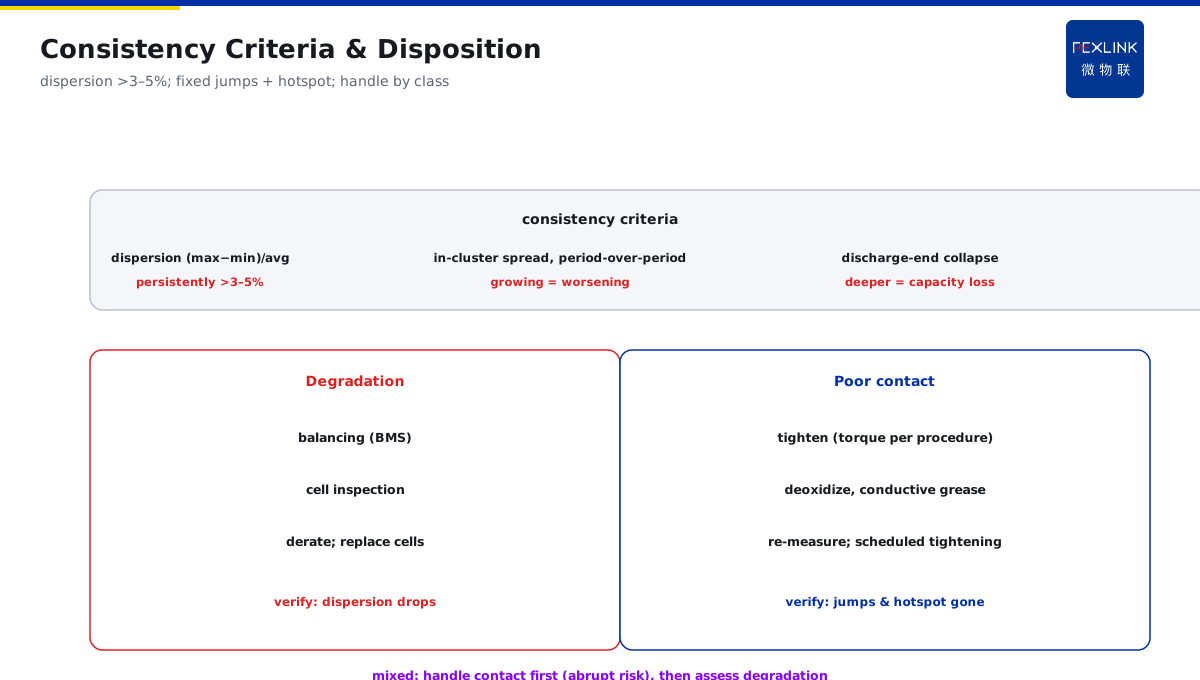
Direct Answer
An energy-storage cabin reports voltage abnormalities twice in a month — battery degradation or loose connectors? The answer: distinguish by data characteristics — sustained deviation in cell-voltage consistency and a whole-cluster low level point to battery degradation; an individual cluster's voltage jumping, uncorrelated with temperature, points to increased contact resistance. Trend data between the two events is the key; poor contact usually comes with a local hot spot — use temperature review to locate it.
At a storage cabin, "voltage abnormal" was reported twice in a month. Operations first suspected battery degradation and prepared to replace the whole cluster — costly and uncertain. Reviewing cluster-level data: the same cluster reported the alarm, but voltage was not uniformly low; individual cell voltages jumped (dip and recover), and near one connector the temperature was 8 °C higher than other spots. Verdict: poor contact (loose connector). After tightening, voltage returned to normal and the hot spot disappeared — not degradation, no cluster replacement needed. For voltage abnormalities, look at the data characteristics first — overall low means degradation; jumping + a local hot spot means contact.
Because:
- Degradation's voltage signature: sustained consistency deviation, whole-cluster low level, progressing gradually with charge/discharge cycles — "slowly getting worse";
- Poor contact's voltage signature: an individual cluster's voltage jumps suddenly, uncorrelated with temperature, recurring between events — "suddenly worse, then recovered";
- Temperature is the divider: poor contact comes with a local hot spot (contact-resistance heating); degradation usually has no local hotspot;
- Data between the two events: the interval trend (gradual for degradation vs recurrent jumps for contact) distinguishes the two causes directly.
Key insight: storage voltage abnormalities are "distinguished by data characteristics," not guessed. Degradation shows in consistency; contact shows in jumps plus temperature — with cluster-level data laid out, the direction is clear.
At another cabin reporting voltage abnormality, data review showed: among 86 cells, several showed persistently widening consistency deviation (dispersion from 2% to 5%), overall voltage low, no local hotspot. Verdict: battery degradation (some cells degrading); balancing and cell-level inspection arranged — the right disposition, avoiding repeated tightening from a misjudged contact issue.
1. Battery-Degradation Voltage Signature
First recognize what degradation looks like:
Degradation voltage characteristics:
- Cell-voltage consistency deviates persistently (dispersion slowly grows);
- Whole-cluster voltage low overall (capacity loss, lower discharge plateau);
- Gradual worsening with each cycle (a bit worse every cycle);
- Smooth voltage fluctuation, no sudden jumps.
How to identify:
- Look at in-cluster cell-voltage dispersion (max − min / average);
- Dispersion persistently growing (e.g., 2% → 5%) → consistency deteriorating;
- Whole-cluster discharge plateau dropping → capacity loss;
- Review 2–3 cycles of voltage curves for a trend.
Disposition directions:
- Mild degradation: balancing maintenance, adjust charge/discharge strategy;
- Moderate: cell-level inspection, locate degraded cells;
- Severe: replace degraded cells/modules (not blindly replacing the whole cluster).
Key insight: degradation is "gradual consistency deviation." Dispersion persistently growing, overall low — the direction is cell degradation; disposition is balancing and cell-level inspection.
2. Poor-Contact Voltage Jump
Now recognize what poor contact looks like:
Poor-contact voltage characteristics:
- An individual cluster's voltage jumps suddenly (dip and recover);
- Abrupt onset, no gradual trend;
- Uncorrelated with temperature data (voltage jumps but in-cluster temperature shows no corresponding pattern) — note the contact point itself does heat;
- Triggered easily by vibration or charge/discharge current changes (mechanical looseness).
How to identify:
- Jump amplitude and duration (instant dip vs sustained deviation);
- Whether the jump position is fixed (same cluster/connector);
- Accompanying local hot spot (IR/temperature review near the connector);
- Interval data: recurrent jumps without gradual trend → contact.
Disposition directions:
- Tighten connectors/terminals (torque per procedure);
- Check oxidation/corrosion (treat the contact surface);
- Re-measure voltage and temperature (normal after tightening).
Key insight: contact is "abrupt jump + local hotspot." An individual cluster jumping, events recurring, high temperature near the connector — the direction is contact; disposition is tightening and review.
3. How Temperature Corroborates
Temperature is the key evidence separating the two causes:
Poor-contact temperature characteristics:
- Local hot spot near connector/terminal (contact-resistance heating);
- Fixed hotspot position (corresponding to the loose/oxidized contact point);
- Temperature rise grows with current (I²R heating).
Degradation temperature characteristics:
- Generally no local hotspot (degradation is a capacity issue, no local hot point);
- If temperature is abnormal, it is usually a thermal-management problem (cooling failure) — review separately from the voltage issue.
How to use temperature:
- Cluster-level temperature/IR review of the abnormal voltage position;
- Jumping cluster + high temperature near connector → poor contact confirmed;
- Low-level cluster + no local hotspot → degradation direction;
- Overlay temperature data and voltage events on the same timeline (platform auto-links).
Where to place temperature points:
- Connectors/terminals are key points (contact-resistance heating happens there);
- At least one temperature point per cluster; densify on abnormal clusters;
- Align temperature points with voltage acquisition positions so "voltage jump + hot spot" line up;
- Periodic IR inspection as a supplement (looseness outside temperature points can also heat).
Temperature judgment notes:
- Contact-point heating grows with current (I²R); higher during high-current periods;
- In hot ambient conditions, contact temperature rise is also higher — compare with the same-condition historical baseline;
- Hot spot disappearing = contact treatment effective (confirm by re-measurement).
Key insight: temperature is the divider for voltage abnormalities. Jump + local hotspot = contact; low + no hotspot = degradation — one temperature check separates the two causes.
4. Consistency-Deviation Criteria
Quantify with consistency-deviation criteria:
Criteria indicators:
- Cell-voltage dispersion = (max − min)/average, persistently above 3%–5% → consistency deteriorating;
- Voltage spread within a cluster growing continuously (period-over-period) → deteriorating;
- Discharge-end voltage collapse deepening → capacity-loss signal.
How to use:
- Continuously monitor in-cluster cell voltage (high acquisition rate to catch jumps);
- The platform auto-computes dispersion and trend; alarms above threshold;
- Distinguish "gradual deviation" (degradation) from "abrupt jump" (contact).
Criteria comparison of the two causes:
- Degradation: dispersion gradually growing + overall low + no local hotspot;
- Contact: individual voltage jumping + fixed position + local hotspot;
- Mixed: degradation plus contact (contact appears after long-term deterioration) — handle contact first (abrupt risk is high), then assess degradation.
Key insight: consistency criteria turn "feelings" into numbers. Dispersion thresholds, period-over-period trends, end collapse — data speaks; the two causes do not mix up.
5. Different Dispositions for the Two Causes
Once distinguished, the dispositions differ completely:
Battery-degradation disposition:
- Balancing maintenance (BMS balancing strategy);
- Cell-level inspection to locate degraded cells;
- Adjust charge/discharge strategy (current limit, derating);
- Severe degradation: replace degraded cells/modules.
Poor-contact disposition:
- Tighten connectors/terminals (torque per procedure);
- Treat contact surfaces (remove oxidation, apply conductive grease);
- Re-measure voltage and temperature (restored after tightening = confirmed);
- Scheduled tightening plan (prevent recurrence).
Verification after disposition:
- Degradation: dispersion drops, voltage plateau recovers;
- Contact: voltage jumps disappear, hot spot disappears;
- Both handled: monitoring returns to normal before restoring full power.
Key insight: the two causes are handled differently — degradation is replaced/maintained, contact is tightened. A wrong direction wastes money and raises risk.
6. Product Landing: Storage Voltage-Anomaly Diagnosis
FEXLINK products bring storage voltage-anomaly diagnosis to the field:
- Cluster/cell voltage monitoring: high-frequency cell-voltage acquisition to catch jumps and trends;
- Temperature monitoring support: connector/terminal temperature, local hotspots auto-linked to voltage events;
- ESX Edge Computing Gateway: the platform auto-computes cell-consistency dispersion; gradual deviation vs abrupt jump auto-classified;
- Electrical-Hazard Early-Detection System: voltage + temperature linked alarms, outputting "suspected degradation / contact / mixed";
- The platform visualizes the trend data between the two events — diagnosis without guessing.
Design principle in one sentence: turn "battery or contact" into "automatic classification by data characteristics." Consistency, jumps, and hotspot signals — the direction is given automatically; disposition follows the class.
7. Common On-Site Mistakes
- Suspecting degradation at the first voltage alarm: preparing a whole-cluster replacement. Consequence: it was a loose connector; replacing the cluster is a huge waste. Correct: look at data characteristics first (jump vs gradual).
- Ignoring temperature data: the local hotspot of poor contact missed. Consequence: repeated tightening without finding the point. Correct: temperature review is mandatory for an abnormal cluster.
- Catching events but not trends: ignoring data between the two events. Consequence: gradual degradation missed. Correct: review the interval trend data.
- Wrong disposition direction: treating degradation as contact (tightening) or contact as degradation (cluster replacement). Consequence: waste and higher risk. Correct: classify by data characteristics before disposing.
- Acquisition rate too low: voltage jumps not caught. Consequence: only an "abnormal" conclusion without characteristics. Correct: high-frequency acquisition to catch jumps and trends.
Scope and Limitations
This article discusses diagnosing storage-cabin "voltage abnormalities" (distinguishing battery degradation from poor contact by data characteristics) for electrochemical energy-storage systems in service. The judgment indicators (e.g., 3%–5% dispersion) are engineering experience references; actual practice follows battery type, BMS acquisition rate, and system configuration. Tightening and contact-surface treatment must follow procedures by qualified personnel. Degradation assessment requires capacity testing and cell-level inspection; replacing cells/modules follows the manufacturer's specification. Online monitoring data is managed uniformly through the platform to form trend alerts. All cases are anonymized (a certain storage cabin) and do not refer to any specific customer.