 微物联研究院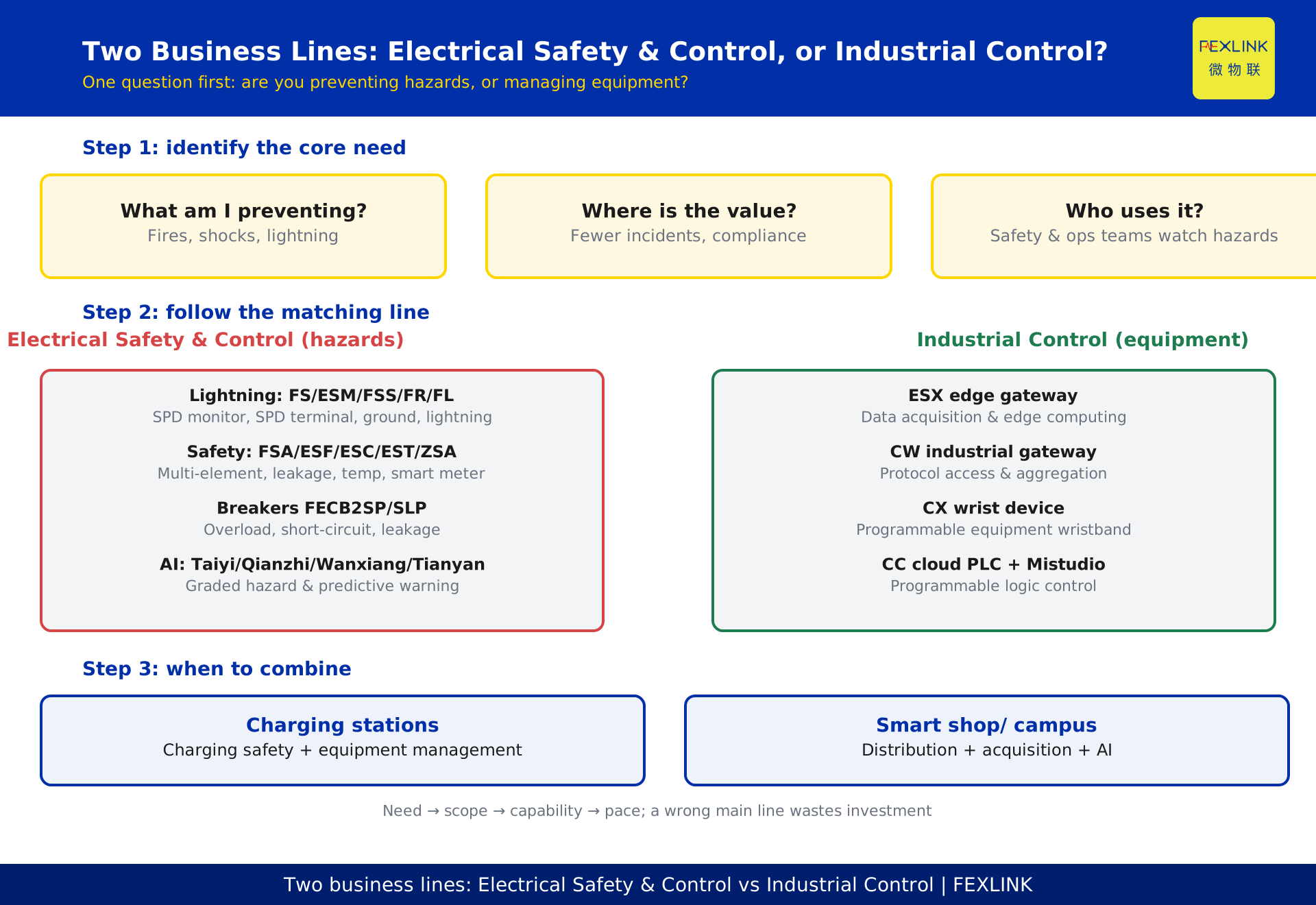
# Two Business Lines, One Decision: Electrical Safety & Control, or Industrial Control
Direct Answer
FEXLINK products fall into two major series — "Electrical Safety & Intelligent Control" and "Industrial Control." The right way to enter a project: first decide whether your core need is "preventing electrical hazards" or "making equipment intelligent," then choose the matching product line. Electrical Safety & Control addresses monitoring and early warning for switchgear, lightning protection, leakage, and temperature hazards; Industrial Control addresses equipment data acquisition and programmable control. Different needs mean completely different selection paths — mixing them is both expensive and ineffective.
For project owners and channel partners, this article provides an entry decision tree: first, three questions to identify your need type; second, mapping typical products to the two lines; third, clarifying when the two lines need to be combined. Product attribution in this article follows the FEXLINK product knowledge base.
What the Two Lines Each Solve
The division between the two FEXLINK product series is clear:
- Electrical Safety & Intelligent Control: focuses on "whether the electricity itself is safe." Covers intelligent lightning protection (FS/ESM/FSS/FR/FL), digital power-use and electrical safety monitoring (control devices/meters/leakage/temperature/power quality), and smart breakers (FECB2SP/SLP), ultimately converging into the AI model family for hazard assessment;
- Industrial Control: focuses on "how equipment data is acquired and how equipment is controlled." Covers intelligent gateways/edge computing (ESX/CW), industrial wrist devices (CX), cloud PLCs (CC), and the Mistudio programmable logic control software.
One sentence: Electrical Safety & Control manages "hazards"; Industrial Control manages "equipment."
Three Questions to Identify Your Core Need
If you are unsure which category you belong to, ask yourself three questions:
- What am I preventing? Distribution fires, leakage shocks, lightning damage, overheating — or equipment data that cannot be collected and control logic that is not flexible enough?
- Where is the business value? In "fewer incidents, earlier warnings, compliance," or in "smarter equipment, automated processes, monetizable data"?
- Who uses it? Is the safety and operations team watching hazards, or are production and equipment teams tuning control logic?
Answers leaning to the former go down the Electrical Safety & Control line; the latter, the Industrial Control line. If both apply, look at which one justifies the project.
Mapping Typical Products to the Lines
Expanding both lines makes product attribution clear:
- Electrical Safety & Control: lightning-protection series (FS SPD monitor, ESM intelligent SPD monitoring terminal, FSS intelligent SPD, FR grounding-resistance monitor, FL lightning-current monitor) → electrical safety series (FSA/FSB/FSE multi-element control devices, ESF electrical-fire control device, ESC multi-channel leakage control device, EST temperature controller, ZSA/ESA smart meters) → breakers (FECB2SP standard / FECB2SLP with leakage protection) → AI assessment (Taiyi/Qianzhi/Wanxiang/Tianyan);
- Industrial Control: ESX intelligent edge gateway, CW industrial gateway, CX industrial wrist device (programmable equipment wristband), CC cloud PLC and expansion modules, Mistudio programmable logic control software.
When selecting, first find which line your need falls on, then pick the specific product within that line — rather than starting from the model table.
When the Two Lines Need to Be Combined
Although the two project types differ in need, their scenarios often intersect:
- Charging stations: charging safety is itself an electrical-hazard issue (Electrical Safety & Control), but the station's equipment needs unified data collection and remote management (gateways/PLCs on the Industrial Control line handle aggregation and control);
- Smart-manufacturing workshops: equipment control uses the Industrial Control line, while switchgear safety monitoring uses the Electrical Safety & Control line; the two lines converge on one platform through gateways;
- Smart campuses: distribution monitoring (electrical safety) + equipment data collection (industrial control) + AI hazard assessment stack together.
The principle of combination: select with the project's founding need as the main line and supplement the other line as required — do not deploy everything at once just to be "complete."
A Decision Tree to Determine the Entry Point
Four steps determine which line to enter from:
- Define the need: safety hazard → Electrical Safety & Control; equipment control → Industrial Control;
- Define the scope: whole-plant distribution or critical circuits? all equipment or a pilot line?
- Define the capability: monitoring and warning only, or control linkage (relay output, local linkage) as well?
- Define the pace: sensing first then intelligence, or control first then optimization?
This sequence avoids the two most common mistakes: misconfiguring an "equipment control" project as an "electrical safety" stack, and turning a "hazard monitoring" project into a "control retrofit" — with the wrong direction, the more you invest, the more you waste.
How Channel Partners Help Customers Choose a Line
Facing customers, the fastest entry script for channel partners is "explain the two lines first, then let the customer choose":
- Use "Electrical Safety & Control = prevent hazards; Industrial Control = manage equipment" to establish the mindset in one sentence;
- Use the customer's business scenarios (switch room/line/charging station/campus) as examples to help them self-select;
- Start with a small-scope pilot to prove value, then discuss expansion.
Identifying the main line is the first step of selection and the premise for later proposals, pricing, and delivery pace — once this gate is passed, subsequent communication flows much more smoothly.
Seven: Mapping the Two Lines to Customer Departments
You can validate line selection by asking "who owns the budget and who uses it" inside the customer:
- Electrical safety and intelligent control: usually owned by the safety/environment department, facilities or operations; key metrics are incident counts, hazard closure rate, and compliance-pass rate — the concern is "fewer incidents, earlier warning";
- Industrial intelligent control: usually owned by production, equipment, or process departments; key metrics are output, downtime, automation rate, and data completeness — the concern is "smarter equipment, smoother flow."
Different owning departments mean different reporting lines and acceptance criteria: mapping the line to the department locks the acceptance logic in advance. Conversely, a project facing two departments at once usually needs both lines combined — just make the primary/secondary order explicit.
Eight: From Line to Purchase List — Assembling a Typical Project
Take "distribution safety monitoring at a park" as an example of the electrical-safety line:
- Sense: deploy FSA/FSB/FSE multi-element control devices on critical circuits, FSS/FL on key lightning-protection points, and ESC on high-leakage-risk circuits;
- Connect: on-site devices aggregate through ESX/CW smart gateways, protocol-normalized and uploaded uniformly;
- Intelligence: the platform connects Taiyi/Qianzhi for hazard assessment and alarm grading; circuits needing local protection add FECB2SP/FECB2SLP breaker linkage.
The assembly order follows the line: sense first, connect second, intelligent last. A purchase list is not product stacking but capability completion along the line — every step answers one business question.
Nine: Drawing the Boundary of a Combined Project
When the two lines combine, the biggest risk is "wanting everything with no clear boundary." Draw the line on three things:
- Who owns the data: electrical-hazard data goes to safety supervision; equipment-operation data goes to production management. The two streams may share a gateway but should not mix into one business loop;
- Who issues the actions: electrical linkage actions (tripping, alarming) are triggered by safety logic; equipment-control actions (start/stop, speed) by production logic. Control authority must be separate;
- Who accepts the results: safety metrics are accepted by the safety department, production-efficiency metrics by the production department — do not merge them into one acceptance criterion in the contract.
With boundaries clear, a combined project will not end up blaming each other during implementation and acceptance.
Common Questions — Do the Two Lines Conflict?
- Do they duplicate? Control devices of the electrical-safety line and gateways of the industrial line coexist at the same site with clear data ownership on each side — no duplicated construction;
- Do they fight for control? Safety-linkage tripping has higher priority than production control; when safety logic triggers, production logic yields. This is a hard design constraint, not an option;
- Do we need two platforms? The Taiyi platform can present both in one view, but the business loops — the safety loop versus the production loop — keep separate dashboards and separate acceptance criteria.
In one sentence: each line owns its segment and they share the base — the base (gateway/platform) is shared; the businesses (hazards/production) stay separated. This shared-base, separated-loop pattern is exactly what lets a combined project keep safety accountability clear while production keeps its own key performance indicators.
The clearest way to test whether you have drawn the boundary correctly is a simple drill: when a safety alarm fires, the production team should know exactly who decides and who acts; when a production stop is requested, the safety team should never be bypassed. If either drill is ambiguous on paper, fix the boundary before procurement, not after commissioning.
Scope and Limitations
Reading page for KD-0018. The two major product series (① Electrical Safety & Intelligent Control, ② Industrial Control) and product attribution (A intelligent lightning protection, B digital power-use and electrical safety monitoring, C intelligent gateway/industrial control, D breakers, G AI model family) come from the FEXLINK product knowledge base (product-line map) as product-documentation conventions. The "three questions" and "four-step decision tree" are this article's synthesis of selection methods for project-entry reference. Main-line selection and product combinations for a specific project should be confirmed by professional pre-sales staff based on site conditions; this page is not a specific project proposal.