 微物联研究院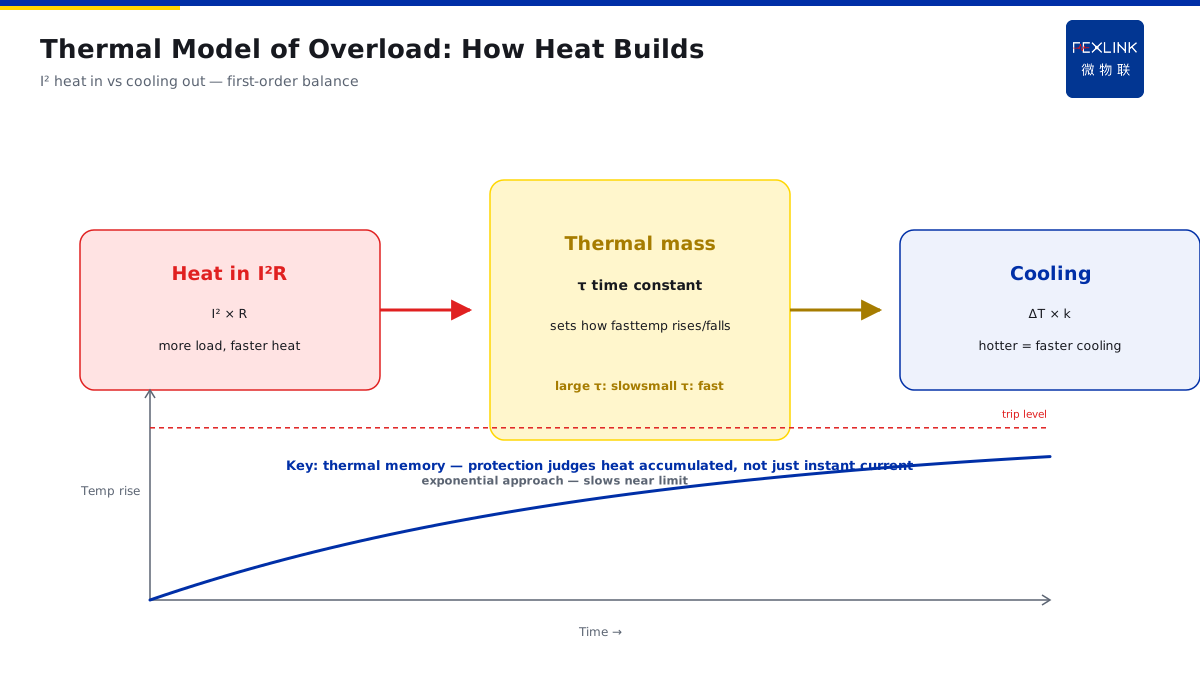
Direct Answer
Motor protection set per the manual still burns motors or misoperates — not because the setting is wrong, but because it only looks at current, not thermal accumulation.
Many factories have this problem: motor protectors set per the manual, yet either the motor burns and the protector does not trip, or the motor starts normally and the protector misoperates. Why? Because:
- Motor heating is a thermal accumulation process: it does not burn just because current is high, heat slowly builds up;
- I²t approximates thermal damage: current squared multiplied by time equals heat accumulation;
- Inverse-time curve: higher current = shorter trip time;
- Starting process needs separate setting: high starting current but short time, cannot use the same threshold as normal running.
Key insight: motor protection is not "trip when current exceeds threshold," it is about thermal accumulation. High current but short time = little heat accumulation, will not burn. Low current but long time = lots of heat accumulation, also burns.
One factory, a pump motor:
- Protector set per rated current;
- Motor often overloaded but did not trip;
- Later motor burned, opened it up: winding had been aging for a long time;
- Why? Because protector only looked at instantaneous current, not thermal accumulation.
1. Motor First-Order Thermal Model Input and Output
Motor heating is a thermal process, can be described by a first-order thermal model:
Input:
- Copper loss (heat from current flowing through winding);
- Iron loss (heat from core magnetization);
- Mechanical loss (heat from friction, windage).
Output:
- Winding temperature;
- Temperature rise.
Thermal inertia:
- Motor has thermal mass, temperature does not rise instantly;
- Like boiling water, turn on the fire, water does not boil immediately;
- Takes time to accumulate.
Key: motor temperature is not determined instantaneously, it is the result of thermal accumulation. One high current spike, temperature does not jump. Low current but sustained overload, temperature slowly climbs.
2. Why I²t Approximates Thermal Damage
Why does I²t approximate thermal damage?
Because:
- Copper loss P = I²R;
- Heat Q = P × t = I²R × t;
- If R roughly constant, heat ∝ I²t;
- So higher I²t = greater thermal damage.
Example:
- 1× rated current, run 100 hours, I²t = 1×100 = 100;
- 2× rated current, run 25 hours, I²t = 4×25 = 100;
- Both cases have about the same thermal damage.
Key: do not just look at current magnitude, look at I²t accumulation. High current short time, and low current long time, can have the same thermal damage.
3. Why Inverse-Time Curve Has Its Shape
Why is inverse-time protection curve "higher current, faster trip"?
Because:
- Higher current = faster heating;
- Temperature reaches dangerous value in shorter time;
- So trip time must be shorter.
Curve shape:
- 1.0× rated: no trip (normal running);
- 1.2× rated: trip after hours (slow overheating);
- 2× rated: trip after minutes (fast overheating);
- 5× rated: trip after seconds (severe overload);
- Short circuit current: instantaneous trip.
Key: inverse-time is the time reflection of thermal accumulation. Higher current = faster thermal build-up = shorter trip time.
4. Why Starting Needs Separate Setting
Why does motor starting need separate setting?
Because:
- Starting current is high (5~7× rated);
- But starting time is short (seconds to tens of seconds);
- Thermal accumulation at this time is actually small;
- If set by normal running inverse-time, it will misoperate during starting.
So starting process needs:
- Ride through starting current;
- Ride through starting time;
- Enter normal protection after starting completes.
Key: starting is "high current short time," different from "low current long time" thermal damage. Cannot use the same threshold.
5. How Online Temperature Monitoring and Protection Setting Cross-Calibrate
How do online temperature monitoring and protection setting cross-calibrate?
Protector limitations:
- Protector calculates I²t from current, estimates temperature;
- Estimate and actual temperature may deviate;
- Because ambient temperature, cooling conditions differ.
Online temperature monitoring role:
- Directly measures winding temperature (via embedded sensor or surface measurement);
- Compare actual temperature vs estimated temperature;
- Big deviation means setting needs adjustment.
FEXLINK WB-TM-01/02 wireless temperature node measures motor housing temperature. Combined with ESA full-element smart meter current data, calibrates the protector thermal model.
6. A Real Case
One factory, a crusher motor:
- Protector set per manual;
- Motor often overheated alarm, but when opened, temperature was actually not high;
- Why? Because protector was set for standard ambient temp, site ambient temp was much higher;
- Added online temperature monitoring, recalibrated protector setting;
- Misoperations disappeared, protection became more accurate.
7. Three Common On-Site Mistakes
Mistake 1: only look at current threshold, not thermal accumulation. One high current spike does not mean it will burn, look at I²t accumulation.
Mistake 2: starting and running use the same curve. Starting current is high but time is short, cannot use the same threshold as running.
Mistake 3: no temperature monitoring, only rely on protector estimate. Protector estimates temperature, actual temperature may differ a lot. Need online temperature to calibrate.
8. One Sentence to Remember
Motor heating is thermal accumulation: I²t determines thermal damage. Inverse-time curve is the time reflection of thermal accumulation. Starting needs separate setting, running needs online temperature to calibrate.
Do not just look at current magnitude, look at thermal accumulation.
9. Common Questions
Q: Why does motor protector still burn motors even when set correctly? A: Because the protector estimates temperature from current, it does not measure temperature directly. If cooling is poor, ambient temp is high, estimate and actual deviate. Need online temperature monitoring to calibrate.
Q: Motor starting current is so high, why does it not trip? A: Because starting time is short, thermal accumulation is small. Starting current 5~7×, but only seconds to tens of seconds, I²t accumulation is small. Protector must ride through starting.
10. Why This Is Becoming More Important
As motors get more powerful and processes get more demanding, thermal protection accuracy becomes more critical. A motor that burns unexpectedly causes production downtime. A protector that misoperates during starting causes nuisance trips. Both cost money.
That is why thermal modeling and online temperature monitoring are not luxury, they are necessity. FEXLINK provides both: WB-TM for temperature, ESA for current data. Together, they make motor protection smart, not just on/off.
Stay safe. Stay professional. Stay curious.
11. Quick Checklist
Before you trust your next motor protection setting, run through this checklist:
- Do you understand that motor heating is cumulative, not instantaneous?
- Have you calibrated your protector with actual temperature measurement?
- Do you have separate starting and running settings?
- Do you track I²t accumulation, not just instantaneous current?
- Have you checked whether ambient temperature affects your cooling?
If you answered "no" to most of these, your motor protection may be less reliable than you think. It may look fine on paper, but under real operating conditions, it may either burn motors unnecessarily or misoperate during normal starts.
The FEXLINK platform helps you make motor protection smarter. WB-TM measures actual temperature. ESA measures current. Together, they give you the full picture: not just what the current looks like, but what the actual temperature is. That is how you protect motors properly.
12. How to Build a Routine
A good motor thermal protection routine starts with understanding your motors. Not every motor needs the same level of protection. Start with the most critical ones.
Measure the core parameters. Current, voltage, motor housing temperature. Three parameters is enough. Current lets you calculate I²t. Temperature lets you calibrate the thermal model.
Build a baseline. When a new motor is commissioned, record its rated current, rated temperature rise, ambient temperature. That is your baseline. Then compare every overload event to baseline, see how much thermal accumulation has happened.
Set warning thresholds. For example, when estimated winding temperature exceeds 80% of rated, warning. When exceeds 95%, alarm, schedule inspection. Thresholds are not guesses, they are tuned over time with manufacturer data and field experience.
Start today. Identify your most critical motor. Install temperature monitoring. Build your baseline. Then you can make smart maintenance decisions, not expensive emergency motor replacements.
Final Thoughts
Motors are everywhere in modern industry. They drive pumps, fans, compressors, conveyors. When a motor burns out unexpectedly, it stops production. It costs money. It causes delays.
But motor failure is usually not sudden. It is gradual. Thermal accumulation builds up over time. With the right monitoring, you can see it coming. You can schedule maintenance before failure. You can avoid the emergency motor replacement and the production downtime.
Do it smart. Do it early. Do it with data.
Your motors will thank you. Your production team will thank you. Your budget will thank you. Stay safe, and keep monitoring.
See you in the next article. Take care, and remember: motor heating tells a story — read it early, read it right.
That is all for this article. Good luck, and stay motor-safe. Until next time.