 微物联研究院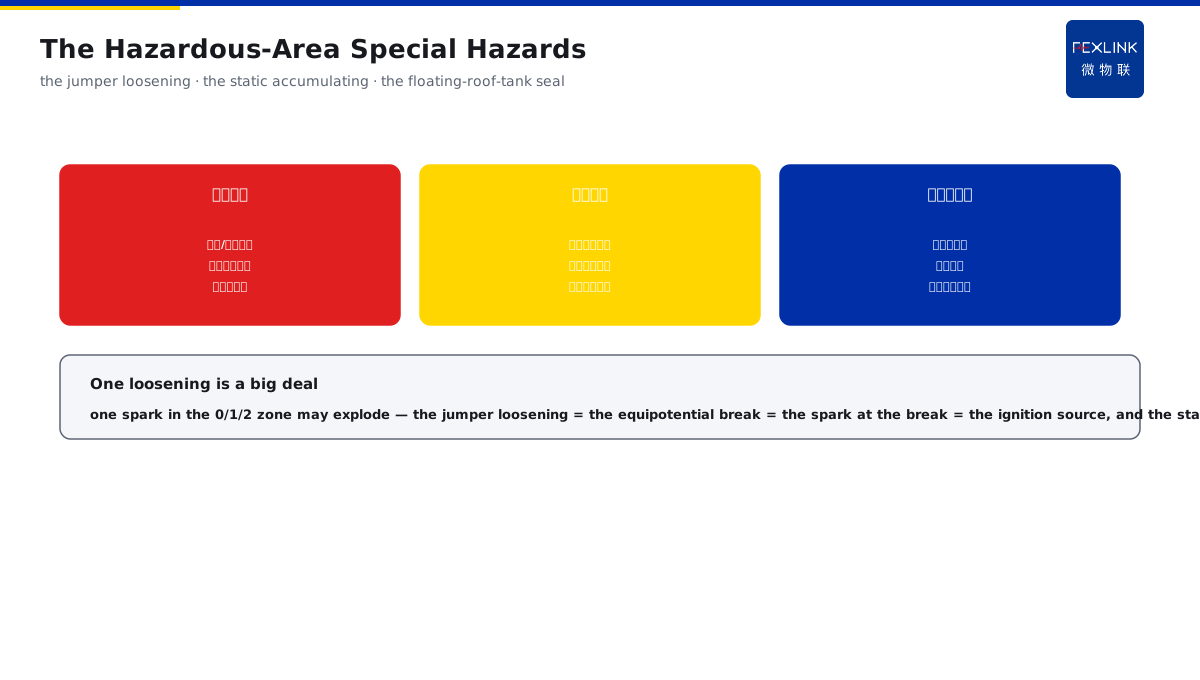
Direct Answer
The petrochemical tank-farm lightning inspection passes every year, but the management is still uneasy in the lightning season — what is missing? The answer: the annual inspection only proves the earthing resistance qualified at that moment of the inspection, and cannot cover — the equipotential break caused by the valve/flange jumper loosening, the static-discharge hazard at the floating-roof-tank seal, the hidden degradation after the SPD operation, and the monitoring blind spot; in the explosive hazardous area, one loosened jumper can become the ignition source, and the online monitoring must fill the gap "between the two inspections".
At a petrochemical tank farm, the annual inspection passed every year; during one thunderstorm patrol, a discharge trace was found near the floating-roof-tank seal, and the investigation confirmed that the flange jumper loosening had broken the equipotential, so the static electricity could not be discharged and formed the ignition source. With the online monitoring filling the gap: the explosion-proof earthing-resistance monitor watched the jumper and the earthing trend, and the lightning-current monitor recorded the strike events; the hazard was exposed early between the two inspections. The key distinction: the inspection qualified ≠ the hazard removed — the annual inspection only proves the qualification at that moment; the jumper loosening, the static hazard, the SPD hidden degradation and the monitoring blind spot are all uncovered; in the hazardous area, one loosened jumper is the ignition source, and the online monitoring must fill the gap.
Why:
- The inspection is the instantaneous value: only proves that moment;
- The jumper loosens: the equipotential break and the ignition source;
- The static accumulates: the floating-roof-tank-seal hazard;
- The online fills the gap: watching between the two inspections.
Key insight: "The inspection qualified ≠ the hazard removed — the annual inspection only proves that moment; the jumper loosening, the static hazard, the SPD hidden degradation and the monitoring blind spot are all uncovered; in the hazardous area, the online monitoring must fill the gap."
At a tank farm relying on the annual qualified report, the online check was not done before the lightning season; after one storm, a discharge trace was found at the seal, and the jumper loosening had existed for months. After the online monitoring was installed, the hazard was exposed by the trend before the outbreak. Lesson: the inspection qualified is only the instantaneous proof — the jumper loosens, the static accumulates and the SPD degrades hiddenly; the online monitoring fills the gap between the two inspections.
Overview: run "how the inspection-qualified and the continuously-effective differ → what special hazards the hazardous area has → how the SPD hidden degradation is seen → how the online monitoring fills the gap" as one tank-farm lightning cognition. The annual inspection only proves the earthing resistance qualified at that moment, and cannot cover: the equipotential break caused by the valve/flange jumper loosening, the static-discharge hazard at the floating-roof-tank seal, the hidden degradation after the SPD operation, and the monitoring blind spot. The four layers are unfolded below.
A "physical-exam report and daily maintenance" analogy: think of the tank-farm lightning protection as the personal health management. The annual inspection is the annual physical-exam report — the report says "all indicators qualified" (the earthing resistance qualified at that moment), but the physical exam qualified does not mean healthy for 365 days: the blood pressure fluctuates (the jumper loosens), the cholesterol quietly accumulates (the static accumulates at the seal), and the organ function slowly degrades (the SPD hidden degradation) — all of which the exam report cannot manage. What truly reassures is the daily blood-pressure meter, the scale and the regular self-check (the online monitoring watching the trend), letting the abnormality be found before the outbreak. The exam qualified is only the starting point; the daily monitoring is the continuous guarantee. The physical-exam analogy: the annual inspection = the exam report only proving that moment, the blood pressure fluctuating = the jumper loosening, the cholesterol accumulating = the static hazard, the function degrading = the SPD hidden degradation — the exam qualified is only the starting point, and the daily monitoring (the online trend watching) is the continuous guarantee.
1. The Gap Analysis: Qualified vs. Continuously Effective
Step one: first look at the gap between the annual-inspection qualified and the continuously effective.
The annual-inspection limitation:
- The instantaneous-value proof;
- Qualified at that moment;
- Unwatched in the gap period;
- Not covering the whole process.
The continuously-effective requirement:
- The jumper continuously reliable;
- The static continuously discharged;
- The degradation trend visible;
- The whole process recorded.
The gap essence:
- The inspection is the sampling;
- The hazard regenerates;
- The gap is the blind spot;
- The online fills it.
Key insight: "The gap essence is clear — the annual inspection is the instantaneous sampling (qualified at that moment), the jumper loosening and the degradation regenerate in the gap period, the gap is the blind spot, and only the online monitoring fills it."
2. The Special Hazards: What the Hazardous Area Guards Against
Step two: the jumper, the static and the floating-roof-tank special hazards in the hazardous area.
The jumper hazard:
- The valve/flange jumper;
- The loosening causing the break;
- The equipotential failure;
- The ignition source formed.
The static hazard:
- The floating-roof-tank seal;
- The static accumulating and discharging;
- The oil-gas environment igniting;
- The discharge must be continuous.
The floating-roof-tank hazard:
- The seal-ring part;
- The friction electrification;
- The discharge channel key;
- The trend watched online.
Key insight: "The hazardous-area special hazards have three items — the jumper loosening breaking the equipotential into the ignition source, the floating-roof-tank seal accumulating the static and discharging, and the discharge channel must be continuously reliable — one loosening may ignite."
3. The Hidden Degradation: How to See the SPD after the Operation
Step three: the hidden degradation after the SPD operation and the monitoring blind spot.
The SPD hidden degradation:
- The element damaged after the operation;
- The leakage slowly climbing;
- Not visible from the outside;
- Failing at the next operation.
The monitoring blind spot:
- The annual-inspection interval;
- The degradation not found;
- The blind spot is the risk;
- The trend exposes it.
The FS monitoring role:
- The leakage continuously recorded;
- The degradation trend visible;
- The replacement timing clear;
- The blind spot filled.
Key insight: "The hidden degradation has three items — the SPD element damaged after the operation with the leakage slowly climbing, not visible from the outside, and possibly failing at the next operation; the FS monitors the leakage trend, and the blind spot is filled."
4. The Online Fill: How to Watch between the Two Inspections
Step four: how the online monitoring fills the inspection gap.
The FR explosion-proof monitoring:
- The earthing-resistance trend;
- The jumper state visible;
- The explosion-proof level adapted;
- Usable in the hazardous area.
The FL lightning-current monitoring:
- The strike events recorded;
- The discharge path verified;
- The events associated with the degradation;
- The data closed-loop.
The gap-filling solution:
- The key points covered;
- The trends recorded in real time;
- The hazards exposed early;
- The lightning season confident.
Key insight: "The online gap-filling three-piece set — the FR explosion-proof watches the earthing and the jumper trend, the FL records the strike events, and the FS watches the SPD leakage — the hazards between the two inspections are exposed early, and the lightning season is confident."
5. Product Implementation: The Tank-Farm Lightning Closed Loop
WeiWuLian products move the tank-farm lightning protection from "qualified" to "continuously effective":
- FR explosion-proof earthing-resistance monitor: the jumper and the earthing trend watched;
- FL lightning-current monitor: the strike events and the discharge path recorded;
- FS surge-protective-device monitor: the SPD hidden degradation exposed;
- The data closed loop: the inspection + the online double guarantee.
The design principle in one sentence: "The inspection qualified is the starting point, and the online monitoring is what continues — FR watches the jumper, FL records the strikes, FS sees the SPD, and the hazardous-area hazards do not survive overnight."
6. Common Understanding Misjudgments
- "The inspection qualified = the hazard removed": wrong. The instantaneous value cannot cover the whole process.
- "The jumper installed needs no care": wrong. The loosening is the norm, and the trend must be watched.
- "The SPD operated is fine": wrong. The hidden degradation may fail at the next operation.
- "The monitoring cannot be installed in the hazardous area": wrong. The explosion-proof products can adapt.
- "The blind spot is unavoidable": wrong. The online monitoring is exactly the blind-spot-filling means.
Scope and Limitations
This article explains the "inspection-qualified ≠ continuously-effective" diagnosis of the petrochemical tank-farm lightning protection (the gap analysis, the special hazards, the hidden degradation and the online fill), applicable to the hazardous tank-farm lightning management. The specific inspection follows GB/T 21431-2015 and the protection follows GB 50057-2010; this article explains only the diagnostic logic. All cases are anonymized (a petrochemical tank farm) and do not refer to any specific customer.