 微物联研究院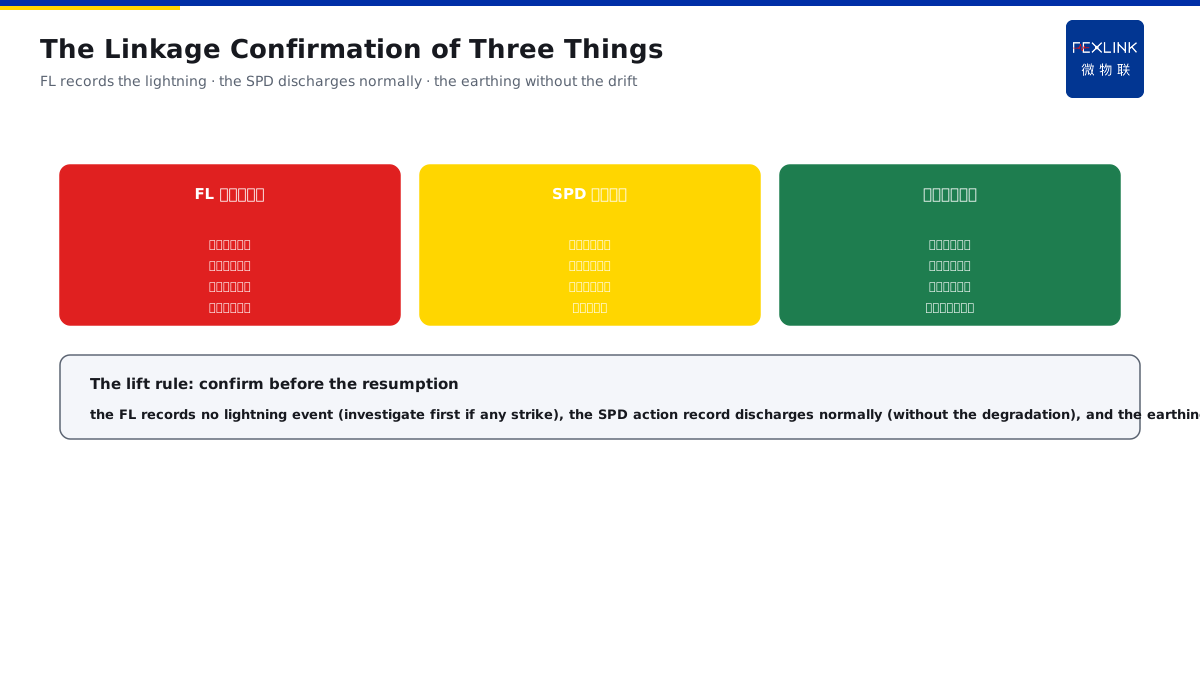
Direct Answer
In the stadiums and the transit stops where people are dense and the venue is open-air, how do the lightning protection plus the early warning protect the people? The answer: adopt the "engineering protection + proactive warning" combination — the fixed air-termination, the down-conductor and the earthing ensure the facility and the power-supply safety; the lightning early-warning system triggers the graded "suspend the outdoor activity → broadcast the evacuation → cut off the outdoor power" when the thunderstorm approaches, and confirms the SPD/earthing state together with the on-site lightning monitoring; the key is to pre-compile the warning-action plan and the evacuation process.
At a sports center, when the thunderstorm approached, the early warning triggered the yellow warning, the broadcast notified to suspend the outdoor training, guided the spectators into the indoor area and cut off the outdoor power of the venue; after the warning was lifted, the FL lightning-current monitor confirmed that no lightning event occurred in the venue and the SPD did not act, and the activity resumed. The whole process had nobody exposed to the thunderstorm, and the evacuation had zero confusion. The design core: the engineering protection protects the facility, and the proactive warning protects the people — the graded warning triggers the "suspend → evacuate → cut off the power" action chain, and the monitoring confirms the state — with the plan pre-compiled, the evacuation is not panicked.
Why:
- The engineering protection protects the facility: the air-termination, the down-conductor and the earthing;
- The proactive warning protects the people: the graded action trigger;
- The action chain is clear: the suspend → the evacuation → the power cut-off;
- The monitoring confirms together: the SPD/earthing state.
Key insight: "The combined protection has both — the engineering protection protects the facility and the power supply (the air-termination/down-conductor/earthing), and the proactive warning protects the people (the graded trigger of the suspend → the evacuation → the power cut-off) — with the plan pre-compiled and the monitoring confirming together, the evacuation is not panicked."
At a transit stop, the warning was triggered but the evacuation was not timely, and a waiting passenger lingered at the edge of the canopy — fortunately no strike; after the graded warning plan was compiled, the next thunderstorm broadcast the evacuation 15 minutes ahead, and nobody lingered outdoors. Lesson: the value of the warning lies in the plan — without the pre-compiled "suspend → evacuate → cut off the power" action chain, the warning is only a ringing bell, and the people still have no time to leave.
Overview: run "how the combined architecture is arranged → how the graded warning and the action process are compiled → how the monitoring confirms together → how the plan and the broadcast are designed" as one public-facility lightning design. The outdoor public facilities adopt the "engineering protection + proactive warning" combination: the fixed air-termination, the down-conductor and the earthing ensure the facility and the power-supply safety, and the lightning early-warning system triggers the graded "suspend the outdoor activity → broadcast the evacuation → cut off the outdoor power" when the thunderstorm approaches. The four layers are unfolded below.
A "fire-evacuation drill" analogy: think of the lightning early warning as the building fire-alarm system. The engineering protection (the air-termination, the down-conductor and the earthing) is like the fire-resistant building materials and the fire-fighting pipelines — guaranteeing that the building itself can withstand the fire (the strike), but not responsible for taking the people in the building out; what really makes the people evacuate safely is the fire alarm (the lightning early warning), the evacuation plan and the broadcast (the graded action chain), and the fire-control-center linkage (the monitoring confirming the state). The fire alarm does not wait until the fire is in front of the eyes to ring, and the lightning early warning does not wait until the thunderstorm is overhead to trigger — the early graded warning gives the people the time to leave the open-air area. If the building has only the fire-resistant materials without the evacuation plan, when the fire alarm rings nobody knows where to go; similarly, only installing the air-termination without compiling the evacuation plan, when the warning rings the people still have no time to evacuate. The fire-alarm analogy: the fire-resistant materials = the engineering protection protecting the facility, the fire alarm = the lightning early warning, the evacuation-plan broadcast = the graded action chain, and the fire-control-center linkage = the monitoring confirmation — with the plan compiled before the fire alarm, the evacuation is not learned during the fire alarm.
1. The Combined Architecture: How the Protection + the Warning Are Arranged
Step one: first look at the "engineering protection + proactive warning" combined architecture of the public facilities.
The engineering-protection layer:
- The fixed air-termination device;
- The down-conductor and the earthing;
- The facility and the power-supply safety;
- Against the direct strike and the discharge.
The proactive-warning layer:
- The lightning early-warning system;
- The thunderstorm-approach monitoring;
- The graded action trigger;
- Protecting the crowd ahead.
The combination connection:
- The protection manages the facility, and the warning manages the people;
- The warning trigger and the protection linkage;
- The monitoring confirms the protection state;
- The double insurance of the people and the facility.
Key insight: "The combined architecture has two layers — the engineering protection manages the facility (the air-termination/down-conductor/earthing protecting the power supply), and the proactive warning manages the people (the graded action trigger) — the warning trigger and the protection link together, the monitoring confirms the state, and the people and the facility have the double insurance."
2. The Graded Process: How the Warning Triggers the Action
Step two: the graded warning and the evacuation/cut-off action process.
The warning grades:
- The blue reminder, the yellow warning;
- The orange strong thunderstorm, the red direct strike;
- The grades correspond to the actions;
- The thresholds set ahead.
The action process:
- Suspend the outdoor activity;
- Broadcast and guide the evacuation;
- Cut off the outdoor power;
- The people enter the indoor area.
The evacuation points:
- The evacuation paths predetermined;
- The guide division of labor;
- The broadcast continuing to prompt;
- Returning orderly after the lift.
Key insight: "The graded action chain — the blue reminds, the yellow suspends the outdoor activity, the orange broadcasts the evacuation, and the red cuts off the outdoor power — with the thresholds set ahead, the actions triggered by the grades, and the evacuation paths predetermined, the thunderstorm approach is not chaotic."
3. The Linkage Confirmation: How the Monitoring Verifies the State
Step three: the on-site SPD/earthing state confirmed together with the warning.
The FL lightning-current monitoring:
- The lightning-event record;
- Whether the strike occurred;
- The evacuation-lift basis;
- The data supporting the judgment.
The SPD state confirmation:
- The action record reviewed;
- The discharge normal;
- The degradation trend checked;
- Confirmed before the resumption.
The earthing state confirmation:
- The earthing trend reviewed;
- The discharge capability verified;
- The before/after warning comparison;
- Reliable before the resumption.
Key insight: "The linkage confirmation has three things — the FL records the lightning event (the evacuation-lift basis), the SPD action record is reviewed (the discharge normal), and the earthing trend is confirmed (the capability reliable) — the state is confirmed before the resumption, not by the feeling."
4. The Plan and the Broadcast: How to Pre-Compile
Step four: the plan and the broadcast linkage design.
The plan compilation:
- The graded action card;
- The responsibility division table;
- The evacuation-path diagram;
- The drill verification.
The broadcast linkage:
- The warning trigger auto-broadcasts;
- The graded scripts pre-recorded;
- Covering the whole area;
- The bilingual prompt.
The drill closed loop:
- The regular drill;
- The action-card review;
- The plan iteration;
- Familiar to all before the lightning season.
Key insight: "The plan and the broadcast have three things — the plan pre-compiled (the graded action card/the responsibility division/the evacuation path), the warning trigger auto-broadcasts (the graded scripts/the whole-area coverage), and the regular drill and review (familiar to all before the lightning season) — the plan takes effect before the thunderstorm, not learned during the thunderstorm."
5. Product Implementation: The Public-Facility Lightning Closed Loop
WeiWuLian products make the public-facility lightning protection "the warning has the basis, and the state visible":
- FG lightning intelligent gateway: the warning and the monitoring data converged;
- FL lightning-current monitor: the lightning-event record supporting the evacuation judgment;
- The graded plan linkage: the warning triggers the broadcast and the cut-off action;
- The data closed loop: the warning-monitoring-evacuation traceable throughout.
The design principle in one sentence: "The engineering protection protects the facility, and the proactive warning protects the people — the FG converges the data, the FL records the lightning, and the plan triggers by the grades; the people are not panicked when the thunderstorm approaches."
6. Common Understanding Misjudgments
- "Installing the air-termination settles everything": wrong. The air-termination protects the facility but not the people; the warning is the people-protecting means.
- "Think about how to evacuate after the warning rings": wrong. The plan must be compiled and drilled before the thunderstorm.
- "One evacuation is enough": wrong. Every warning lift must rely on the monitoring data to confirm.
- "Just skip the cut-off if it affects the operation": wrong. The personal safety comes first, and the cut-off action must be resolute.
- "The monitoring data is useless": wrong. The FL record is the basis of the evacuation lift and the responsibility definition.
Scope and Limitations
This article explains the "protection + warning" combined design of the outdoor public facilities such as the stadiums and the transit stops (the combined architecture, the graded process, the linkage confirmation and the plan broadcast), applicable to the lightning design of the dense open-air places. The specific design follows GB 50057-2010; this article explains only the design logic. All cases are anonymized (a sports center/a transit stop) and do not refer to any specific customer.