 微物联研究院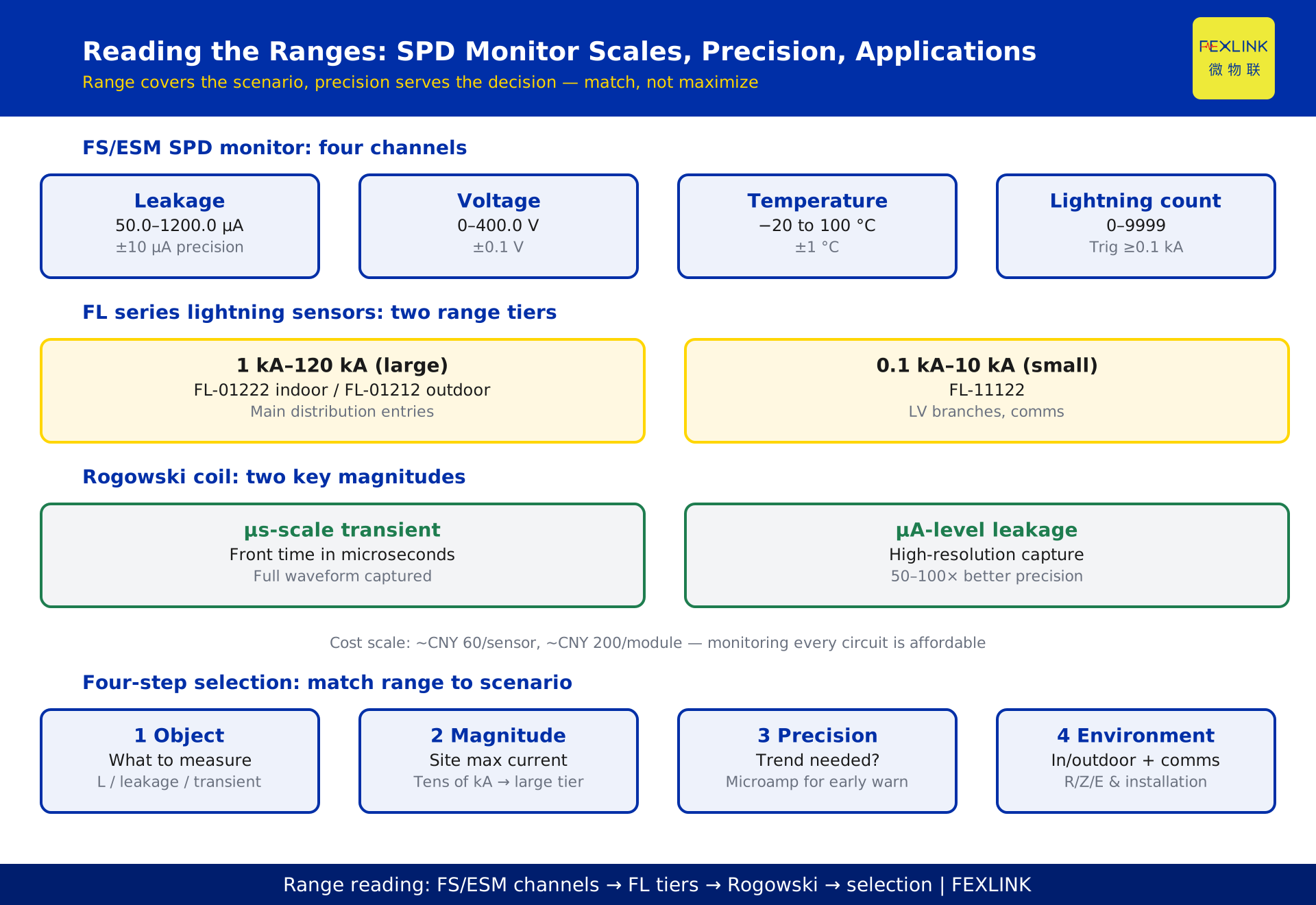
# Reading the Ranges: Measurement Scales, Precision, and Applications of SPD Monitors and Lightning Counters
Direct Answer
For intelligent lightning-protection monitoring products, parameters are not "bigger is better" — the rule is "range covers the scenario, precision serves the decision": the FS/ESM SPD monitor measures leakage from 50.0 to 1200.0 μA (±10 μA), voltage 0–400.0 V (±0.1 V), temperature −20 to 100 °C (±1 °C), and counts lightning strikes 0–9999 (minimum trigger 0.1 kA); the FL series lightning-current sensors come in two ranges (1 kA–120 kA and 0.1 kA–10 kA); the Rogowski coil supports microsecond-scale transients and microamp-level leakage acquisition. The key to selection is making the range cover your actual lightning-current and leakage levels — not chasing larger numbers.
For electrical designers and lightning-protection engineers, this article answers three questions: what each range and precision parameter means in practice; which range tier suits different monitored objects (leakage current, lightning current, transient impulses); and how precision parameters influence monitoring and maintenance decisions. The desensitized scenarios of "an airport terminal" and "a campus distribution system" are used for illustration.
Why Reading Parameters Matters More Than a Model Table
The easiest approach to a selection manual is copying model numbers and ranges. But the real value of these parameters is judging whether a range covers your scenario:
- Choose a lightning-current range too small, and amplitudes clip — count and energy data become distorted;
- Choose it too large, and small lightning signals lose low-end resolution and may be missed;
- If leakage-monitoring range and precision do not match, you cannot tell "normal leakage" from "early degradation."
So the right order for reading parameters is: first clarify the physical magnitude of what you monitor, then check range and precision against it, and finally confirm communication and installation conditions. This principle runs through every parameter below.
FS/ESM: Range and Precision of Leakage Monitoring
The core channel of the FS/ESM SPD monitor is leakage monitoring: range 50.0–1200.0 μA, precision ±10 μA.
- Why microamp-level. During normal operation, SPD (surge protective device) degradation often starts with a slow change in leakage current. A microamp-level range captures changes in the "tens to hundreds of microamps" band — the key window for judging whether an SPD is entering its aging phase.
- What ±10 μA means. At this range, ±10 μA is enough to tell "stable at 80 μA" from "drifted to 100 μA," supporting trend judgment such as CUSUM drift warnings.
- What the 50 μA floor means. A lower limit of 50 μA means the channel focuses on SPD states with clear leakage characteristics; noise below this level is not counted, avoiding false alarms.
For the field, the leakage channel turns "SPD degradation" from "wait until it fails" into "watch the trend and replace early" — the heart of moving intelligent lightning protection from passive to proactive.
Voltage and Temperature Channels: What ±0.1 V and ±1 °C Mean
FS/ESM also provides auxiliary voltage and temperature channels: voltage 0–400.0 V (±0.1 V), temperature −20 to 100 °C (±1 °C).
- Voltage channel. It monitors the supply voltage of the SPD's circuit, to correlate whether voltage anomalies (surges, overvoltage) relate to SPD operation. 0–400 V covers single-phase 220 V and three-phase phase voltages; ±0.1 V is far more than enough to judge whether voltage stays within its allowed deviation.
- Temperature channel. SPD degradation or frequent discharging is accompanied by temperature rise. ±1 °C is enough to identify the difference between ambient and body temperature, helping judge whether the SPD is continuously discharging abnormal energy.
These two channels monitor the SPD's environment rather than the SPD itself: voltage anomalies and temperature rise can both appear before SPD failure, and recording them early gives fault traceability.
Lightning Counting: 0–9999 and the 0.1 kA Minimum Trigger
The lightning-count channel ranges 0–9999 counts, with a minimum trigger current of 0.1 kA:
- What the 0.1 kA trigger means. Current impulses above 100 A are counted as lightning events. This threshold separates induced noise from actual surges — interference far below 0.1 kA is not counted, so the count reflects real lightning activity.
- The 9999 capacity. For a single SPD's cumulative lightning life, 9999 counts is ample recording space; what matters more in practice is the distribution over time — a sudden rise in one month indicates higher lightning exposure on that circuit.
- The decision value of counting. Combined with the life estimate (0–100%), counting directly answers "how much life does this SPD have left, and should it be scheduled for replacement."
Lightning counting is not a number for the lightning authority — it is baseline data for SPD life management and storm-activity analysis.
FL Series: Two Ranges of Lightning-Current Sensing
The FL series lightning-current sensors come in two range tiers: FL-01222 (indoor) / FL-01212 (outdoor) cover 1 kA–120 kA; FL-11122 covers 0.1 kA–10 kA.
| Model | Range | Typical application |
|---|---|---|
| FL-01222 (indoor) | 1 kA–120 kA | Main distribution, building service entries, large lightning currents |
| FL-01212 (outdoor) | 1 kA–120 kA | Outdoor towers, incoming lines |
| FL-11122 | 0.1 kA–10 kA | Small-current branches, low-voltage systems |
- What the 120 kA ceiling covers. In the lightning-protection classification of GB 50057, some scenarios design lightning-current amplitudes up to hundreds of kiloamps; the 1 kA–120 kA tier covers the main magnitude range of building protection.
- The value of the 0.1 kA–10 kA tier. Low-voltage, security, and communication systems see lower lightning amplitudes; a small-range tier gives better low-end resolution, avoiding "big range, inaccurate small signals."
Selection tip: use the large-range tier for main incoming lines and the small-range tier for branches and low-voltage systems — do not use one tier for everything.
Rogowski Coil: Microsecond Transients and Microamp Leakage
The Rogowski coil measures alternating current, and this solution's coil supports two key magnitudes:
- Microsecond-scale transient response. Lightning impulse front times are on the microsecond scale; microsecond-level response captures the full lightning waveform rather than "measuring a peak."
- Microamp-level leakage acquisition. Combined with the leakage-monitoring channel, it performs high-resolution leakage acquisition, with precision 50–100 times better than comparable products.
- Cost and deployment. At roughly CNY 60 per sensor and CNY 200 per module, equipping every circuit with current monitoring becomes economically viable, supporting large-scale deployment.
For engineering, the Rogowski coil is the hardware foundation for rolling current monitoring out to every circuit: magnitude parameters decide the quality of the acquired data, and cost parameters decide whether large-scale deployment is feasible.
How Precision Parameters Affect Monitoring Decisions
Precision parameters (±10 μA, ±0.1 V, ±1 °C) are not "does it look good" indicators — they are the source of decision resolution:
| Parameter | Decision impact |
|---|---|
| Leakage ±10 μA | Whether "normal fluctuation" vs "degradation drift" can be distinguished; enables trend warnings |
| Voltage ±0.1 V | Whether voltage deviation can be identified; correlates SPD operation with supply quality |
| Temperature ±1 °C | Whether body temperature rise can be identified; supports degradation judgment |
| Count trigger 0.1 kA | Whether counts reflect real lightning rather than noise |
Without enough precision, data only tells you "there is a problem," not "which direction the problem is moving." Precision is the prerequisite for trend judgment and lead time.
Matching Range to Scenario in Selection
To translate range parameters into selection, use a four-step check:
- Define the object. What are you measuring — lightning current (FL series), leakage (FS/ESM), or transient current (Rogowski coil)?
- Define the magnitude. What are the site's maximum lightning current / leakage levels — main incoming lines often see tens of kiloamps, so choose 1 kA–120 kA; low-voltage branches choose 0.1 kA–10 kA.
- Check precision needs. Do you need trend judgment — for early warnings choose the microamp leakage channel; precision decides the warning resolution.
- Consider the environment. Choose indoor/outdoor protection accordingly (e.g., FL-01222 indoor / FL-01212 outdoor), and confirm communication options (R/Z/E) and installation conditions.
Follow this order and the result is not "the most expensive configuration" but "a configuration whose range matches the scenario and whose precision matches the decision."
Scope and Limitations
This is the reading page for KD-0015. The FS/ESM ranges and precisions (leakage 50.0–1200.0 μA ±10 μA, voltage 0–400.0 V ±0.1 V, temperature −20 to 100 °C ±1 °C, lightning count 0–9999 with 0.1 kA minimum trigger, life estimate 0–100%), FL series ranges (1 kA–120 kA / 0.1 kA–10 kA, indoor/outdoor models), and Rogowski coil (microsecond transients, microamp leakage acquisition, roughly CNY 60 per sensor and CNY 200 per module) all come from the FEXLINK product knowledge base (SPD monitors and lightning-current sensors) as product-documentation conventions; final values follow the selection manual and product datasheet. The "airport terminal" and "campus distribution system" are desensitized examples. "50–100 times better than comparable products" is a product-documentation disclosure. Range selection must be based on actual site lightning-current and leakage levels and determined by professional designers; the GB 50057 reference follows the knowledge-base convention, and the currently effective edition follows the standard itself.