 微物联研究院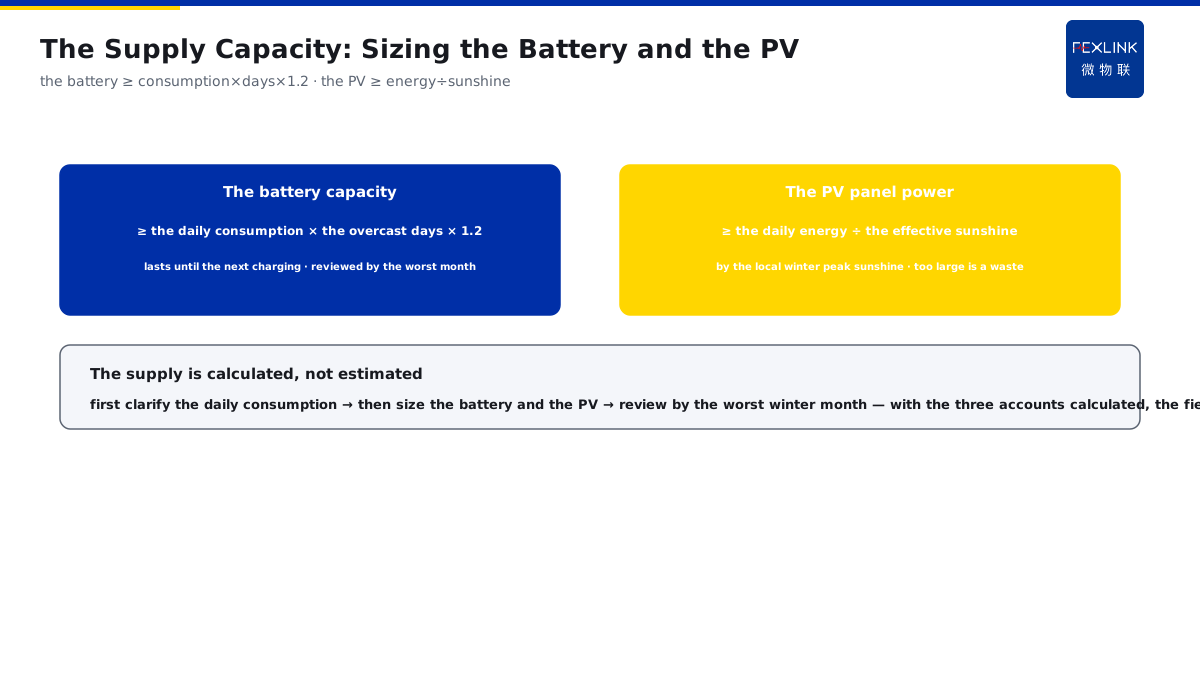
Direct Answer
At a mountain-top weather station or a remote base station without mains power, the lightning-protection monitoring equipment is powered by solar energy — how should it be configured so that it does not fail? The answer: select the DC12V solar-powered monitoring products for the unattended sites, size the battery capacity by "the daily average power consumption × the consecutive overcast-rainy days" and the PV panel power by "the daily average energy consumption ÷ the effective sunshine"; give priority to the 4G/wireless communication, and the gateway local cache ≥ 15 days to guarantee the data continuation after the network outage; the low-power standby and the lightning-event-triggered reporting significantly reduce the power-supply pressure.
At a mountain-top weather station, the lightning-current and SPD monitoring was installed, and the 40Ah battery with the 30W PV panel was configured by experience; after 5 consecutive overcast-rainy days in winter, the device died and the lightning-season data was missing. After the recalculation by "the daily average power consumption × the consecutive overcast-rainy days": the daily consumption was about 8Ah, the 50Ah battery was configured for 5 overcast-rainy days with the 1.2 margin, and the 60W PV panel was configured by the daily energy consumption divided by the effective sunshine; with the 4G outage cache, there was no death throughout the winter. The key distinction: the power supply is not "estimating a rough panel" — the battery is sized by "the daily average power consumption × the consecutive overcast-rainy days × the margin", and the PV panel by "the daily average energy consumption ÷ the effective sunshine"; the 4G communication is the priority, the gateway local cache ≥ 15 days, and the low-power standby with the event-triggered reporting reduces the power-supply pressure.
Why:
- The battery capacity: the daily average power consumption × the overcast-rainy days;
- The PV power: the daily average energy consumption ÷ the effective sunshine;
- The communication: the 4G/wireless priority;
- The outage continuation: the local cache ≥ 15 days.
Key insight: "The power supply must be calculated, not estimated — the battery is sized by the daily average power consumption × the consecutive overcast-rainy days × the margin, and the PV panel by the daily average energy consumption ÷ the effective sunshine; the 4G communication is the priority, the local cache ≥ 15 days, and the low-power standby with the event-triggered reporting greatly reduces the power-supply pressure."
At a remote base station, the monitoring equipment lost power 3 times during the consecutive overcast-rainy days, and the strike events had no records after the data gap. After the battery and the PV panel were re-configured by the power formula and the low-power standby was enabled, there was no power loss throughout the year. Lesson: the field power supply by estimation must fail — calculate the capacity by the power consumption and the overcast-rainy days, reduce the pressure with the low-power strategy, and the data is not interrupted.
Overview: run "how the supply capacity is calculated → the solar/lithium model boundaries → how the communication and the cache are selected → how the low-power strategy works" as one field-supply selection cognition. Select the DC12V solar-powered monitoring products for the unattended sites, size the battery capacity by "the daily average power consumption × the consecutive overcast-rainy days" and the PV panel power by "the daily average energy consumption ÷ the effective sunshine"; give priority to the 4G/wireless communication, and the gateway local cache ≥ 15 days. The four layers are unfolded below.
A "army provisions" analogy: think of the field power supply as preparing the provisions for an isolated army. The soldiers (the monitoring devices) eat every day (the daily average power consumption), and the granary (the battery) must last until the next supply (the sunny-day charging) — the consecutive overcast-rainy days are the days when the supply line is cut off, and the granary must be prepared by "the daily consumption × the supply-cut days × the surplus"; the PV panel is "the daily transport capacity of the supply team", sized by "the daily requirement ÷ how much can be transported per day" — too small a transport capacity and the granary can never be filled, and too large is a pure waste. In winter, the transport team is less efficient (poor sunshine) and the granary gets "damp" (the lithium battery capacity discounted at the low temperature), so the design by the worst month in winter is safe. The army-provisions analogy: the monitoring device = the soldiers eating every day, the battery = the granary prepared by the consumption × the supply-cut days × the surplus, and the PV panel = the supply team sized by the daily requirement ÷ the daily transport capacity — the winter transport is low and the granary is discounted, so design by the worst month.
1. The Supply Capacity: How to Calculate So That It Does Not Fail
Step one: first look at the supply-capacity calculation of the field site.
The battery capacity:
- The daily average power consumption first clarified;
- Multiplied by the consecutive overcast-rainy days;
- Plus the 1.2 margin;
- The capacity then has the guarantee.
The PV power:
- The daily average energy consumption calculated;
- Divided by the effective sunshine duration;
- The peak sunshine by the local data;
- The panel power then sufficient.
The algorithm formulas:
- The battery ≥ the daily average power consumption × the overcast-rainy days × 1.2;
- The PV ≥ the daily average energy consumption ÷ the effective sunshine;
- The local sunshine data;
- Winter by the worst month.
Key insight: "The capacity formula must be calculated — the battery ≥ the daily average power consumption × the overcast-rainy days × 1.2, and the PV ≥ the daily average energy consumption ÷ the effective sunshine; design by the worst month in winter locally, and the supply does not fail."
2. The Model Boundaries: How to Select the Solar/Lithium
Step two: the boundaries of the solar and the lithium-battery power-supply models.
The DC12V solar model:
- Applicable to the sites without mains;
- Powered by the PV panel + the controller;
- With the built-in lithium battery storage;
- Running independently in the field.
The lithium-battery characteristics:
- The low-temperature performance decreased;
- The winter capacity discounted;
- Corrected by the low temperature;
- The capacity selection with the margin.
The selection boundaries:
- The solar model for the sites without mains;
- The lithium correction in the low-temperature areas;
- The panel power increased with the high consumption;
- The model matching the field.
Key insight: "The model boundaries are clear — the DC12V solar model for the sites without mains (the PV panel + the controller + the lithium battery storage); the lithium capacity is discounted at the low temperature and corrected in winter, and with the high consumption the panel power is increased, with the model matching the field."
3. The Communication and the Cache: How the Data Continues after the Outage
Step three: the 4G/wireless communication and the local-cache selection.
The 4G/wireless priority:
- The field cabling difficult;
- The 4G ready to use;
- The wireless without the cabling;
- The communication independent of the supply.
The local cache:
- The gateway cache ≥ 15 days;
- The data not lost after the outage;
- Automatically continued after the recovery;
- The data complete.
The cache points:
- The cache capacity sufficient;
- The outage continuation automatic;
- The timestamps preserved;
- The data not overwritten.
Key insight: "The communication and the cache configured — the field 4G/wireless priority without the cabling, and the gateway local cache ≥ 15 days not losing the data after the outage and automatically continuing after the recovery; the cache capacity sufficient and the timestamps preserved, the data complete and uninterrupted."
4. The Low-Power Strategy: How to Reduce the Supply Pressure
Step four: the low-power standby and the event-triggered reporting strategy.
The low-power standby:
- Sleeping without the event;
- The timed wake-up for the collection;
- The power consumption minimized;
- The supply pressure decreased.
The event-triggered reporting:
- The strike triggering the immediate report;
- The event-driven rather than the polling;
- The key data transmitted;
- The communication power decreased.
The strategy combination:
- The standby + the event trigger;
- The timed state + the event record;
- The power and the data balanced;
- The supply worry-free.
Key insight: "The low-power strategy combined — sleeping without the event and waking up on time for the collection, and the strike event triggering the immediate report; the standby + the event trigger balance the power and the data, and the supply pressure is greatly reduced."
5. Product Implementation: The Field-Site Solution
WeiWuLian products bring the field-site supply to the ground:
- FR-01311 solar model: the independent supply of the field earthing monitoring;
- FL series low-power models: the lightning-current monitoring triggered by the event;
- FG gateway solar/lithium models: the data aggregation and the cache continuation;
- The 4G/wireless communication: ready to use without the cabling;
- The low-power design: the supply pressure minimized.
The design principle in one sentence: "The supply calculated clearly and the power kept low — the capacity by the power consumption and the overcast-rainy days, and the low-power standby + the event-triggered reporting make the field site uninterrupted throughout the year."
6. Common Understanding Misjudgments
- "The bigger the PV panel, the better": wrong. Size by the daily energy consumption and the effective sunshine; too large is a waste.
- "The battery capacity by the gut": wrong. Calculate by the daily power consumption × the overcast-rainy days × the margin.
- "Winter the same as summer": wrong. The lithium capacity is discounted at the low temperature, and design by the worst month.
- "Nothing can be done after the outage": wrong. The local cache ≥ 15 days continues the data.
- "The monitoring must be online in real time": wrong. The low-power standby + the event trigger do not lose the data.
One sentence to remember: the field power supply is "calculated", not "estimated" — the power consumption × the overcast-rainy days determines the battery, the energy consumption ÷ the sunshine determines the PV, and the event trigger saves the communication; with the three accounts calculated clearly, the site is uninterrupted throughout the year.
Scope and Limitations
This article explains the solar-power supply and the low-power selection of the lightning-protection monitoring at the unattended remote sites (the capacity calculation, the model boundaries, the communication/cache, and the low-power strategy), applicable to the monitoring-solution design of the field sites. The specific capacity and the models follow the product manuals and the local sunshine data; this article explains only the selection logic. All cases are anonymized (a mountain-top weather station/a remote base station) and do not refer to any specific customer.