 微物联研究院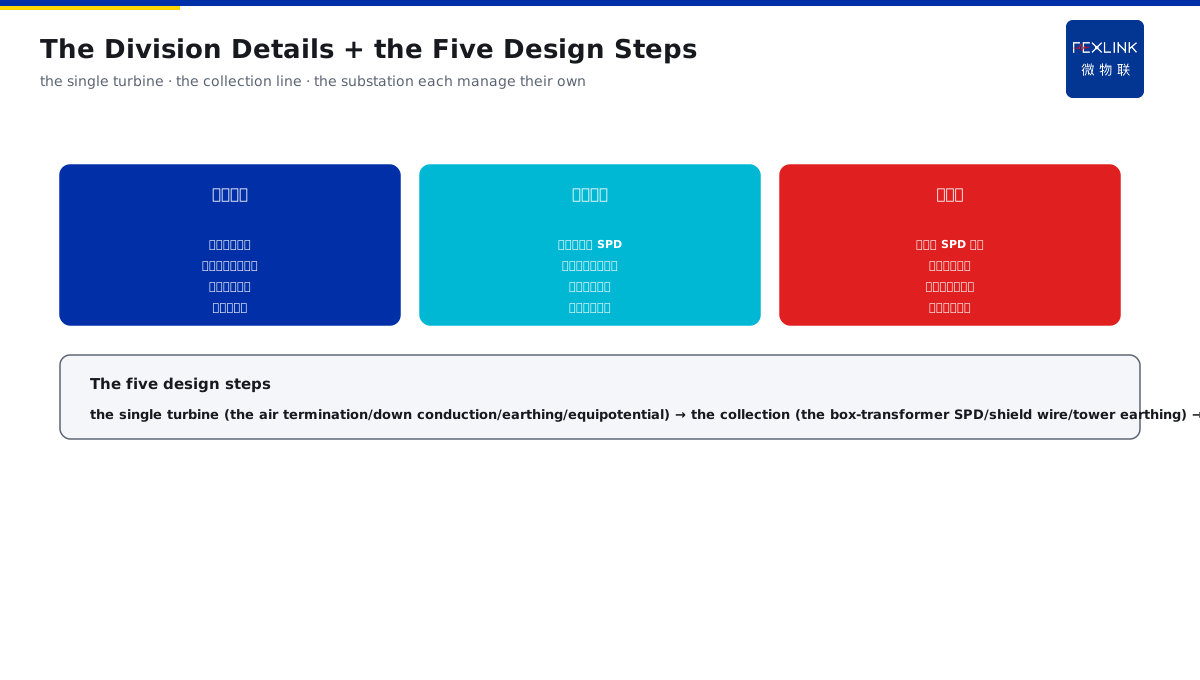
Direct Answer
For a wind farm with dozens of turbines scattered on the ridge, how is the lightning protection designed as one whole? The answer: design it in three grades — the single turbine (the blade air termination + the tower down conductor + the tower-base earthing) → the collection system (the SPDs on the high/low-voltage sides of the box transformer, the shield wire and the earthing of the overhead collection line) → the substation (the earth grid + the incoming/outgoing-line SPDs + the FL lightning-current monitoring); the scattered turbines rely on the unified earthing and the equipotential, and the substation relies on the centralized monitoring, forming the "single-turbine protection — line isolation — station-level monitoring" system.
At a mountain wind farm with 40 turbines scattered, the three-grade system was designed: the blade air-termination, the tower down conductor and the tower-base ring earthing for each turbine, the SPDs on the high/low-voltage sides of the box transformer, the shield wire configured by the lightning zone for the collection line, and the FL lightning-current monitoring and the FR earthing monitoring installed centrally at the substation; in the lightning season, no turbine stopped due to lightning, and the monitoring data supported the whole-year lightning assessment. The design core: the three grades each manage their own — the single turbine against the direct strike and the down conduction, the collection line isolating and limiting the voltage, and the substation monitoring centrally — the scattered turbines with the unified earthing, and the whole-farm lightning clear at a glance.
Why:
- The single turbine manages the direct strike: the blade air termination and the tower down conductor;
- The line manages the isolation: the box-transformer SPD and the shield wire;
- The station manages the monitoring: the FL/FR seen centrally;
- The whole farm forms the system: the three grades closed-loop.
Key insight: "The three grades each manage their own — the single turbine against the direct strike (the blade air termination + the tower down conductor + the tower-base earthing), the collection line isolating and limiting the voltage (the box-transformer SPD + the shield wire), and the substation monitoring centrally (the FL/FR) — the scattered turbines with the unified earthing, and the whole-farm lightning clear at a glance."
At a wind farm with only the single-turbine earthing early and no defense on the collection line and the substation, one strike invaded along the collection line, and the box transformer and the substation equipment were damaged in batches. After the three-grade system was completed, the same strike only caused the single-turbine SPD to operate, and the whole farm had no equipment damage. Lesson: the wind-farm lightning protection is not "each turbine defends itself" — the lightning travels along the line, and only with the single-turbine protection—line isolation—station-level monitoring complete is the loop closed.
Overview: run "how the three-grade system is arranged → what the single turbine/the line/the substation each manage → how the scattered-turbine earthing is unified → how the station-level monitoring is arranged" as one wind-farm lightning design. The wind-farm lightning protection is divided into three grades: the single turbine (the blade air termination + the tower down conductor + the tower-base earthing) → the collection system (the SPDs on the high/low-voltage sides of the box transformer, the shield wire and the earthing of the overhead collection line) → the substation (the earth grid + the incoming/outgoing-line SPDs + the FL lightning-current monitoring). The four layers are unfolded below.
A "three-level community security" analogy: think of the wind-farm lightning protection as the community security. The lightning current is like an intruder entering the community. The first level is each family's own security door (the single-turbine protection: the blade air termination + the tower down conductor + the tower-base earthing, stopping the intruder outside each door and safely leading it away); the second level is the community wall and the gate (the collection-line isolation: the box-transformer SPD + the shield wire, stopping the intruder running along the line outside the building); the third level is the property monitoring center (the substation centralized monitoring: the FL recording the strikes, the FR watching the earthing, and the FG gathering the data, with the whole situation clear at a glance). The three levels each manage one section: the security door manages the single household, the wall manages the community, and the monitoring center manages the whole. If only the security doors are installed without repairing the wall, the intruder will still run into the building from the wall gap — with only the single-turbine earthing and no line or station-level defense, the lightning runs along the collection line into the equipment. The security analogy: the security door = the single-turbine protection against the direct strike and the down conduction, the wall and the gate = the collection-line isolation and the voltage limiting, and the monitoring center = the substation centralized monitoring — the three levels each manage one section, and the lightning does not enter the equipment.
1. The Three-Grade Overview: How the System Is Arranged
Step one: first look at the overview of the wind-farm three-grade lightning system.
The first grade · the single turbine:
- The blade air termination;
- The tower down-conductor path;
- The tower-base ring earthing;
- Against the direct strike and the discharge.
The second grade · the collection:
- The box-transformer high/low-voltage SPDs;
- The shield wire of the overhead line;
- The line insulation and the earthing;
- The strike isolated and the voltage limited.
The third grade · the substation:
- The station earth grid;
- The incoming/outgoing-line SPDs;
- The FL lightning-current monitoring;
- The station level seen centrally.
Key insight: "The three grades each guard one section — the single turbine against the direct strike and the discharge, the collection line isolating and limiting the voltage, and the substation monitoring centrally — the grades connect by the unified earthing and the equipotential, and the system is closed-loop."
2. The Division Details: What Each Grade Manages
Step two: the protection division of the single turbine, the collection line and the substation.
The single-turbine protection:
- The blade air-termination coverage;
- The lightning current down-conducted through the tower;
- The tower-base earthing dissipating;
- The nacelle equipment equipotential.
The collection-line protection:
- The box-transformer high/low-voltage SPDs;
- The shield wire configured by the lightning zone;
- The tower earthing continuous;
- The strike not entering the switchgear.
The substation protection:
- The incoming/outgoing-line SPDs graded;
- The station earth grid grading;
- The secondary equipment equipotential;
- The station-level data closed-loop.
Key insight: "The division essence — the single turbine manages the direct strike and the discharge (the air termination/down conduction/earthing), the collection line manages the isolation (the box-transformer SPD + the shield wire + the tower earthing), and the substation manages the station level (the incoming/outgoing-line SPDs + the earth grid + the monitoring) — each manages its own, and the strike does not enter the equipment."
3. The Unified Earthing: How the Scattered Turbines Connect
Step three: the unification of the scattered-turbine earthing and the equipotential.
The tower-base earthing:
- The ring earthing electrode;
- Connected with the foundation reinforcement;
- The earthing-resistance target value;
- The lightning current dissipated quickly.
The nacelle equipotential:
- The nacelle equipment equipotential connection;
- The multiple redundant down conductors;
- The blade bearing jumper;
- The potential difference eliminated.
The whole-farm unification:
- The unified earthing concept;
- The inter-turbine earth grids interconnected;
- The substation earth grid converged;
- The potential balanced overall.
Key insight: "The unified earthing has three items — the tower-base ring earthing dissipating quickly, the nacelle equipotential eliminating the potential difference, and the whole-farm earth grids interconnected and converged at the substation — the scattered-turbine potential balanced overall, and the strikes do not implicate each other."
4. The Station-Level Monitoring: How FL/FR Are Arranged
Step four: the station-level FL/FR monitoring and the whole-farm comparison.
The FL lightning-current monitoring:
- The substation incoming-line monitoring;
- The strike events recorded;
- The whole-farm strike distribution;
- The single-turbine operation compared.
The FR earthing monitoring:
- The station earth-grid trend;
- The tower-base earthing sampled;
- The earthing degradation found early;
- The dissipation capability verified.
The FG gateway aggregation:
- The whole-farm data aggregated;
- The single turbine compared with the station level;
- The strike assessment supported;
- The operation decision closed-loop.
Key insight: "The station-level monitoring three-piece set — the FL records the whole-farm strike distribution, the FR watches the earthing trend, and the FG gateway aggregates and compares — the data supports the strike assessment, and the protection effect is verifiable."
5. Product Implementation: The Wind-Farm Lightning Closed Loop
WeiWuLian products make the wind-farm lightning protection "systematic and verifiable":
- FL lightning-current monitor: the whole-farm strike events recorded;
- FR earthing-resistance monitor: the tower-base and station earthing trends;
- FSS intelligent surge-protective device: the box-transformer and station SPD states;
- FG lightning-protection gateway: the whole-farm data aggregated and analyzed.
The design principle in one sentence: "The single-turbine protection is the foundation, the line isolation is the middle, and the station-level monitoring is the eye — FL records the strikes, FR watches the earthing, FSS sees the SPD, and FG gathers the whole farm; the three-grade system is closed-loop and verifiable."
6. Common Understanding Misjudgments
- "Each turbine defends itself well": wrong. The lightning travels along the collection line, and without the line and station-level defense, the damage still happens.
- "The blade air termination is enough": wrong. The tower down conduction and the tower-base earthing are the discharge key.
- "The box transformer needs no SPD": wrong. The high/low-voltage SPDs are the first gate of the line isolation.
- "The scattered turbines earth each on their own": wrong. Only the unified earthing and the equipotential prevent the mutual implication.
- "The strike data is useless": wrong. The FL whole-farm records support the strike assessment and the operation decision.
Scope and Limitations
This article explains the wind-farm three-grade lightning system design (the three-grade overview, the division details, the unified earthing and the station-level monitoring), applicable to the wind-farm lightning design and retrofit. The specific design follows GB/T 21714 and IEC 62305-3; this article explains only the design logic. All cases are anonymized (a mountain wind farm) and do not refer to any specific customer.