 微物联研究院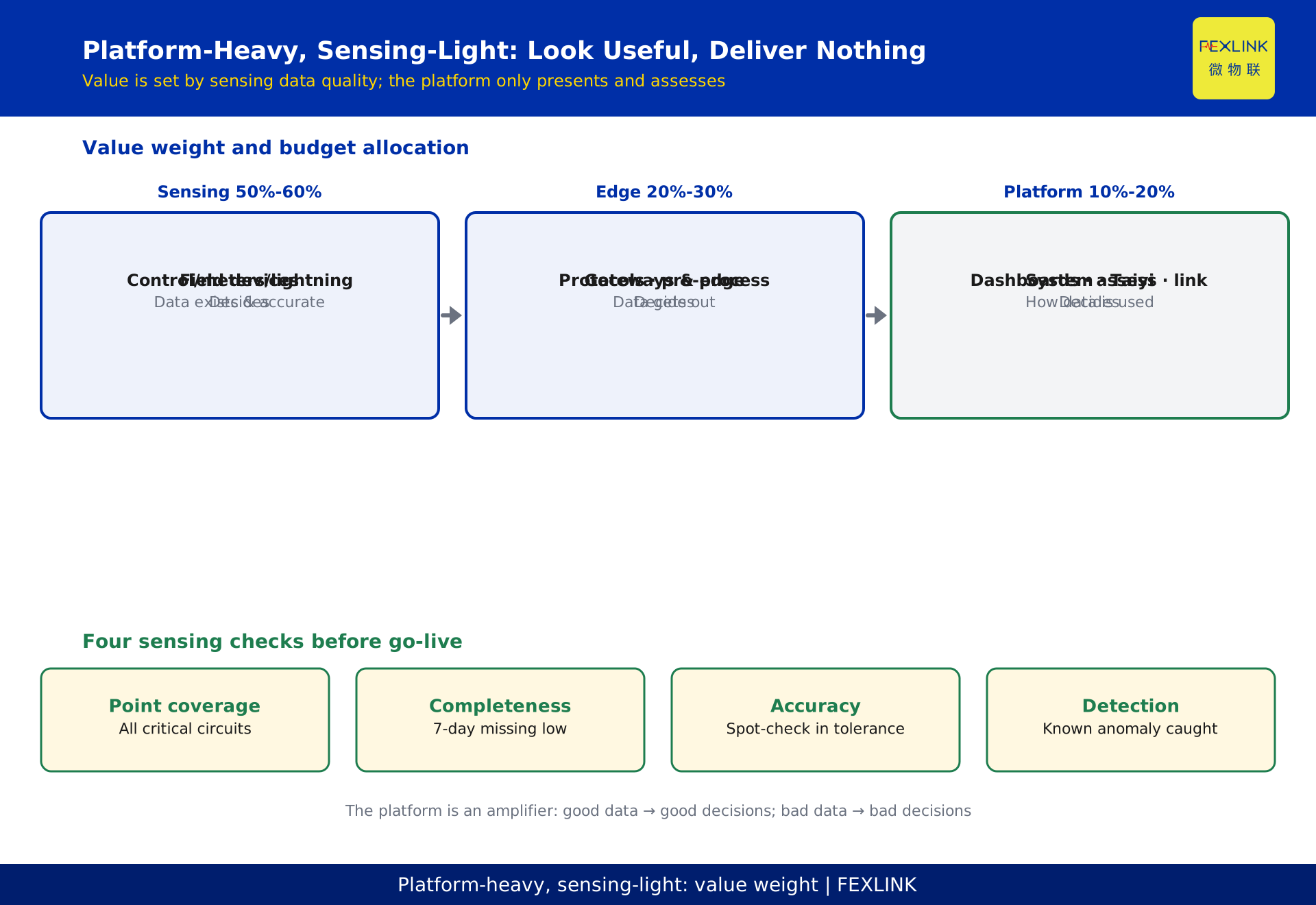
# Platform-Heavy, Sensing-Light: Why Systems Look Useful but Deliver Nothing
Direct Answer
The value of an electrical digitalization project is set by sensing data quality, not by the platform interface — the platform is the presentation and assessment layer; sensing is the value base. Budget should tilt toward roughly 5:2:3 to 6:2:2 across sensing:edge:platform. If data quality is not up to standard, even the most polished platform is "garbage in, garbage out."
For project owners, budget decision-makers, and IT leads, this article explains three things: why sensing carries the largest value weight; how to allocate budget across the three layers; and how to verify "sensing is truly qualified" before go-live.
The Value Weight of the Three Layers
The edge-cloud architecture has three layers:
- Sensing layer: field devices such as control devices, meters, and lightning monitoring — decides "whether data exists and whether it is accurate";
- Edge layer: gateways and edge computing — decides "whether data gets out and how much is pre-processed at the edge";
- Platform layer: supervision systems, the Taiyi platform, dashboards and alarms — decides "how data is presented, assessed, and linked."
Value weight is not equal: the sensing layer decides whether data exists, the edge layer decides whether data flows, and the platform layer decides how data is presented. Without the first two, the platform only outputs empty dashboards.
Why "Platform-Heavy, Sensing-Light" Disappoints
Putting most of the budget in the platform produces three typical outcomes:
- Rich platform features but no data to assess — dashboards full of empty tables and "insufficient data";
- Data exists but quality is poor — unreasonable sampling periods, incomplete point coverage, alarms that either miss or false-alarm;
- Data is not trusted — uncalibrated devices, gateway data loss; operations lose trust and eventually abandon the system.
Root cause: the platform's intelligence ceiling is locked by sensing data quality.
How to Allocate Budget
Allocate budget by value weight:
- Sensing layer (50%-60%): point count, device accuracy, installation quality — the biggest "is it worth it" factor;
- Edge layer (20%-30%): gateway count, protocol adaptation, edge pre-processing;
- Platform layer (10%-20%): software platform, dashboards, algorithms, implementation services.
The ratio is not a fixed rule, but the direction is clear: the part that produces data gets the majority of the budget.
Verifying the Sensing Layer Before Go-Live
Before platform acceptance, run the "four sensing checks":
- Point coverage: are all critical circuits covered — is any important circuit missing data?
- Data completeness: is the 7-day continuous missing rate below the threshold?
- Value accuracy: spot-check voltage/current/temperature against physical instruments — within tolerance?
- Anomaly detection: inject one known anomaly on site and see whether the sensing layer captures it truthfully.
If the four checks fail, platform acceptance should wait.
How the Edge-Cloud Collaboration System Helps
FEXLINK's edge-cloud collaboration system designs the three layers as one whole: sensing devices, edge gateways, and the platform with AI engines collaborate on a unified object model. Its value is aligning sensing quality with platform capability — data travels from acquisition to assessment without detours, rather than the platform "catching up" alone.
Three Sentences for Decision-Makers
- Ask about data before asking about the platform: before budget decisions, ask "who collects the critical data and how is quality assured?";
- Write acceptance on sensing: contract acceptance items should lead with "data completeness and accuracy," then the "platform feature list";
- The platform is an amplifier: it amplifies good data into good decisions and bad data into bad decisions.
Get the direction right, and the budget earns its value.
Seven: How to Allocate a Small Budget
When the budget is tight, sort by value rather than by price:
- Sense plus a basic dashboard only: first equip 20% of the high-risk circuits with control devices and surface the data on a basic dashboard — this step has the best cost-performance ratio and first solves "we cannot see it";
- Use a lightweight platform mode: start with standard supervision functions (overview, alarms, reports) and defer advanced modules such as AI assessment until later, enabled on demand;
- Reserve budget for linkage: if the site has a clear high-risk action need such as leakage tripping, linkage capability outranks nice-to-have analytics.
Small-budget rule: first make critical circuits visible, then make the data explainable, and only then make the system act automatically.
Priority Order for Selecting Sensing Points
When sensing points are limited, rank them in this order:
- High-risk circuits first: circuits with past incidents, high load rates, or obvious insulation aging;
- Critical loads first: core loads of hospitals, data centers, and production lines — the circuits whose outage costs are highest;
- Leakage-prone points first: humid environments, aged wiring, and locations with many socket circuits;
- Lightning-exposed points first: rooftop distribution, outdoor poles, and high-thunderstorm regions.
The essence of ranking is putting limited sensing budget where risk is highest, not spreading it evenly — a ranked point plan is also much easier to defend in front of an owner than an across-the-board list, because every point on it answers "why here first."
Nine: Acceptance Checklist for Decision Makers
- Is the data real and usable? spot-check three points against on-site meter readings; the error should be within a reasonable range;
- Can the value be told? can one chart explain "which circuit is most at risk, why, and what to do";
- Are the mechanisms in place? someone reads the dashboard, someone owns alarms, someone reads the weekly report — mechanisms prove success better than hardware;
- Is evolution space reserved? can the platform smoothly add points and models, so the second purchase does not overthrow the first? If the answer is yes, the first investment is an asset; if not, it is a sunk cost.
The Cooperation Boundary Between Sensing and Platform
"Platform-heavy, sensing-light" is essentially an imbalance between the two layers. Draw the boundary along three lines:
- Data line: the sensing layer must "measure accurately and completely"; the platform must "store and compute." Without sensing, the most capable platform cooks nothing — no ingredients, no meal;
- Judgment line: single-point threshold crossing is judged locally at the sensing end for speed; trends and correlations are judged by platform AI for depth. The boundary sits between response latency and judgment depth;
- Value line: the sensing layer answers "is there a problem"; the platform answers "what problem, how serious, what to do." Each layer owns one segment, and value closes only when both exist.
With the boundary drawn, budget allocation has a basis: build sensing solidly first (data line), then platform depth (judgment line), then value presentation (value line).
Eleven: Common Questions — Sensing First or Platform First?
- If the budget covers only one, buy which? Buy sensing. The platform can be deployed in phases and expanded on demand, but once sensing points are missing, the later retrofit cost far exceeds the device cost itself;
- Must the platform include AI? Not necessarily. First run the deterministic functions — collection, dashboard, alarms — solidly; AI is the value-add layer. A solid deterministic system beats a pile of smart modules nobody trusts;
- How to avoid buying sensing and never using it? On the day sensing devices arrive, configure the commissioning checklist, dashboard, and alarms. Acceptance ticks "data continuous for 7 days + alarms traceable," so "installed but not commissioned" cannot hide. This single habit prevents most idle-system outcomes, because idleness usually begins on day one, not day one hundred.
One Line Each for Sales, Implementation, and After-Sales
- Sales: put "sensing-point list + platform-function list" explicitly in the quotation, so the customer sees what capability each purchase buys rather than a vague "system";
- Implementation: in the first week on site, configure the commissioning checklist, dashboard, and alarms; acceptance ticks "data continuous for 7 days + alarms traceable," leaving no room for "installed but not commissioned";
- After-sales: write quarterly calibration into the service scope, re-calibrate thresholds with real event data — a dropping false-alarm rate is the best reason for renewal.
Each layer holds its own segment, and only then does the system's value move from the proposal paper to the field.
One final framing for decision makers: a sensing layer is the only part of the system that cannot be added retroactively without paying construction costs again — walls, trenches, and shutdown windows. Platform capability, by contrast, can always be added later with a license. So when in doubt between the two, let the physical constraint decide: sense first, because it is the only layer where the future retrofit cost is already real today. Budget the sensing layer first and every later phase becomes cheaper, cleaner, and far easier to fund, because the first phase already produced visible value instead of a promise.
Scope and Limitations
Reading page for KD-0023. Products and solutions (edge-cloud collaboration system, control devices/meters/lightning monitoring, gateways, supervision system and Taiyi platform) come from the FEXLINK product knowledge base as product-documentation conventions. The "three-layer value weight," "budget ratio 5:2:3 to 6:2:2," and "four sensing checks" are this article's methodology for reference; specific budgets and acceptance standards should be confirmed by professional pre-sales staff based on the actual project. This page is not a specific project proposal.