 微物联研究院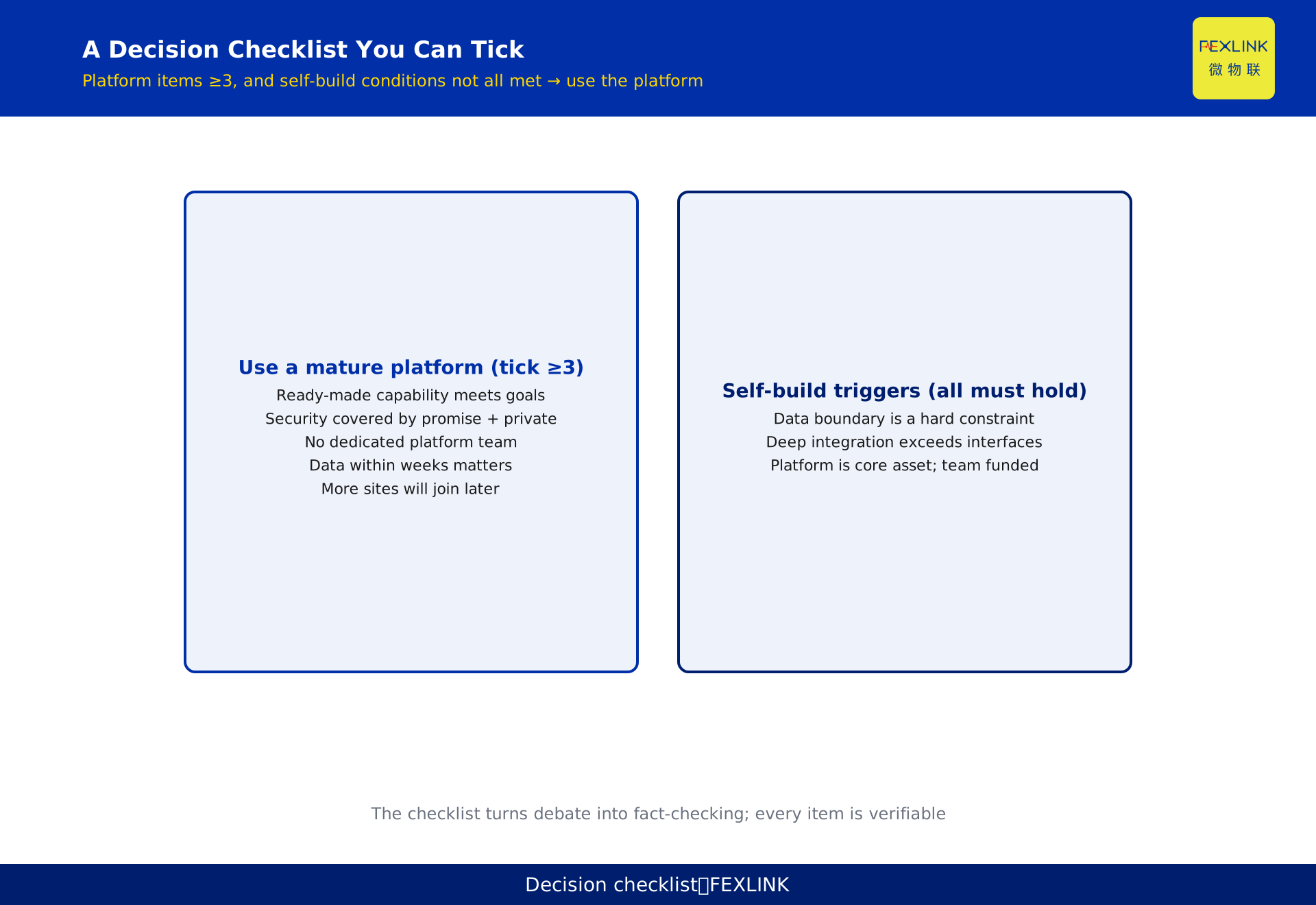
Direct Answer
When an enterprise goes digital in electrical monitoring, there are two ways to get a platform — build one in-house or use a mature platform directly — and the costs and outcomes differ sharply. Direct answer: for most enterprises, using a mature IoT platform directly is the better deal in the start-up phase and in the expansion phase, because it goes live quickly and brings ready-made analytics. Self-building is worth it only when data-security requirements, deep custom integration, or a long-term strategy clearly point to full self-control. The key is not "do we have budget" but three questions: can your management goals be met by ready-made capabilities? How strict are your data-security requirements? Does your team have the resources and patience to run a platform long-term? The answers decide the phase — this is not a once-and-for-all choice.
The Cost Structures Are Completely Different
A self-built platform is not a "develop once" cost; it is three long-term accounts:
Development investment. Device access, protocol parsing, time-series storage, an alarm engine, dashboards, mobile clients — every piece needs people to build it and to keep iterating. A mature platform is maintained by a team of dozens; self-building means the enterprise carries that headcount itself.
Operations investment. A platform must run 7×24: storage grows, versions upgrade, faults get fixed. Every extra operator on a self-built platform adds fixed cost; a mature platform spreads this across many customers.
Hidden cost. The easiest item to forget is iteration: alarm rules need tuning, reports need changing, new analytics keep appearing — every change goes through the development queue on a self-built platform, while on a mature platform it is configuration, not development.
When both accounts are done, self-building usually costs far more than the initial development quote — and the gap widens over time.
Time to Go Live and Speed of Iteration
Time to go live. A usable self-built platform takes months from requirements to launch, sometimes years; a mature platform — connect devices, create points, configure alarms — can show data within weeks. For most enterprises, monitoring value starts the day data begins to flow; every late day is a late day in seeing hazards.
Speed of iteration. Electrical-safety analytics evolve fast — new alarm models, new standard baselines, new analysis dimensions. A self-built platform iterates at the pace of internal scheduling; a mature platform iterates through the vendor's continuous investment, and customers automatically get new capabilities. Using a mature platform means "analytics follow the platform," not "wait for your own team's queue."
Fast go-live plus fast iteration almost decides the start-up phase in favor of a mature platform.
Data Ownership and Security: Three Answers to the Concern
"Data sits on someone else's platform" is the most common reason to lean self-built. The concern is legitimate, but the conclusion is not necessarily self-building, because mature platforms have established answers:
Ownership. Monitoring data belongs to the owner — that is the industry-standard contractual arrangement. The platform is an entrusted operator, not an owner; ownership is written in the contract, independent of build-vs-rent.
Access control. Data lives on the platform, but access control stays with the owner: who can view, export, or configure alarms is governed by the owner's account system. Platforms do not show one customer's data to another — that is a platform's basic survival line.
Security level. For higher-security requirements, mature platforms usually offer private deployment: the software runs on the owner's servers and data never leaves the enterprise network. Security needs are met by the deployment form, not by self-building.
Ask these three questions, and much "data worry" turns out to be "never asked how the platform protects it."
Four Scenarios Where a Mature Platform Fits
These four scenarios usually favor a mature platform:
Validation phase. An enterprise runs electrical monitoring for the first time and is unsure which points have value and which alarms truly matter. The priority is low-cost trial: get data running on a mature platform, then decide on real data. Self-building means carrying heavy assets during validation.
Standard monitoring needs. Goals are covered by over-limit alarms, reports, and inspection; management questions are clear and processes are mature. Ready-made capabilities cover them directly.
Multi-site replication. After one site succeeds, the enterprise replicates to others. A mature platform's "one platform, many sites" capability is ready; adding a site is configuration. A self-built platform reinvests for every replication.
Limited people and budget. No dedicated platform developers or operators, and no budget to support a platform team. Here "self-build" is not a choice; it is a risk.
The common thread: management goals are met by ready-made capability, and the enterprise does not want to carry long-term platform operations.
Three Conditions That Trigger Self-Building
Conversely, self-building has real value only when all three conditions hold — note: all three, not any one:
One: data-security requirements exceed platform commitments. Regulation requires data never to leave the enterprise network, fully local storage, and even private deployment cannot satisfy it (e.g., classified scenarios). The data boundary is a hard constraint; only self-building or full localization works.
Two: custom integration depth exceeds platform capability. Platform interfaces cannot support deep integration with internal systems (ERP, MES, dispatch), and the custom needs are long-term and structural, not a few field changes.
Three: long-term strategy explicitly targets platform self-control. The enterprise treats the monitoring platform as a core asset, plans to build its own analytics on top, and is willing to sustain a dedicated team.
Only when all three hold is self-building worth it. If one or two hold, return to the mature platform and spend resources on the business instead.
Middle Routes: Private Deployment and Hybrid Mode
Build and rent are not a binary; two middle routes exist:
Private deployment. The mature platform software runs on the owner's servers, data stays inside the enterprise network — the combination of "security requirement" and "ready-made capability." Compared with self-building, it saves platform R&D and iteration cost; compared with public cloud, it satisfies localization. Enterprises with high security requirements should ask the platform whether this option exists.
Hybrid mode. Start on a mature platform to go live fast; after value is proven, migrate data and analytics to self-built or private environments gradually. The key to hybrid is data portability: when choosing a platform, confirm open export interfaces and standard formats, to avoid lock-in.
The point of middle routes: turn "to build or not" from a single decision into a phased decision, driven by data rather than anxiety.
Why Self-Built Platforms Fail: Not a Technology Problem
Self-built platforms usually fail not on technology but on three points:
Underestimating operations. Launch is just the beginning; growth, upgrades, and fault handling follow endlessly. Many projects peak at launch and then enter long-term maintenance with deteriorating ROI.
Underestimating iteration. Alarm rules, analytics models, and visualization components all need continuous updates. The pace of electrical-safety analytics exceeds an internal team's iteration speed, and the platform soon lags the need.
Key-person risk. A self-built platform often depends on a few core developers; when they leave, the platform becomes a black box. A mature platform's capability is embedded in the vendor's system and has no such problem.
All three point to one conclusion: the real cost of self-building is not "getting it made" but "keeping it alive long-term."
A Decision Checklist
Turn the discussion into a checkable list — tick items and read the result:
Tick to use a mature platform first:
- Goals are met by ready-made alarms, reports, and dashboards;
- Data-security needs are met by platform commitments and the private-deployment option;
- No dedicated platform developers or operators on the team;
- Hope to see data within weeks;
- More sites will join later and need multi-site management.
Tick to trigger self-building (all must hold together):
- The data boundary is a hard constraint no platform form can satisfy;
- Deep integration with internal systems exceeds platform interfaces;
- Long-term strategy treats the platform as a core asset and funds a dedicated team.
After ticking: if mature-platform items ≥ 3 and the self-build items are not all met, the conclusion is "use a mature platform, at least for now." The list's value is turning debate into fact-checking — every item is verifiable, not "I feel." A practical habit: re-run the checklist every 12 to 18 months, because team size, security requirements, and strategy all change; the answer from two years ago may no longer be the answer today. Choosing a platform is a phase decision, and the checklist is the cheapest way to re-decide.
Scope and Limitations
The build-vs-rent framework in this article targets electrical-monitoring projects going to the cloud; the conclusion (mature platform first in start-up and expansion phases) is based on typical enterprise staffing, budget, and management goals, and does not apply to classified scenarios where full localization is mandated. FEXCloud capabilities mentioned (device access, time-series database, AI inference engine, multi-site management) follow the FEXLINK product knowledge base; the actual capability scope and private-deployment options depend on the vendor's current version and contract. Self-build cost and operations estimates are general industry patterns; actual figures vary by enterprise, and investment decisions should be evaluated against one's own team capability and budget. Scenarios are anonymized (a generic park, a generic factory, and similar references) and do not refer to any specific customer.