 微物联研究院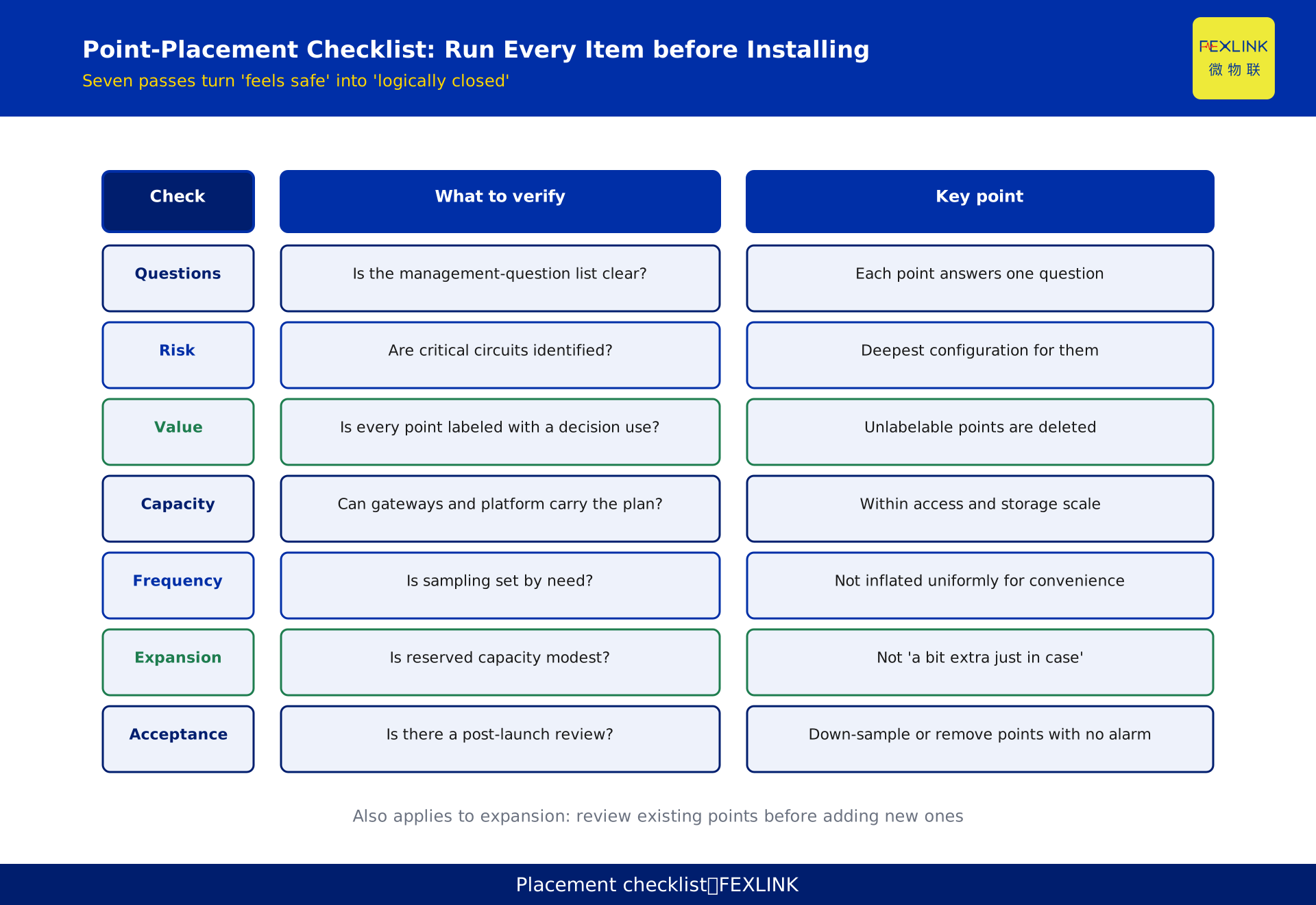
Direct Answer
A common assumption in monitoring planning: equip every circuit with sensors—the more points, the safer. In fact, the opposite is true. More points than management needs bring three costs: data overload, alarm flooding, and wasted investment. Too many points can "break" the system. The number of points should be decided by management needs, not by an impulse for "full coverage." Place points in tiers by risk and management value—dense on critical circuits, sparse on ordinary ones—so every point answers a management question. Decide which circuits are most costly to fail, then where and how many points to install.
1. The Allure of "Full Coverage" and Its Hidden Costs
Full coverage feels safe: every cabinet, every feeder monitored. But a monitoring system is not insurance—it is an information pipeline, and every stage (collection, transmission, storage, analysis, alarming) has a capacity limit. Beyond it, extra points are not "extra eyes"; they are extra burden.
Three accounts make this clear:
The cost account. Behind every point is a sensor, a collection module, wiring, installation, commissioning, calibration and maintenance. Spending grows linearly with point count. Spreading money thinly over hundreds of points is worse than concentrating it on a few critical ones.
The data account. More points mean more data, forcing edge devices and the platform to scale storage and compute. Only data that supports decisions has value; redundant data dilutes analytical capacity.
The management account. Every point can raise alarms. Double the points and alarms usually more than double, with cascading correlations. Overwhelmed operators end up with a "cry wolf" effect—real alarms go unresponded.
The illusion of safety lives in these three accounts.
2. Cost One: Data Overload—A System That Chokes
In a mid-size park distribution system, fitting every level, phase and feeder with voltage, current, temperature and leakage monitoring can create thousands of points per substation, streamed every second to gateways and the platform.
The problem: systems have finite capacity. Edge gateways have rated access scales; platform storage and compute are limited. When points exceed capacity: collection cycles stretch and real-time performance drops; storage grows by points × frequency, forcing down-sampling; compute is consumed by irrelevant data while data needing deep analysis starves.
More insidious is the falling signal-to-noise ratio: valuable signals drown in normal data, and models must search for signal in noise. The system is not starved—it is suffocated.
3. Cost Two: Alarm Flood—Operators Grow "Deaf"
Downstream of data overload comes alarm flooding, the most direct harm of point greed. More points mean more alarm sources and more cascades—one circuit anomaly can trigger alarms across upstream and downstream points. A park's real lesson: after full coverage, daily alarms grew from dozens to over a thousand. The control room went from "handling every alarm" to "bulk-ignoring most," and real hazard alarms were ignored with the noise.
That is alarm fatigue: once alarms lose scarcity, they are no longer signals—they are noise. Operators can only filter by experience, and experience-based filtering misses most precisely at the stage when hazards most need detection—early-stage alarms are usually the least conspicuous.
The value of an alarm system is not "report every anomaly" but "report anomalies worth handling." Point greed destroys exactly that.
4. Cost Three: Wasted Investment—O&M Costs Scale with Every Point
The third cost is money. Investment has two parts: one-time construction and long-term operation—and operation is the most underestimated.
One-time: sensors, modules, wiring and installation add up linearly with point count; a "full coverage" plan can double the initial investment versus tiered placement.
Long-term: sensors age, modules need calibration, wiring degrades. More points mean more inspection workload, more failure points, higher spare-part inventory. One factory found full coverage added dozens of man-hours per month for inspection—while many points had not raised a single useful alarm in three years. They were "quiet redundancy."
The test for whether a point is worth installing is not "can it fail?" but "does it feed a decision?" A point that never alarms and never participates in analysis is a perpetual sunk cost.
5. The Right Starting Point: Define Monitoring from Management Questions
If "more is better" is wrong, what is the right starting point? One sentence: derive monitoring needs from management questions.
Write down the questions you need answered: which circuits cost the most if they fail? How do we track critical equipment health? Can power-quality events be traced to their source quickly? How do we break down energy use? Every management question points to concrete monitoring needs: which parameters, at which locations, at what accuracy and frequency. The management-question list is the "requirements source"; the point list is its physical realization.
Conversely, if a point answers no management question—it is measured, but no person or system uses the data for decisions—it is redundant. Strike it from the plan without losing any management capability.
6. Tier by Risk: Dense on Critical Circuits, Sparse on Ordinary Ones
The most practical way to go from management questions to placement is tiering by risk. Electrical risk is not evenly distributed: a few critical circuits carry most of the failure cost; most ordinary circuits fail with limited impact.
High tier—dense. Transformers and outgoing feeders, main busbars, critical process loads, sites with prior incidents, fire and safety circuits. These justify multi-parameter, high-frequency, deep monitoring: voltage, current, temperature, leakage, power quality—even trend analysis and standard comparison.
Medium tier—moderate. Important feeders, main lighting and power trunks. Monitor key parameters (voltage, current, temperature) for basic visibility and circuit-level fault location.
Ordinary tier—sparse. Non-critical branches and ordinary lighting. Monitor at busbar level or rely on upstream data; branch faults are found indirectly through upstream limit and harmonic signatures, at far lower cost.
The direct result: roughly 30% of the points cover roughly 90% of the risk. Compared with even spreading, investment drops by more than half, alarms drop sharply, and critical circuits get deeper monitoring.
7. Tier by Management Value: Install Only What Feeds a Decision
Risk tiering answers "where dense, where sparse"; management value answers "whether it is worth it." Two points with identical parameters and accuracy—one on a critical load, one on a warehouse branch—have totally different value.
Three principles:
Failure cost. If this circuit fails, do you lose an hour of production or ten minutes? Higher cost deserves deeper monitoring.
Decision use. Which decisions will this point's data enter—hazard analysis, energy accounting, or archive reference? Points that feed decisions are worth installing; pure archives can go.
Data continuity. A point nobody views, that raises no alarms and enters no analysis, has no real user. A point without a user is redundant.
A practical habit: label every point with its "decision use." Unlabelable points get deleted.
8. A Point-Placement Checklist before You Install
Turn the principles into a checklist and run through it during planning:
Questions: Is the management-question list clear? Which question does each point answer? Risk: Are critical circuits identified and given the deepest configuration? Value: Is every point labeled with a decision use? Were unlabelable points removed? Capacity: Can gateway scale and platform storage/compute carry the plan? Frequency: Is sampling set by need, not inflated uniformly for convenience? Expansion: Is reserved capacity modest, not "a bit extra just in case"? Acceptance: Is there a post-launch review—points with no useful alarm in six months get down-sampled or removed?
Seven passes turn the plan from "feels safe" into "logically closed." The same checklist applies to expansion and retrofit—review existing points before adding new ones.
9. Layered Placement and "Data Flow First"
Layered placement is the point-level realization of "define the data flow first, then choose products": management questions set needs, needs set point distribution, distribution sets sensing configuration, and sensing sets edge and platform scale. The order cannot be reversed—stacking points first is exactly this article's pitfall.
Data-flow design also bounds placement: how many devices a gateway can carry and how long the platform retains data set the ceiling for point planning. Putting capacity constraints into the plan early keeps placement under control.
In mature electrical supervision solutions this is fully realized: the sensing layer deploys FS/FR/FL/ES-series modules and smart meters on critical circuits, gateways aggregate at the edge, and the platform handles alarms and analysis—density and sparsity are jointly decided by each layer's capacity.
Scope and Limitations
The conclusion "more points is not better; tier by risk" applies to point planning, expansion and retrofit of electrical monitoring systems, for project owners, designers and integrators. Risk distribution, goals and budgets vary by project; point counts and depth need site surveys and management needs. The "30% of points cover 90% of risk" figure is a rule of thumb, not a promise. Product capabilities cited (gateway access scale, FS/FR/FL/ES series modules) are public descriptions from the FEXLINK product knowledge base for the Digital Electrical Intelligent Supervision System; final selection follows the vendor's current specifications. All cases are anonymized (a park, a factory), not tied to any specific customer.