 微物联研究院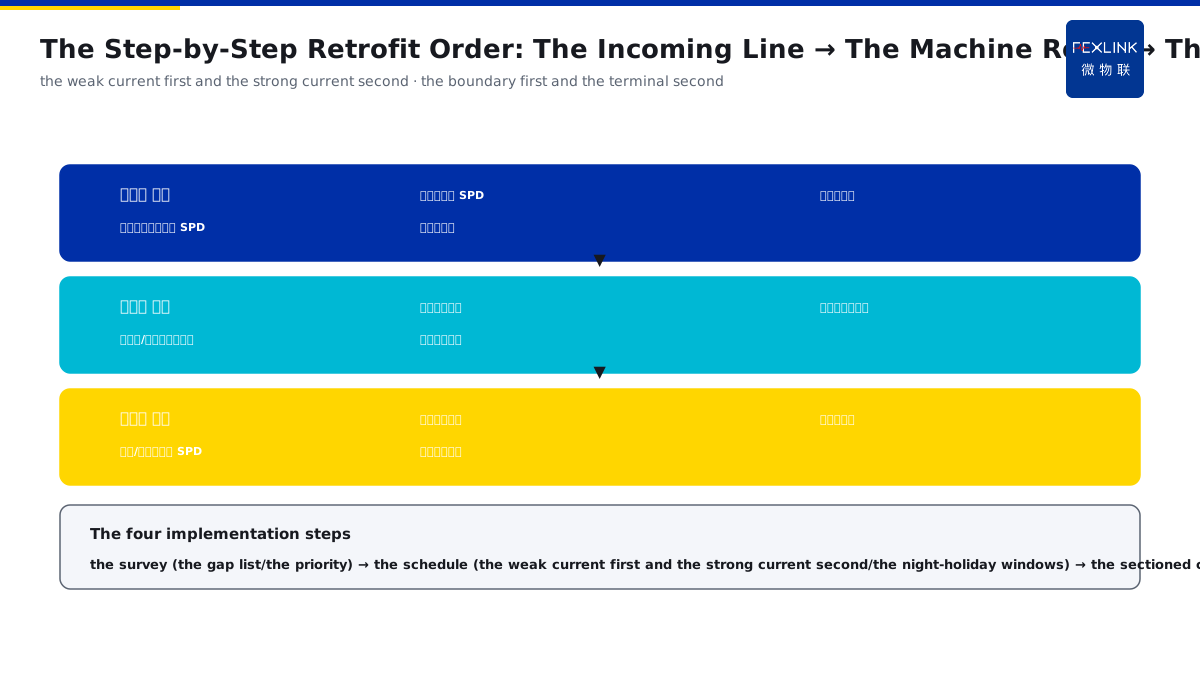
Direct Answer
In the old hospitals and the schools where the electronic equipment grows more and more but the building lightning protection was made decades ago, how to fill the LEMP gap without stopping the diagnosis or the classes? The answer: retrofit step by step with "the weak current first and the strong current second, the boundary first and the terminal second" — add or replace the graded SPDs at the power incoming lines with the backup protection, make the local equipotential and the zero-earth-voltage monitoring in the machine rooms, the operating rooms and the monitoring centers, and add the signal SPDs to the signal and network lines; implement with the sectioned power cut-offs in the nights and the holidays, prioritizing the protection of the critical loads such as the ICU, the operating rooms and the data machine rooms.
At an old hospital where the outpatient and the inpatient buildings shared the decades-old lightning protection system, the CT and the monitors restarted multiple times in the lightning season due to the surges. The retrofit went in three steps "incoming line → machine room → terminal" with the sectioned cut-offs in the nights and the holidays: step one, the graded SPDs and the backup protection at the power incoming lines; step two, the local equipotential and the ESP zero-earth-voltage monitoring in the operating rooms and the data machine rooms; step three, the signal SPDs on the signal and network lines. The whole process did not stop the diagnosis, the critical loads were prioritized, and the equipment had zero restart after the lightning season. The design core: the weak current first and the strong current second, the boundary first and the terminal second — the graded SPDs at the incoming lines, the LEB and the zero-earth monitoring in the machine rooms, and the signal SPDs at the terminal — with the sectioned cut-offs without stopping the diagnosis, the critical loads prioritized.
Why:
- The boundary first and the terminal second: the incoming line → the machine room → the terminal;
- The weak current first and the strong current second: the signal first, the distribution following;
- The construction without stopping the diagnosis: the sectioned cut-offs in the nights and the holidays;
- The critical loads prioritized: the ICU/operating rooms/machine rooms.
Key insight: "The step-by-step retrofit has three principles — the weak current first and the strong current second (the signal first, the distribution following), the boundary first and the terminal second (the incoming line → the machine room → the terminal), and the sectioned cut-offs without stopping the diagnosis (implemented in the nights and the holidays) — with the critical loads prioritized, the retrofit does not disturb the diagnosis and the treatment."
At a school, the projectors and the broadcast system in the multimedia classrooms were damaged by the lightning multiple times in the lightning season, interrupting the teaching. After the three-step retrofit "incoming-line SPD → machine-room equipotential → terminal signal SPD" completed in the holidays, the equipment had zero damage in the lightning season, and the teaching was no longer interrupted. Lesson: without filling the LEMP gap of the old building, the equipment breaks every year and the teaching interrupts every year — with the step-by-step retrofit and the holiday implementation, the gap can be filled without stopping the classes.
Overview: run "how the gap is diagnosed → how the step-by-step retrofit order is arranged → how the sectioned construction is scheduled → how the critical loads are prioritized" as one old-building LEMP retrofit design. The LEMP retrofit of the old hospitals and the schools goes step by step with "the weak current first and the strong current second, the boundary first and the terminal second": the graded SPDs at the power incoming lines, the local equipotential and the zero-earth-voltage monitoring in the machine rooms, and the signal SPDs at the terminal, implemented with the sectioned cut-offs in the nights and the holidays. The four layers are unfolded below.
A "renovating an old house without stopping the tenancy" analogy: think of the old-building LEMP retrofit as renovating the circuits of an old house without evicting the tenants. The landlord does not evict all the tenants of the whole building to change the wires — he does it section by section during the tenants' working days and the holiday weekends: first change the corridor main switch (the incoming-line SPD guarding the boundary), then make the separate protection for the most valuable rooms (the operating rooms and the machine rooms) (the LEB and the zero-earth monitoring), and finally renew the socket panels of each room one by one (the terminal signal SPDs). The key tenants (the ICU and the operating rooms) are always protected first and prioritized, and the critical rooms are temporarily switched to the backup lines during the construction — the tenants do not move out for a single day. The old-building LEMP retrofit works the same: without stopping the diagnosis or the classes, it relies on the sectioned cut-offs, the critical prioritization and the monitoring traces. The renovation analogy: the corridor main switch = the graded SPDs at the incoming lines, the separate protection of the valuable rooms = the machine-room LEB and the zero-earth monitoring, the socket panels = the terminal signal SPDs, and the key-tenant priority = the ICU/operating-room protection first — with the sectioned renovation without stopping the tenancy, the retrofit does not disturb the life.
1. The Gap Diagnosis: What the Old Building Lacks
Step one: first diagnose the LEMP gaps of the old building.
The equipotential gap:
- No local equipotential in the machine room;
- The equipment earth potentials inconsistent;
- The potential difference during the strike;
- The port damage risk.
The SPD gap:
- No graded SPD at the incoming line;
- The old SPD degraded;
- No backup protection;
- The surge intruding directly.
The shielding and monitoring gap:
- No line shielding;
- No online monitoring;
- No lightning-event record;
- The state invisible.
Key insight: "The gap diagnosis has three places — the equipotential missing (no LEB in the machine room, the potential-difference spark), the SPD missing (no graded SPD at the incoming line/the old part degraded/no backup), and the monitoring missing (no record and the state invisible) — diagnose first and retrofit second, without an unprepared fight."
2. The Step-by-Step Order: How the Weak Current First and the Strong Current Second
Step two: the step-by-step retrofit order (the incoming line → the machine room → the terminal).
Step one, the incoming line:
- The graded SPDs at the power incoming lines;
- The degraded old SPDs replaced;
- The backup protection added;
- The boundary guarded first.
Step two, the machine room:
- The local equipotential in the operating rooms/machine rooms;
- The zero-earth-voltage monitoring;
- The cabinet equipment converged;
- The critical-area potential consistent.
Step three, the terminal:
- The signal SPDs on the signal/network lines;
- The terminal equipment guaranteed;
- The monitoring center matched;
- The terminal filled in later.
Key insight: "The step-by-step order has three steps — the graded SPDs at the incoming lines guard the boundary first (with the backup protection), the machine-room LEB and the zero-earth monitoring fill the equipotential (the critical area), and the terminal signal SPDs guarantee (the monitoring center matched) — with the boundary first and the terminal second, the gaps are filled block by block."
3. The Sectioned Construction: How to Schedule Without Stopping the Diagnosis
Step three: implement with the sectioned cut-offs in the nights and the holidays.
The construction windows:
- The low-load night hours;
- The holiday/weekend windows;
- The sectioned cut-off with a small range;
- The impact minimized.
The no-stop arrangement:
- The non-critical area first and the critical area second;
- The critical loads temporarily switched;
- The emergency-plan backup;
- The diagnosis uninterrupted.
The retrofit records:
- The sectioned retrofit ledger;
- Each section accepted;
- The monitoring access confirmed;
- The state fully traced.
Key insight: "The sectioned construction has three things — the windows selected at the nights/holidays (the sectioned cut-off with a small impact), the no-stop arrangement with the non-critical first and the critical second (the critical loads temporarily switched), and the retrofit records ledgerized (each section accepted and the monitoring accessed) — the retrofit does not stop the diagnosis, and the state is fully traced."
4. The Critical Loads: How the Operating Rooms and the Machine Rooms Are Prioritized
Step four: prioritize the critical loads (the ICU, the operating rooms and the data machine rooms).
The priority ranking:
- The ICU/operating rooms highest;
- The data machine rooms second;
- The imaging equipment following;
- The teaching/office last.
The priority measures:
- The critical area LEB first;
- The critical lines SPD first;
- The ESP covering the critical area first;
- The resumption verified first.
The continuous guarantee:
- The critical-area online monitoring;
- The lightning-season key watch;
- The quick event response;
- The guarantee uninterrupted.
Key insight: "The critical-load priority has three things — the priority ranking (the ICU/operating rooms highest, the machine rooms second, the office last), the priority measures first (the LEB/SPD/ESP covering the critical area first), and the continuous guarantee with the online monitoring (the lightning-season key watch) — the critical loads protected first, and the diagnosis and the teaching uninterrupted."
5. Product Implementation: The Old-Building LEMP Retrofit Closed Loop
WeiWuLian products make the old-building LEMP retrofit "the step-by-step landable and the state visible":
- FSS intelligent surge-protective device: the graded SPD installation at the incoming lines and the state online;
- ESP zero-earth-voltage monitor: the zero-earth-voltage monitoring in the machine rooms/operating rooms;
- FS SPD monitor: the SPD action and the leakage-trend record;
- The data closed loop: the sectioned acceptance of the retrofit and the lightning-season continuous guarantee.
The design principle in one sentence: "The weak current first and the strong current second, the boundary first and the terminal second — the FSS guards the incoming lines, the ESP watches the zero earth, and the FS records the actions; with the sectioned cut-offs without stopping the diagnosis, the critical loads prioritized."
6. Common Understanding Misjudgments
- "The old-building lightning retrofit must stop the diagnosis and the classes": wrong. With the sectioned cut-offs and the night/holiday implementation, it can proceed without stopping.
- "Only replacing the incoming-line SPD is enough": wrong. The terminal signals and the machine-room equipotential must be filled too.
- "The strong current first and the weak current second": wrong. The weak current first and the strong current second — the signal first and the distribution following.
- "All the areas retrofitted together": wrong. The critical loads first and the general areas second, with the minimal impact.
- "No care after the retrofit": wrong. The online monitoring keeps watching, and only with the visible state is it reassuring.
Scope and Limitations
This article explains the LEMP-gap-filling retrofit path of the old hospitals and the schools without stopping the diagnosis or the classes (the gap diagnosis, the step-by-step order, the sectioned construction and the critical loads), applicable to the LEMP retrofit of the existing buildings. The specific design follows GB 50343-2012; this article explains only the design logic. All cases are anonymized (an old hospital/a school) and do not refer to any specific customer.