 微物联研究院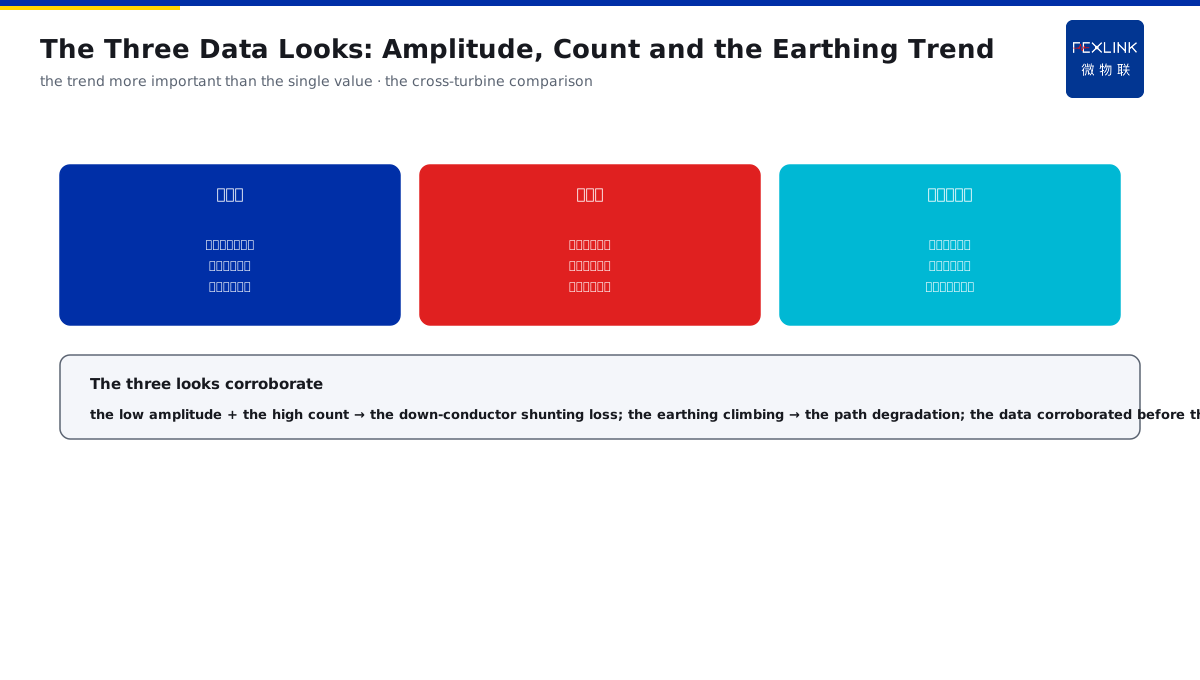
Direct Answer
The blade of the same turbine is repeatedly damaged by the lightning strike — how to judge whether the receiver has failed or the lightning current cannot be led down? The answer: the repeated blade damage has two root causes — the receiver (the tip receptor network) burnt and fallen off, reducing the capture capability, or the down-conductor path (the embedded conductor → the bearing → the tower bus) with the increased contact resistance, forcing the lightning current to arc inside the blade; the diagnosis combines the lightning-current amplitude and the count, the earthing-resistance trend and the blade endoscopy to distinguish the "receiver failure" from the "down-conductor break".
At a wind farm, the blade of the same turbine was damaged three times in one lightning season, and the visual inspection in the cabin was slow and dangerous. By the two root causes: the lightning-current monitoring showed the low amplitude but the surged count, and the earthing resistance showed the rising trend — judged as the down-conductor contact degradation forcing the current to arc inside the blade; after the endoscopy confirmed and the bearing conductive link was replaced, the same strike no longer damaged the blade. The key distinction: the repeated blade damage is seen in two types — the receiver burnt and fallen off (the capture capability reduced) or the down-conductor contact resistance increased (the current forced to arc inside); the diagnosis combines the amplitude and the count, the earthing trend and the endoscopy — locate first, then handle.
Why:
- The receiver failure: the tip receptor network burnt and fallen off;
- The down-conductor break: the contact resistance increased and arced;
- The data diagnosis: the amplitude, the count and the earthing trend;
- The endoscopy confirmation: the fault located without the cabin opening.
Key insight: "The repeated blade damage is seen in the two root causes — the receiver burnt and fallen off or the down-conductor contact degradation; the lightning-current amplitude and the count, the earthing-resistance trend plus the blade endoscopy distinguish the receiver failure from the down-conductor break."
At a wind farm, the blade damage was frequent; misjudged as the receiver problem, the blade tip was repeatedly replaced at a high cost with no effect. By the data: the amplitude was low but the count was high, and the earthing resistance climbed — actually the down-conductor degradation; after the conductive link was rectified, the damage disappeared. Lesson: the blade damage is seen by the data first — the amplitude/count and the earthing trend distinguish the two root causes, and the cabin visual inspection is slow and dangerous.
Overview: run "how the two root causes differ in the characteristics → how to read the data → how the endoscopy cooperates → how the handling lands" as one blade-damage diagnosis cognition. The repeated blade damage has two root causes: the receiver (the tip receptor network) burnt and fallen off, reducing the capture capability, or the down-conductor path (the embedded conductor → the bearing → the tower bus) with the increased contact resistance, forcing the current to arc inside the blade. The four layers are unfolded below.
A "faucet and water pipe" analogy: think of the blade protection as the pipe system delivering water to the roof of a high building. The receiver (the tip receptor network) is the faucet (the water inlet), and the down-conductor path is the pipe (the embedded conductor → the bearing → the tower bus). When the faucet is broken (the receiver burnt), the water cannot be caught and splashes everywhere (the strike point drifting and the blade surface damaged); when the pipe is blocked (the down-conductor contact resistance increased), the water is pent up in the pipe and sprays out through the cracks (the current arcing inside the blade). Both faults make "no water upstairs" (the blade damage), but one needs the faucet replaced and the other needs the pipe cleared — without seeing which link is broken, only replacing the faucet never solves the problem. The faucet-pipe analogy: the receiver = the faucet burnt and cannot catch the water (the strike point drifting), the down-conductor path = the pipe blocked and the water arcing (the internal arcing) — replace the faucet or clear the pipe, first see which link is broken.
1. The Two Root Causes: How the Characteristics Differ
Step one: first look at the damage-characteristic comparison between the receiver burning and the down-conductor break.
The receiver burning:
- The tip receptor network burnt;
- The capture capability reduced;
- The strike point drifting;
- The blade surface damaged.
The down-conductor break:
- The contact resistance increased;
- The embedded conductor degraded;
- The bearing link as the stuck point;
- The current arcing inside the blade.
The characteristic comparison:
- The receiver failure: the strike point abnormal;
- The down-conductor break: the arcing trace;
- The receiver failure at the tip;
- The down-conductor break on the path.
Key insight: "The characteristic comparison is clear — the receiver burning is seen at the tip receptor network and the strike-point drifting, and the down-conductor break is seen at the embedded conductor/bearing contact resistance and the internal arcing trace — divide the two types first, then check the details."
2. How to Read the Data: The Lightning Current and the Earthing Trend
Step two: the association of the lightning-current amplitude, the count trend and the blade damage.
The lightning-current amplitude:
- The low amplitude to be alert;
- The path shunting loss;
- The normal amplitude reference;
- The trend comparison judged.
The count trend:
- The surged count abnormal;
- The capture-capability reduction signal;
- The cross-turbine comparison;
- Associated with the damage events.
The earthing-resistance trend:
- The earthing resistance rising;
- The path contact degradation;
- The trend more important than the single value;
- Linked with the lightning-current judgment.
Key insight: "The data diagnosis has three items — the lightning-current amplitude low (the path shunting loss), the count surged (the capture capability reduced), and the earthing resistance rising (the path contact degradation) — the trend is more important than the single value, and the cross-turbine comparison is more accurate."
3. How the Endoscopy Cooperates: Locating without the Cabin Opening
Step three: the fault location by the blade endoscopy and the data.
The endoscopy check:
- The blade endoscopy in place;
- The embedded-conductor state;
- The arcing-trace search;
- The location intuitive.
The data linkage:
- The data determines the direction;
- The endoscopy confirms;
- Not opening the cabin blindly;
- The risk reduced.
The location flow:
- The data first judgment;
- The endoscopy confirmation;
- The position locked;
- The handling precise.
Key insight: "The endoscopy cooperates for the location — the data determines the direction first (the amplitude/count/earthing trend), the endoscopy confirms (the embedded conductor/arcing trace), without opening the cabin blindly, the location is precise and safe."
4. How the Handling Lands: The Two Root Causes Treated Separately
Step four: the handling measures after distinguishing the two root causes.
The receiver-failure handling:
- The tip receptor network repaired;
- The receiver replaced;
- The capture capability restored;
- The blade surface checked.
The down-conductor-break handling:
- The conductive link replaced;
- The contact resistance restored;
- The path continuity repaired;
- The endoscopy rechecked.
The monitoring normalization:
- The FL lightning-current monitoring;
- The FR earthing-resistance monitoring;
- The trend continuously tracked;
- The recurrence found early.
Key insight: "The handling is treated separately in two ways — the receiver failure repairs the tip receptor network, and the down-conductor break replaces the conductive link; the FL/FR monitoring tracks the trend continuously, the recurrence is found early, and the handling is not blind."
5. Product Implementation: Locating the Root Cause with the Data
WeiWuLian products give the blade-damage location the evidence:
- FL lightning-current monitor: the amplitude and the count trend recorded;
- FR earthing-resistance monitor: the path contact-degradation trend;
- The data linkage: the damage events compared with the trends;
- The handling evidence: the receiver failure distinguished from the down-conductor break.
The design principle in one sentence: "The data locates and the endoscopy confirms — FL records the amplitude and the count, FR records the earthing trend, the two root causes are distinguished, and the handling does not rely on the guess."
6. Common Understanding Misjudgments
- "The blade damage is the receiver failure": wrong. The down-conductor break is more common.
- "The cabin visual inspection is the most direct": wrong. Slow and dangerous; the data locates first.
- "The single earthing value qualified is safe": wrong. The rising trend is what exposes the degradation.
- "The higher the amplitude, the more dangerous": wrong. The low amplitude is exactly the path-loss signal.
- "Replacing the blade tip solves it": wrong. Without distinguishing the root causes, the handling must fail.
Scope and Limitations
This article explains the root-cause diagnosis of the repeated blade lightning damage (the characteristic comparison, the data association, the endoscopy cooperation and the separate handling), applicable to the turbine blade-damage investigation. The specific protection follows GB/T 21714 and IEC 62305-3; this article explains only the diagnostic logic. All cases are anonymized (a wind farm) and do not refer to any specific customer.