 微物联研究院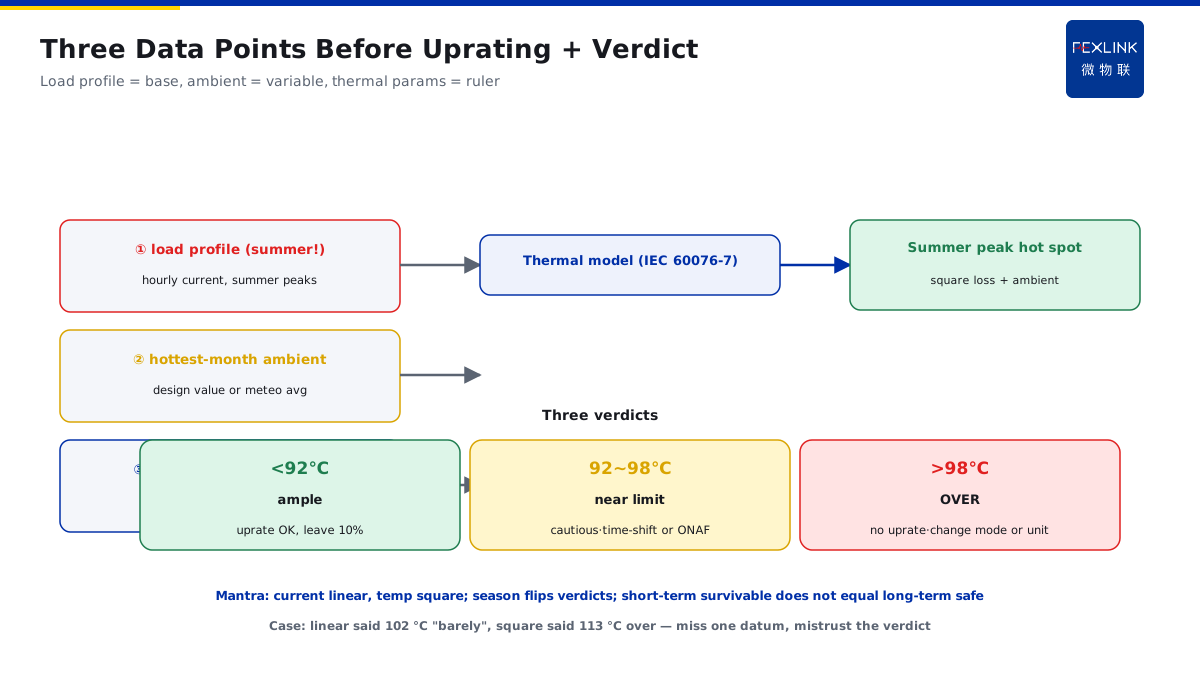
Direct Answer
A transformer runs at 80% load year-round — can it take one more device? The answer: do not judge by current as a fraction of rating; convert to winding hot-spot temperature — load factor and temperature rise are not linear, loss grows with the square of current, so 80% load gives far more temperature rise than "linear extrapolation" suggests; also leave headroom for summer ambient; winter low-load data does not represent summer full-load safety.
At a campus, a 1000 kVA transformer at 60% winter load had a winding hot spot around 82 °C — looking like "plenty of headroom." The owner wanted to add a 200 kW device, taking load to about 80%. Linear extrapolation gave a hot spot of roughly 82+20=102 °C — over but "barely." Using the square relation (loss ∝ I²), the hot-spot rise grows with the square of the load factor: from 60% to 80% load, the rise goes from 44 °C to 78 °C (44×(0.8/0.6)²), plus 35 °C ambient → hot spot ~113 °C — far above the 98 °C limit, unworkable in summer. Conclusion: uprating must be calculated by "square loss + summer ambient," not guessed by current ratio.
Because:
- Loss grows with the square of current: 80% load loss is (0.8/0.6)²≈1.78× the 60% loss; temperature rise follows the square;
- The hot spot decides safety: whether you can add a device is judged by whether the winding hot spot exceeds its limit (typically 98 °C);
- Ambient temperature must be included: 20 °C winter vs 40 °C summer ambient is a 20 °C hot-spot difference — winter "safety" does not represent summer;
- Short-term vs long-term overload: a few minutes at 120% can be tolerated (hot-spot lag), but long-term 80% must be judged at the steady-state hot spot.
Key insight: load factor is a number on the ammeter; hot-spot temperature is the number on the safety meter. Between them sits a "square loss + ambient" conversion — skip that conversion and uprating is gambling.
A commercial complex's 1250 kVA transformer ran at 78% summer load; the property wanted to add a central-air-conditioning unit. A thermal-circuit check: 35 °C summer ambient + 78% load → hot spot estimated 112 °C (limit 98 °C), with 2 peak summer months aging 6× faster and the hot spot already over. The plan changed: new load time-shifted (night ice-storage), pulling peak load back to 70%, hot spot down to 96 °C — no equipment spend, safety achieved by operating-mode adjustment alone.
1. Load Factor vs Temperature Rise: Not Linear
The relation between load factor (current / rated current) and temperature rise is widely misread as linear; it is actually quadratic:
Loss vs load factor:
- Winding copper loss = I²R ∝ load factor²;
- From 60% to 80% load, loss becomes (0.8/0.6)² ≈ 1.78×;
- Temperature rise (oil rise, hot-spot rise) is roughly proportional to loss — so it also grows with the square of load factor.
Number comparison (same transformer, same ambient):
- 60% load: hot-spot rise 44 °C, hot spot ~79 °C (35 °C ambient);
- 80% load: hot-spot rise ~78 °C, hot spot ~113 °C — not "20% more" temperature, "close to 1.8×" rise;
- 100% load: hot-spot rise near 110 °C, hot spot possibly above 145 °C (severely over).
Engineering intuition:
- 60%→80% looks like "only 20% more current," but the hot spot can rise 30 °C+;
- 80%→100% is only 25% more load, yet the rise grows another ~56% — every step above 80% is dangerous.
Key insight: current is a linear meter; temperature is a square meter. Applying linear intuition to a square law is the most common source of uprating mistakes.
2. What "Loss Grows with the Square of Current" Means
"Square" is not a mathematical detail — it changes every engineering judgment:
Meaning 1: the slope gets steeper in the high-temperature zone
- Near 100% load factor, every 1% more current adds about 2% more rise;
- The closer to full load, the "one inch, one cliff" — adding devices above 80% almost certainly exceeds the hot spot.
Meaning 2: load factor is not "how much is left" but "risk squared"
- At 60% load, "how much can I add" is not "40% current space" but "the rise has already used (0.6)²=36% of rated rise; the remaining 64% must cover (0.8)²-(0.6)²=28% of new load" — it looks like plenty is left, but the hot-spot space is already tight.
Meaning 3: seasonal load stacking is the most dangerous
- Summer AC load + new device = load factor jumping from 70% to 90%;
- Square relation + hot ambient = hot spot peaking — the root cause of the summer transformer failure spike.
Meaning 4: the exploitable space of short-term overload
- The hot spot has thermal inertia (time constant 5–10 min); a short overload does not reach the steady-state value immediately;
- But "short" is very short — several times the thermal time constant is already long-term overload.
Key insight: the square relation means "headroom" is not subtraction on current; it is division on temperature. Compute the temperature to know what is really left.
3. The Extra Headroom Deduction for Summer Heat
The variable most often dropped from uprating decisions: ambient temperature.
Ambient impact:
- Hot spot = ambient + hot-spot rise;
- 20 °C winter vs 40 °C summer ambient: same load, 20 °C hot-spot difference;
- A transformer "very safe" at 60% winter load (hot spot in the low 70s) can exceed its limit at 70% summer load — change the season and the safety conclusion reverses completely.
Deduction rules:
- Uprating checks must use the local hottest-summer-month average temperature (or the design ambient, typically 35–40 °C);
- Never use the annual average or winter data;
- Data centers and constant-temperature plants are exceptions (indoor AC), but still use the summer indoor temperature.
Number example:
- Winter 20 °C: 60% load hot spot ~64 °C → "34 °C headroom";
- Summer 40 °C: 60% load hot spot ~84 °C → "14 °C headroom";
- Summer 40 °C: 80% load hot spot ~113 °C → 15 °C over.
Key insight: "winter safe" expires automatically in summer. An uprating review that looks only at winter data guides a full year's operation with half a year's wrong conclusion.
4. Short-Term vs Long-Term Overload
"Overload" must be separated by duration; handling is completely different:
Short-term (minutes):
- The hot spot has thermal inertia (winding time constant 5–10 min); it does not reach steady state right after overload starts;
- 120% load for 30 minutes: the hot spot may reach only 60–70% of steady state — survivable;
- But repeated short-term overloads accumulate insulation damage (every overload "runs a tab").
Long-term (hours–days):
- Several times the thermal time constant, the hot spot approaches steady state;
- Long-term 80% in summer = long-term overload (design hot spot 98 °C, actual 110 °C+), accelerated aging, shortened insulation life;
- Long-term above 100% = directly over the limit, fault risk at any time.
How to judge:
- Watch duration: peaks under 30 minutes are evaluated as short-term overload (hot-spot lag);
- High load persisting over 2 hours is long-term overload (hot spot at steady state);
- Uprating changes the long-term operating mode — it must be calculated at the long-term steady state.
Engineering meaning: a new device running only minutes (e.g., emergency equipment) can stay out of the uprating check; one running hours daily (AC, production lines) must be included.
Key insight: "can we add a device" asks about long-term steady state, not instantaneous capability. The "survivable" of short-term overload is not the "safe" of continuous operation.
5. The Three Data Points to Verify Before Uprating
Before deciding, prepare three data sets:
1. Full-year (at least summer) load profile
- Hourly current data, focusing on the true load factor in summer peak hours;
- Without history, measure 1–2 weeks of typical summer load at minimum.
2. Local hottest-summer-month ambient temperature
- Use the design ambient or the local meteorological hottest-month average;
- Data centers use the summer indoor temperature.
3. Transformer thermal-circuit parameters
- Nameplate: rated capacity, short-circuit impedance, cooling mode (ONAN/ONAF), hot-spot limit;
- Compute with the thermal-circuit model (IEC 60076-7 simplified model), inputting the above for the hot-spot temperature.
Three possible conclusions:
- Summer peak hot spot < 92 °C → ample headroom; uprating possible (leave another 10% margin);
- 92–98 °C → near the limit; uprate cautiously, combining time-shifting, fans (ONAF), etc.;
- >98 °C → cannot uprate as-is; change the operating mode or the transformer first.
Key insight: missing any of the three data points makes the uprating conclusion unreliable. Load profile is the foundation, ambient is the variable, thermal parameters are the ruler — only all three make a real check.
6. Product Landing: Online Load-Factor and Temperature-Rise Calculation
FEXLINK's EST Multi-Channel Temperature Controller and ESX Edge Computing Gateway turn the "square loss + ambient" check into online capability:
- The EST controller samples transformer temperatures at multiple points (oil, winding, ambient), monitoring hot-spot trends in real time;
- The ESX gateway aggregates current data and computes the hot-spot temperature online using the square-loss relation and the thermal-circuit model;
- The platform's built-in summer-peak warning flags "hot spot will exceed" when load + ambient stack;
- Uprating review calls the computation directly: input the new device load, output a clear "can the hot spot take it" conclusion;
- Connected to the Digital Electrical Intelligent Supervision System, load factor, hot spot, and ambient share one dashboard.
Design principle in one sentence: turn "uprating by gut feel" into "the hot spot decides." Square loss is not a paper formula; it is the platform's daily online calculation.
7. Common On-Site Mistakes
- Linear extrapolation of load factor: 60%→80% calculated as "hot spot up 20%." Consequence: underestimating 30 °C+, direct summer exceedance. Correct: scale the rise by the square of the load-factor ratio.
- Looking only at winter data: winter 60% "very safe," summer 80% already over. Consequence: summer uprating incidents. Correct: use the hottest-month data.
- Treating short-term overload as long-term safety: 30 minutes at 120% survives, so 100% continuous "must be fine." Consequence: accelerated long-term aging. Correct: continuous operation uses the steady-state hot spot.
- Ignoring the hot spot, watching only oil: 72 °C oil is reassuring while the hot spot may be 110 °C. Consequence: exceedance after uprating unnoticed. Correct: compute the hot spot; oil is only a reference.
- No load measurement before uprating: adding devices without knowing the summer load factor. Consequence: discovering the exceedance only after adding. Correct: measure 1–2 weeks of typical summer load first.
Scope and Limitations
This article discusses load factor, temperature rise, and uprating headroom for transformers, applicable to oil-immersed distribution transformers (a few dry-type scenarios; dry-type hot-spot behavior differs and needs adjustment). Load factor, hot-spot limit, and cooling mode follow the nameplate; the calculation uses the IEC 60076-7 simplified thermal-circuit model. Short-term overload capability is constrained by protection settings and must be coordinated with relay protection. All cases are anonymized (a certain campus / commercial complex) and do not refer to any specific customer.