 微物联研究院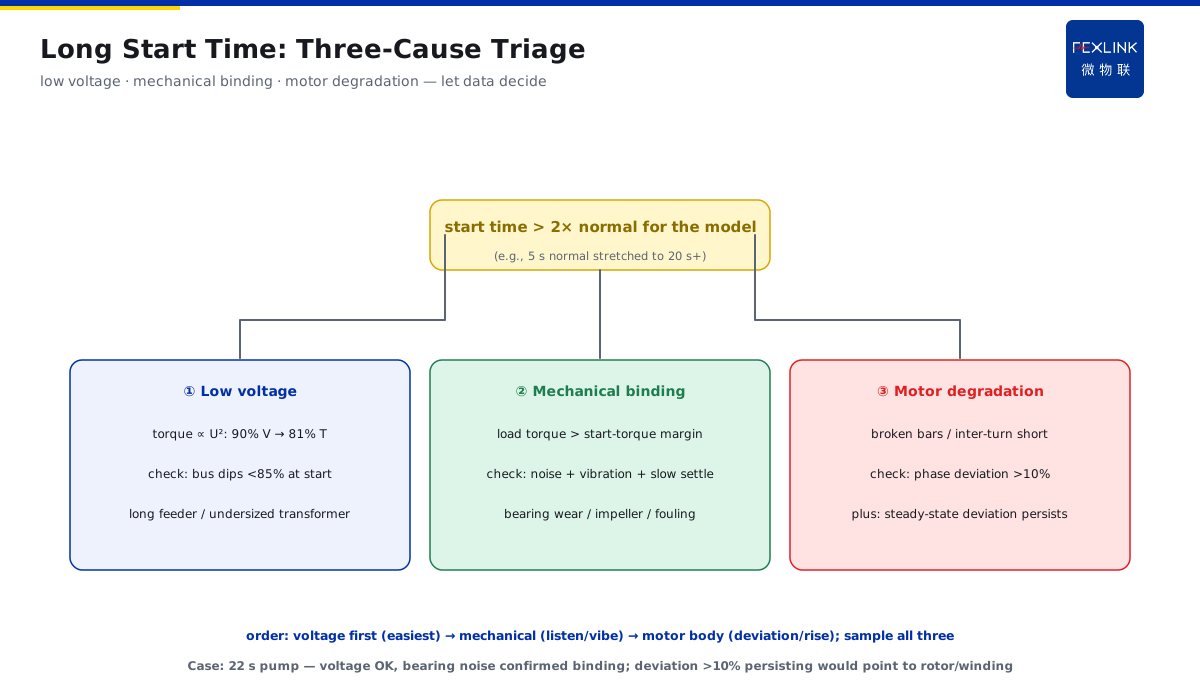
Direct Answer
A motor's starting current surges to 5–7× rated for a few seconds — normal or faulty? The answer: for a direct-on-line start, 5–7× rated starting current lasting a few seconds is normal. The real abnormal signals are — starting current multiplier clearly too high, start time too long without settling, or obvious three-phase unbalance during start. Judge from the starting-current curve, not from "the current is huge" alone.
At a campus, a 75 kW pump motor surged to 6.8× rated at every start and took 22 s to settle near rated — with an 18% three-phase deviation. The operator's first reaction was "starting current too high, the motor will burn." Reading the curve: the 6.8× peak was within the normal 5–7× band; the problem was the settling time — a healthy 75 kW motor settles in 3–8 s; 22 s was far too long, and the 18% deviation exceeded 10%. On-site investigation: bearing wear caused mechanical binding; the motor could not accelerate the load, dragging out the start. After bearing replacement, start time returned to 7 s with 3% deviation.
Because:
- The large starting current is physics: at the instant of starting, slip s=1 and rotor equivalent impedance is minimal, so current surges to 5–7× rated — normal;
- Abnormality is judged by settling time: a normal start settles within seconds; stall or mechanical binding stays high — "not settling" is the danger signal;
- Abnormality also shows in phase balance: a normal start is roughly symmetric (<10% deviation); broken rotor bars or winding faults amplify deviation;
- Start frequency affects life: frequent starts accumulate rotor-bar thermal stress and winding temperature rise — every start consumes life.
Key insight: 5–7× starting current is not a fault; it is the "ID card" of a normal start. Excessive start time, phase unbalance, and high frequency are what to investigate. Treating "big current" as a fault turns normal starts into false trip reasons; treating "normal peak" as safety misses stalls.
At a factory, a 30 kW fan was started 30+ times a day for the process. Six months later the insulation failed; teardown showed discolored overheated winding ends and multiple broken rotor bars. Review: start frequency far exceeded the motor's continuous-start allowance (roughly 3–4/hour); every start was a big-current + heat accumulation event, burning out six months of life — not "poor motor quality," but start-frequency overrun.
1. What a Normal Starting-Current Curve Looks Like
To judge an abnormal start, first know the shape of a normal one:
Direct-on-line starting curve (three-phase induction motor):
- Peak segment: at switch-on, current surges to 5–7× rated (locked-rotor multiplier) for a fraction of a second;
- Settling segment: the motor accelerates, slip falls, current settles within 3–8 s to near rated (small motors 1–3 s, large motors 5–10 s);
- Steady segment: at rated speed, current returns to load current (possibly 50–100% rated).
Three features of a normal curve:
- Peak multiplier 5–7× (direct-on-line; exclude wound-rotor / soft-start / VFD);
- Short settling time (seconds for small motors, within 10 s for large);
- Roughly symmetric phases (<10% deviation).
Mantra: peak → multiplier (5–7 normal); settling → time (seconds normal); symmetry → deviation (<10% normal) — all three normal, the start is normal.
Key insight: "big" is not the problem; "long" and "skewed" are. The curve shape carries far more information than the peak number.
2. Where the 5–7× Comes From Physically
Why does starting current reach 5–7× rated? It follows from the motor's equivalent circuit:
The instant of starting:
- Rotor not yet turning, slip s=1 (maximum relative speed to the rotating field);
- Rotor equivalent impedance minimal (rotor current frequency = supply frequency, small reactance);
- Starting current I_st = U / (Z₁ + Z₂′), roughly 5–7× rated (locked-rotor multiplier, on the nameplate or catalog).
Key numbers:
- Direct-on-line locked-rotor multiplier: typically 5–7× (nameplate I_LRC/I_n);
- Starting torque: typically 1.5–2× rated (torque ∝ U² — low voltage collapses torque fast);
- Large motors (>100 kW) start longer with a slightly lower multiplier (4–6×) but far larger absolute current.
Why "multiplier" matters more than "absolute current":
- For the same motor, the multiplier is roughly constant (factory characteristic);
- A clearly higher multiplier (7×+ sustained) hints at rotor or supply anomalies;
- A normal multiplier with large absolute current is just a bigger motor behaving normally — judging by "huge current" unfairly penalizes large motors.
Key insight: 5–7× is a nameplate characteristic, not a fault value. Judge against the motor's own characteristic (multiplier, settling time), not against expectation.
3. Why Start Time Becomes Too Long
Slow settling (long start time) has three main causes:
1. Low voltage:
- Starting torque ∝ U²: at 90% voltage, torque drops to 81%, acceleration slows;
- Start time stretches, locked-rotor current lasts longer, winding heat rises sharply;
- Typical: long feeders with voltage drop, undersized transformer, multiple motors starting together.
2. Mechanical binding:
- Bearing wear, pump impeller blockage, fan unbalance — load torque exceeds the starting-torque margin;
- The motor "cannot carry it," accelerates slowly or stalls in the low-speed zone, current stays high;
- Typical: start time stretches from 5 s to 20 s+, with noise and vibration.
3. Motor body degradation:
- Broken rotor bars / cracked end rings — lower starting torque, slower acceleration;
- Inter-turn winding short — phase unbalance, slower start with local overheating;
- Bearing jamming (electrical + mechanical combined).
Engineering judgment:
- Start time above 2× the normal value for the same motor model → investigate;
- Low voltage: judge by the voltage dip at start (bus dropping below 85% rated at switch-on is a warning);
- Mechanical binding: combine post-start noise + vibration + slow settling.
Key insight: start time is the most-overlooked abnormal-start signal. It reveals "can the motor actually carry the load" better than the peak multiplier.
4. Distinguishing Start Data from Stall
The worst misjudgment is confusing an abnormal start with a stall (or vice versa). Three differences:
1. Settling time:
- Normal start: current settles within seconds, even a long start is accelerating;
- Stall: current stays at 5–7× without settling; rotor locked;
- Criterion: start time over 2–3× normal with no settling trend = near-stall.
2. Phase balance:
- Normal start: <10% deviation;
- Broken rotor bars: unbalance grows during start (higher current in the broken phase), shrinking at steady state;
- Winding fault: one phase clearly abnormal, deviation persists.
3. Curve shape:
- Normal start: smooth settle after the peak;
- Stall/binding: slow settle or a "plateau" (current parked above 4×);
- Low voltage: slightly lower peak (not enough torque) but slower settle and more heating.
Protection coordination: the thermal relay's trip time must clear the normal start time (set by start duration); stall protection (e.g., 7× for 10 s) coordinates with the starting curve — no false trips on normal starts, fast trip on real stalls.
Key insight: stall is not "big current"; it is "big current that does not settle." With a curve, read the curve; without one, use time + balance.
5. Start Frequency and Life
"Starting a few times is fine" is a misconception — every start consumes motor life:
Thermal effect of starting:
- Each start drives winding and rotor bars through a big-current thermal shock (I²t accumulation);
- At 5–7×, heat scales with current squared — one start equals minutes to tens of minutes of rated operation;
- Bars endure electric + thermal stress at start; repeated starting causes fatigue fracture.
Frequency limits (engineering experience):
- Typical motors: no more than 3–6 continuous starts per hour (fewer for large motors, load-dependent);
- Leave a cooling interval between starts (typically 10–30 min, rise-dependent);
- Cold state allows 2–3 consecutive starts; hot state suggests 1 start then a cooling interval;
- Frequent-start duty (hoists, presses) needs "frequent-start" motors (thicker bars, better cooling).
How to read the data:
- Log daily start count and intervals;
- Count over the limit plus high temperature rise = heat accumulating, life burning faster;
- Persistently abnormal starting curve + high frequency = double damage, address first.
Key insight: start frequency is an invisible life tax. One start looks harmless; 30 starts a day, 10,000 a year, bars and winding age fast — continuous start-counting puts the life ledger in clear view.
6. Product Landing: Continuous Monitoring of the Starting Curve
FEXLINK's ESB Three-Phase Unbalance Monitor turns "starting-curve judgment" into automatic recognition:
- Samples three-phase current continuously, auto-detects every start event (surge + settling features);
- Auto-logs three metrics per start: peak multiplier, settling time, three-phase deviation;
- Threshold alerts: start time too long (mechanical binding / low voltage), phase deviation >10% (broken bars / winding fault), start frequency overrun (heat-accumulation risk);
- Starting curves are replayable: each start's waveform stored, trend comparison shows "the start is getting worse" at a glance;
- Connected to the Digital Electrical Intelligent Supervision System, start events, protection actions, and temperature share one dashboard for clear motor-health status.
Design principle in one sentence: turn "startle at the starting surge" into "automatic starting-curve reading." 5–7× is normal; a bad curve is the signal — the monitor tells them apart.
7. Common On-Site Mistakes
- Treating 5–7× as a fault: reporting "motor abnormal" at a normal peak, even tampering with protection settings. Consequence: false trips on normal starts, protection neutered. Correct: check multiplier + settling time + phase deviation first.
- Watching only the peak: reassured by 6×, missing the 22 s without settling. Consequence: stall/binding missed. Correct: settling time is the key stall indicator.
- Ignoring phase unbalance: 18% deviation at start brushed off. Consequence: broken bars discovered only after full fracture. Correct: >10% deviation at start → inspect rotor and winding.
- Not chasing long start time: 20 s+ every start "at least it starts." Consequence: low voltage / binding keep worsening. Correct: 2× the normal value demands investigation.
- Ignoring start frequency: 30 starts a day "always done this way." Consequence: broken bars, insulation failure, premature scrapping. Correct: count starts; over the limit, change the process or choose a frequent-start motor.
Scope and Limitations
This article discusses starting-current curve reading for three-phase induction motors in direct-on-line, power-frequency starts (wound-rotor, soft-start, and VFD characteristics differ; thresholds need adjustment). Locked-rotor multiplier and start time follow the nameplate and manufacturer data. Protection settings (thermal relay, stall protection) must be coordinated with the starting curve; the values here are engineering references. All cases are anonymized (a certain campus / factory) and do not refer to any specific customer.