 微物联研究院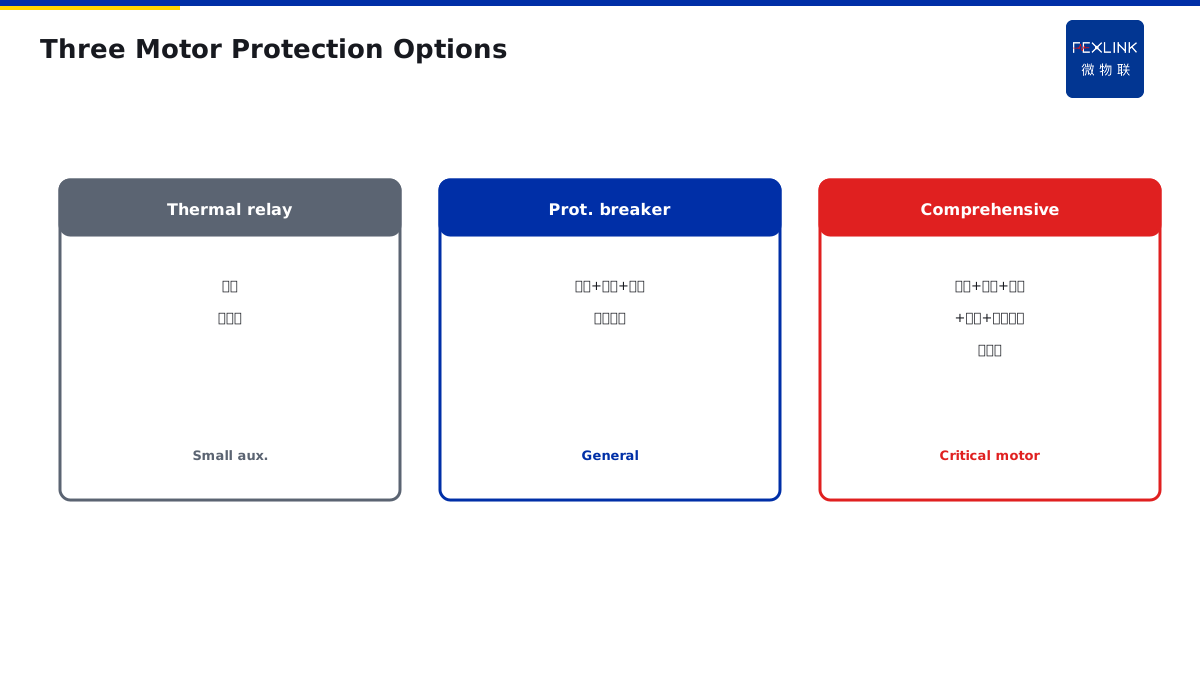
Direct Answer
Motor circuit protection has three options: thermal overload relay, motor-protection breaker, comprehensive protector. Select by motor criticality:
- Auxiliary / ordinary: thermal relay or protection breaker;
- Critical / hard-to-access: comprehensive protector plus online current monitoring for trend warning.
1. Three Options
| Option | Faults covered | Comm |
|---|---|---|
| Thermal relay | Overload (inverse-time) | None |
| Motor-protection breaker | Overload + short-circuit + isolation | Optional |
| Comprehensive protector | Overload + stall + phase-loss + earth + start timeout | Yes |
2. Thermal Relay: Simplest
The thermal relay (FR) uses a bimetallic strip heated to trigger—overload inverse-time only. Cheap, no comm, manual reset.
For unimportant small auxiliary motors.
3. Motor-Protection Breaker
Combines overload + short-circuit + isolation, e.g. FECB2SP smart breaker. Adds short-circuit and isolation vs. a thermal relay; smaller footprint.
For general motor circuits.
4. Comprehensive Protector
Covers all faults: overload, stall, phase-loss, earth, start timeout. Communicates, uploads running data.
The ESB three-phase unbalance monitor fills a key gap—phase loss / unbalance is one of the most common motor failures, and online monitoring detects it early.
For critical, hard-to-access motors (fire pump, main fan, circulating pump).
5. Two-Step Selection
- Motor criticality?
- Ordinary → thermal / protection breaker; - Critical → comprehensive + online monitoring.
- Hard to access?
- Yes → add trend warning.
6. Common Mistakes
- Comprehensive protector not connected: wastes the upgrade—it's just a fancy relay;
- Thermal relay mis-set too high: motor burns before it trips;
- No phase-loss monitoring: ~70% of motor failures relate to phase loss / unbalance.
7. Why Thermal Relays Only Do Overload
You may ask: why can't thermal relays do short-circuit protection?
Because thermal relay principle is "heat bend" — bimetal strip heated by current, bends to trigger.
This process is slow — current exceeds rating, takes seconds or tens of seconds to act.
Short-circuit current is tens of times rated — if you rely on thermal relay for short circuit, by the time it acts, the motor is already burned.
So short-circuit protection relies on breakers (instantaneous), overload protection relies on thermal relays (inverse time) — both work together.
This is why motor circuits are "breaker + thermal relay" combo — breaker handles short circuit (fast), thermal relay handles overload (slow).
8. Why Comprehensive Protectors Need Communication
You may ask: isn't a comprehensive protector just an advanced relay? What's the point of communication?
Because a protector without communication only "trips" when it fails — you don't know why.
Motor trips:
- Overload?
- Phase loss?
- Locked rotor?
- Ground fault?
Without communication: you arrive on site, see motor stopped — open the cover, search for hours, cannot find cause.
With communication: look at phone — "Phase loss, B-phase current 0A, duration 3 seconds".
This is the value of communication — not just protection, but diagnosis.
Also, communication enables trend warning:
- Motor current slowly rises from 30A to 35A — trend warning.
- You schedule maintenance — find bearing wear.
- Replace bearing — cost 5K.
Without trend warning: bearing keeps wearing — finally seizes — motor burns — replace motor 50K.
Trend warning 5K vs motor burned 50K — the math is clear.
9. Why Phase Loss Is Motor's #1 Killer
You may ask: what is the most common motor fault?
Answer: phase loss.
Statistics: 70% of motor burnout incidents relate to phase loss or three-phase imbalance.
Why is phase loss so dangerous?
Three-phase motor loses one phase, remaining two phases suddenly increase — from rated 30A to 50A.
Also, during phase loss, motor keeps running — you don't know it's phase-lost — keeps running, finally burns windings.
This is why phase loss protection matters so much — it is not "occasional", it is "most common".
ESB three-phase imbalance monitor is specifically for this — real-time three-phase current monitoring, alarms on phase loss or imbalance exceeding limit.
10. How to Set Motor Protection Settings
How to set motor protection settings?
Thermal relay / comprehensive protector long delay: set to 1.05–1.1× motor rated current.
Example: motor rated 30A — long delay set 32A.
Why not exactly 30A? Because motor normal operation has fluctuation — set exactly 30A, summer high temperature will nuisance trip. Leave 5–10% margin.
Instantaneous short-circuit protection: set to 1.2× motor starting current.
Example: motor starting current 180A (6×) — instantaneous set 220A.
Why not exactly 180A? Because starting moment has inrush — set exactly 180A, trips on start. Leave 20% margin.
Phase loss protection: three-phase current imbalance > 15% triggers alarm.
11. A Real-Life Lesson
One factory water pump used thermal relay protection — only overload.
During operation, B-phase contact failure — phase loss. Thermal relay did not trip (because remaining two phases current had not reached overload value).
Motor kept running for 2 hours — finally windings burned.
Repair: replace windings 8K, one-day production loss 20K.
Lesson: overload protection alone is not enough — phase loss is motor's #1 killer.
Correct approach: add ESB three-phase imbalance monitor to motor circuit — phase loss alarms immediately, handle early.
12. How to Choose Among Three Options
Summary:
| Motor Type | Recommended Solution | Reason |
|---|---|---|
| Small auxiliary (< 5.5kW) | Thermal relay | Cheap, low failure cost |
| General motor (5.5–55kW) | Motor-protection breaker | Overload + short circuit + isolation in one |
| Critical motor (fire pump/main fan) | Comprehensive protector + online monitoring | Full fault coverage + trend warning |
Selection principle: choose by motor criticality, not by price.
But one baseline: phase loss protection is mandatory — regardless of which solution you use, add phase loss monitoring. Because phase loss is motor's #1 killer, overload protection alone is not enough.
13. ROI of Motor Protection
Do the math:
- Standard thermal relay: 200.
- Comprehensive protector + online monitoring: 5K.
Difference: 4.8K.
But one motor burnout incident: replace motor 50K + production loss 100K = 150K.
Comprehensive protector 5K vs one incident 150K — the math is clear.
Critical motors must have comprehensive protection + online monitoring — not a cost, but insurance.
14. One Sentence to Remember
Motor protection is not "buy the cheapest relay" — match protection level to motor criticality, and always include phase loss protection.
15. Common Questions
Q: Can I use one thermal relay for multiple motors? A: No. Each motor needs its own protection. Sharing a relay means one fault trips all motors.
Q: What if my motor is already running and I want to add monitoring? A: You can add a clamp-on current transformer without shutting down. Just clamp around each phase and connect to the monitor.
16. Quick Checklist
When selecting motor protection:
- Determine motor criticality — small auxiliary, general, or critical.
- Choose solution accordingly — thermal relay, breaker, or comprehensive protector.
- Always include phase loss protection.
- Set long delay to 1.05–1.1× rated current.
- Set instantaneous to 1.2× starting current.
This checklist covers the main points. Do not skip any.
17. Why This Matters
Motor protection is one of the most important investments in any electrical system. Motors are everywhere — pumps, fans, compressors, conveyors. When a motor fails, production stops. When a critical motor fails, lives are at risk.
Every year, motors burn out because of phase loss that was never detected. Every year, production stops for hours because of a nuisance trip that could have been avoided. Every year, mechanics spend hours troubleshooting because the protector has no communication and no diagnosis.
These are not rare events. These are everyday events. And they are preventable.
The problem is that most organizations treat motor protection as a simple "buy the cheapest relay" exercise. They do not think about phase loss. They do not think about trend warning. They do not think about communication.
That is why you need to understand motor protection selection. That is why you need to match protection to criticality. That is why you need to invest in the right solution.
Motor protection is insurance. A 5K comprehensive protector can save you 150K in one incident. That is a 30× return on investment.
This article gave you the fundamentals. Apply them to your next motor project. Teach them to your team. Share them with your colleagues.
Stay safe. Stay professional. Stay curious.
18. Final Thoughts
Motor protection is one of those topics that sounds simple but has many layers. Thermal relay, breaker, comprehensive protector — each has its place. Choose by criticality, not by price.
The good news is that once you have a selection table, it becomes repeatable. Every time you add a new motor, score its criticality and choose accordingly.
Remember: your motors are the workhorses of your facility. Protect them well, and they will serve you for decades. Neglect them, and they will fail when you need them most.
Scope and Limitations
Applies to motor circuit protection selection. FECB2SP/ESB are FEXLINK references; parameters follow the latest catalogue.