 微物联研究院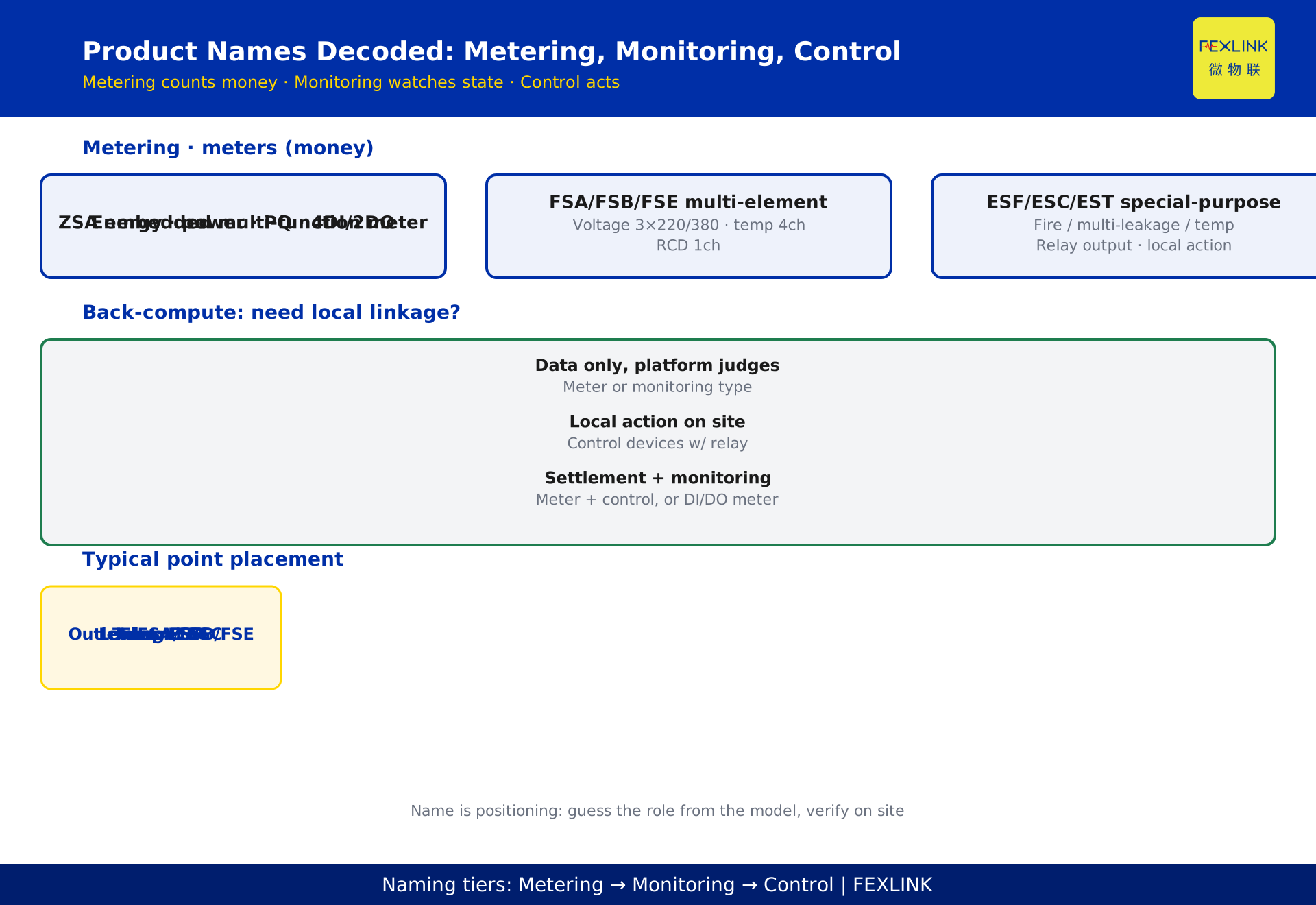
# Product Names Decoded: Metering, Monitoring, Control — Three Tiers
Direct Answer
FEXLINK's meter and control-device naming follows a three-tier structure: "metering — monitoring — control." ZSA/ESA are meters (energy metering and settlement); FSA/FSB/FSE are multi-element control devices (measure + monitor + control); ESF/ESC/EST are special-purpose control devices (leakage / multi-circuit leakage / temperature, with local linkage). Asking "do I need local linkage?" back-computes which tier to choose.
For project owners, electrical engineers, and procurement staff, this article provides a name-to-tier comparison table: what each tier manages, how typical models map in, and how one question — "do I need local control?" — quickly back-computes the selection.
Three Tiers: Metering, Monitoring, Control
By functional depth, from low to high:
- Metering (meters): manages "how much electricity, how the bill is calculated" — energy, power quality, settlement and statistics; typical ZSA embedded multi-function smart meters and ESA full-element smart meters;
- Monitoring (a subset of control devices): manages "is the electrical state normal" — voltage/current/temperature/leakage monitoring;
- Control (monitoring + action): manages "what to do when abnormal" — beyond monitoring, executes linkage locally (relay output, local action).
In one sentence: metering counts money, monitoring watches state, control takes action.
Meters vs. Control Devices
| Aspect | Meters (ZSA/ESA) | Control devices (FSA/ESF/ESC/EST) |
|---|---|---|
| Core task | Energy metering and settlement | Measure + monitor + control |
| Typical features | Energy, power, power quality; some models 4DI/2DO | Voltage/current/temp/leakage/DI/DO/relay output |
| Output form | Metering data reporting | Alarms + local linkage + data reporting |
| Selection test | Only need billing/efficiency | Also need state and action |
Ask first: does the project need "to count accurately" or "to watch state and take action"?
Two Sub-tiers Inside Control Devices
Control devices are not one kind but two:
- Multi-element control devices FSA/FSB/FSE: one device manages many quantities — voltage (3×220/380), temperature (4 channels), residual current (1 channel), DI (2), DO (2), meter monitoring, dual RS485, OLED display; for high-information-density circuits;
- Special-purpose control devices ESF/ESC/EST: one device watches one problem — ESF electrical-fire control device, ESC multi-circuit leakage control device, EST temperature control device; for sites with clear problems deployed by category.
The rule of thumb: choose multi-element when the point needs "everything," choose special-purpose when the problem is "specific."
Name Is Positioning: Guess the Role from the Model
- Z/ESA prefix → meter; think metering and settlement first;
- FSA/FSB/FSE → multi-element control; think comprehensive monitoring plus linkage;
- ESF/ESC/EST → special-purpose control; think the corresponding special topic (fire/leakage/temperature);
- With relay output → has local linkage capability.
Name-is-positioning saves manual lookup: guess the role from the model, then verify against site needs.
Back-Compute Selection with "Do I Need Local Linkage?"
The most practical on-site question:
- Data only, unified assessment on the platform → a meter or monitoring type suffices; linkage is dispatched by the platform;
- Local action required on site (e.g., local tripping on leakage, local alarm on over-temperature) → must choose control devices with relay output (ESF/ESC/EST, FSA/FSB/FSE all qualify);
- Both settlement and monitoring → combine meter + control device, or choose a meter model with DI/DO.
This single question filters out most selection mistakes.
Typical Point Configuration
- Incoming metering point: ESA full-element meter (metering + power quality);
- Outgoing monitoring point: FSA/FSB/FSE multi-element control device (voltage/temperature/leakage combined);
- Leakage-specific point: ESC multi-circuit leakage control device (local watch over multiple circuits);
- Temperature-specific point: EST temperature control device (joints/busbars);
- Fire-specific point: ESF electrical-fire control device (hazard linkage).
Point-matching principle: meters for settlement points, control devices for monitoring points, special-purpose devices for special points.
Seven: Three Common Selection Mistakes
- Mistake one: a meter can serve as a control device. Meters excel at metering and are weak at linkage. If you need on-site action — leakage tripping, over-temperature alarm — you must choose a control device with relay output. Saving one model's cost may mean adding an entire execution loop;
- Mistake two: pick multi-element devices everywhere. Choosing "everything" for every point doubles cost and creates data redundancy. For low-density circuits with clear problems, a dedicated control device is cheaper and clearer;
- Mistake three: check functions but not interfaces. Selection must also verify communication (RS485/Ethernet), DI/DO counts and power supply. Functions may fit while the interfaces do not — and the device still cannot be wired in on site.
Three mistakes, three reminders: need action → choose control; clear problem → choose dedicated; check interfaces first.
Quick Model-Prefix Reference
| Prefix | Category | One-line job |
|---|---|---|
| ZSA | Embedded multi-function meter | Billing/metering; some models 4DI/2DO |
| ESA | Full-element smart meter | Metering + power quality |
| FSA/FSB/FSE | Multi-element control device | Combined monitoring + linkage |
| ESF | Electrical-fire control device | Fire-hazard linkage |
| ESC | Multi-channel leakage control device | Multi-circuit leakage supervision |
| EST | Temperature controller | Joint/busbar temperature |
| FECB2SP/SLP | Smart breaker | Protection + monitoring + linkage |
Classify the prefix first, then verify against the site requirement — selection speed roughly doubles.
Nine: Practical Reminders for Procurement
- Verify the revision before ordering: model functions follow the latest selection manual and order revision; the knowledge base is the baseline, and formal procurement is final only on the vendor's confirmation sheet;
- Keep commissioning margin: size DI/DO and relay-output counts as "actual points + 10–20% spare" so later point additions do not run out of ports;
- Acceptance must test linkage: do not only measure metering accuracy — actually trigger one linkage action (leakage trip / over-temperature alarm) and confirm both channels, data upload and on-site action, are live.
Common Questions — What Else to Check Beyond the Name
- Does the name represent the full function set? No. The naming tier is an entry point to responsibility; actual functions — DI/DO counts, communication protocol, power supply, mounting dimensions — follow the model specification. Verify item by item during selection;
- Are all models with the same prefix identical? The same prefix may have multiple revisions, and functions evolve with versions. Order against the latest selection manual, never from memory of an old project's model;
- What must be confirmed for platform integration? The access method (RS485 bus / gateway), the data point table, and the protocol version. The platform side needs the device point table in advance for configuration, so mismatches are found during design, not on site.
Three questions, three actions: verify specifications item by item, verify the latest revision, and confirm the point table early.
Eleven: Acceptance Checklist for Project Managers
- Metering accuracy spot check: compare meters against a reference meter; check voltage/current/energy error at 3–5 points;
- Data continuity: no gaps in 7 consecutive days of data; alarm-trigger and recovery records complete;
- Linkage test for real: simulate one leakage/over-temperature event; confirm the on-site action and the platform alarm arrive together and that the action can be reset;
- Document handover: point table, device point table, communication parameters, and acceptance records archived together as the baseline for future expansion. An archived baseline like this is what makes later capacity additions a configuration task instead of a discovery project.
Daily-Use Reminders for Operations Staff
- Do not just dismiss alarms; investigate them. Every alarm should have a cause–action–recovery record. Deleting an alarm is not handling it;
- Trends matter more than single points. Review weekly trends of voltage, temperature, and leakage regularly. Abnormalities usually appear first at a trend inflection, not at the moment of exceeding a limit;
- Review every linkage action. After each local linkage triggers, review once whether the judgment criteria were accurate, and use the actual outcome to calibrate thresholds and logic back. Over time this review loop is what converts a static alarm system into a learning monitoring operation.
Using the Naming Tier in Proposals
- Present by responsibility tier in proposals: explain the "metering — monitoring — control" three levels first, then the specific models. Customers understand immediately and are not drowned by model tables;
- Group quotations by tier: meters in one group, control devices in another, dedicated devices in a third. Customers can see what kind of capability each purchase buys, reducing the trust loss of "model-number surprises";
- Build the asset ledger by tier: classify equipment records as metering/monitoring/control/dedicated. Calibration and inspection cycles differ — metering needs periodic verification, monitoring needs regular self-checks, linkage needs live tests — so tiered management is more precise. A tiered ledger also makes replacement planning easier, because each tier has a different obsolescence driver: accuracy drift for meters, sensor degradation for monitoring, relay wear for control.
The tier also gives the maintenance schedule a natural owner: metering verification belongs to the finance or energy team, monitoring self-checks to operations, and linkage tests to safety — so nobody owns the whole asset, and nobody is left unaccountable for any slice of it. This mapping also supports audit readiness and annual safety reviews.
Scope and Limitations
Reading page for KD-0020. Product positioning and model functions (ZSA/ESA meters, FSA/FSB/FSE multi-element control devices, ESF/ESC/EST special-purpose control devices, including relay output and local linkage) come from the FEXLINK product knowledge base as product-documentation conventions. The "metering counts money, monitoring watches state, control takes action" and "back-compute with local linkage" are this article's selection methods for reference; specific selection should follow the latest product documentation and pre-sales confirmation. This page is not a specific project proposal.