 微物联研究院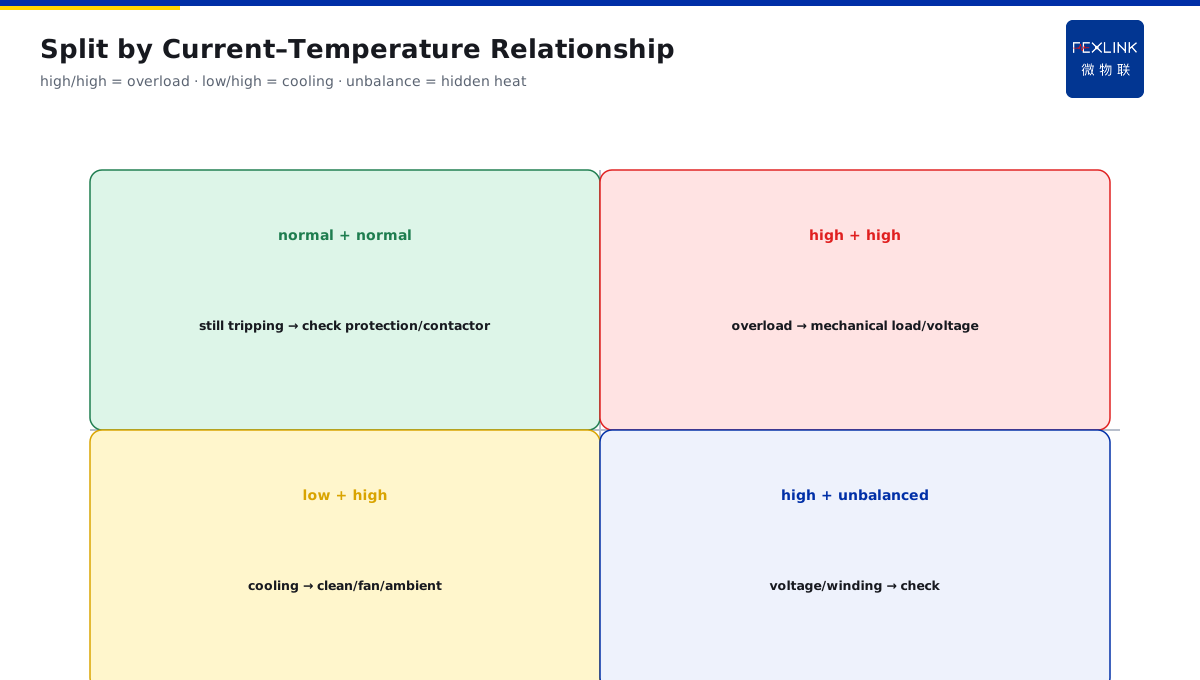
Direct Answer
A motor trips on overheat frequently while its current is far below rating — is it load, cooling, or insulation? The answer: split by the current–temperature relationship — current low but temperature high: check cooling first (duct dust, ambient temperature, fan); current high with phase unbalance: check voltage and mechanical load; current normal but insulation resistance dropping: check moisture and aging. "Temperature rising while current stays flat" points to cooling or contact, not overload.
At a plant, a 45 kW motor tripped on overheat repeatedly at only 70% of rated current — process blamed electrical, electrical blamed load. Splitting by the current–temperature relationship: 70% current is not overload, but temperature was near trip level — cooling first. The fan was heavily dust-clogged, the duct half-blocked, and ambient temperature was 40 °C (summer workshop). After cleaning the duct and replacing the fan, temperature dropped 15 °C at the same load. Judging only by "current is not high" would have missed the real cause. For overheat trips, look at the current–temperature relationship first — current low but temperature high makes cooling the top suspect.
Because:
- Overload shows in current; cooling shows in temperature: high current + high temperature is overload; low current + high temperature means heat cannot escape (cooling) or abnormal heat generation (contact/insulation);
- Poor cooling is the first suspect for "low current, high temperature": duct dust, fan failure, and high ambient temperature all raise temperature while current stays flat;
- Phase unbalance makes a motor "run hot even at low current": negative-sequence current adds extra loss, so the motor overheats at modest current — measure all three phases;
- Moisture/aging insulation is a hidden cause when current and temperature look normal: falling insulation resistance creates leakage-current heating that worsens gradually.
Key insight: motor overheat diagnosis splits by relationship, not by current alone. With the current–temperature relationship right, you can tell load, cooling, and insulation apart — measure three-phase current and temperature first, then compare.
A pump motor had the same "overheat below full load": current normal and balanced, temperature slightly high. Cooling checks found nothing; insulation resistance was clearly down (moisture). After drying, temperature returned to normal. Normal current + falling insulation resistance = moisture/aging — this overheat is only found by measuring insulation.
1. Splitting by the Current–Temperature Relationship
Diagnostic step one: lay out current vs temperature and split directions:
Four combinations set the direction:
- High current + high temperature → overload/heavy load (check mechanical load, voltage);
- Low current + high temperature → poor cooling or abnormal heat source (check cooling, contact, insulation);
- High current + phase unbalance → voltage or winding issue (check voltage, inter-turn);
- Normal current + normal temperature → if still tripping, check protection settings and contactor.
Judgment points:
- Record rated current, actual current, and winding temperature;
- Compare with this motor's historical normal values (what temperature should be at the same load);
- Relationship change (same current now runs hotter) → cooling degraded or internal abnormality.
Directions after splitting:
- Overload → reduce load, check mechanical load;
- Cooling → check duct/fan/ambient temperature;
- Unbalance → check voltage, winding;
- Insulation → measure insulation resistance.
Key insight: the current–temperature relationship is the troubleshooting map. Four combinations map to four cause families — split first, then go deep; direction will not be wrong.
2. Cooling-Check Items
"Low current but high temperature" — cooling is the top suspect; list all check items:
Duct and dust:
- Fan guard/duct dust blockage (most common) — compare temperature before/after cleaning;
- Dust on cooling fins/end caps reduces heat-dissipation area;
- Check frequency: monthly in dusty environments.
Fan itself:
- Broken/deformed fan blades (less airflow);
- Fan motor/bearing fault (lower speed);
- Wrong fan rotation (no airflow if installed backward).
Ambient temperature:
- High workshop ambient (35–40 °C in summer) directly raises motor temperature;
- Poor ventilation (heat sources near the motor, enclosed space);
- Countermeasure: improve ventilation, lower ambient temperature.
Mounting and cooling surface:
- Motor tight against a wall/box, cooling surface blocked;
- Oversized guard restricting airflow;
- Countermeasure: ensure cooling space.
Judgment methods:
- Temperature drops after cleaning/fan replacement at the same load = cooling issue confirmed;
- Temperature tracks ambient temperature = environmental issue.
Key insight: cooling checks go "clean → fan → ambient → cooling surface" in four steps. Most low-current hot motors have duct dust — compare temperature before and after cleaning and the answer appears.
3. Finding Phase Unbalance
A motor running "hot at low current" — do not forget to measure three-phase current:
Why unbalance heats:
- Negative-sequence current adds extra loss (extra rotor heating);
- With unbalanced three-phase current, one phase may exceed rating, heating part of the winding;
- Even with a modest average current, the motor is already hot.
Unbalance sources:
- Unbalanced three-phase voltage (supply-side issue, e.g., large single-phase loads);
- Inter-turn short circuit (one phase draws more current);
- Poor contact (one phase's connection resistance high, that phase heats).
How to find it:
- Clamp meter on three phases while running;
- Unbalance = (max − min)/max; investigate above 10%;
- Use the ESB Three-Phase Unbalance Monitor for online three-phase current and unbalance.
Unbalance disposition:
- Supply side: balance three-phase loads, check voltage;
- Winding side: measure winding DC resistance/insulation, check inter-turn;
- Contact side: check terminals and contactor contacts.
Key insight: phase unbalance is a hidden heat source. The average current may be low yet the motor overheats — measure three phases; act when unbalance exceeds 10%.
4. Insulation-Moisture Evidence
Current and cooling checked, still no cause? Measure insulation resistance:
Moisture/aging insulation characteristics:
- Falling insulation resistance (to ground/phase-to-phase);
- Normal current, slightly high temperature, varying with ambient humidity;
- Insulation resistance even lower after shutdown (moisture absorption).
How to measure:
- Use a megohmmeter to measure winding-to-ground and phase-to-phase insulation resistance;
- Compare cold/hot state (moist motors recover hot, drop cold);
- Compare with historical data (normal values for the same model).
Moisture disposition:
- Light moisture: drying (baking, ventilation);
- Severe moisture/aging: rewind or replace the motor;
- Environmental protection: space heaters (anti-moisture during shutdown), improve ambient humidity.
Evidence judgment:
- Insulation clearly below normal → moisture/aging confirmed;
- Insulation normal → rule out insulation, return to cooling/mechanical.
Key insight: insulation resistance is the final evidence. Normal current + high temperature + falling insulation = moisture/aging — dry or replace and the problem is solved.
5. Diagnostic Decision Path
Chain splitting, cooling, unbalance, and insulation into one decision path:
Decision path:
- Measure three-phase current + winding temperature, record data;
- High current → check load/voltage (overload direction);
- Low current but high temperature → check cooling (clean/fan/ambient);
- Phase unbalance (>10%) → check voltage/winding/contact;
- All normal but temperature still high → measure insulation resistance;
- Insulation down → moisture/aging treatment; insulation normal → re-check mechanical and protection.
Verification for each path:
- Overload: temperature drops after load reduction;
- Cooling: temperature drops after cleaning/fan replacement;
- Unbalance: temperature drops after phase-issue treatment;
- Insulation: temperature normal after drying/replacement.
Prevention:
- Install three-phase current and temperature online monitoring (ESB + temperature);
- Build a current–temperature baseline per motor; alert on deviation;
- Regular dust cleaning in dusty environments on the inspection list.
Key insight: the decision path keeps troubleshooting from zigzagging. Split → cooling → unbalance → insulation, eliminating step by step — every step has a verification, not guesswork.
6. Product Landing: Motor Overheat Diagnosis
FEXLINK products bring motor overheat diagnosis to the field:
- ESB Three-Phase Unbalance Monitor: online three-phase current and unbalance (finds the hidden heat source);
- EST Multi-Channel Temperature Controller/temperature: online winding-temperature acquisition (real-time current–temperature comparison);
- ESF Electrical Fire Controller: overcurrent/leakage monitoring, trip records assisting diagnosis;
- ESX Edge Computing Gateway: edge analysis of the current–temperature relationship, labeling "suspected cooling / unbalance / insulation";
- The platform builds a current–temperature baseline per motor; trend deviation auto-alerts.
Design principle in one sentence: turn "I don't know where to check" into "split by the current–temperature relationship." The platform gives direction, baseline, and verification — maintenance without detours.
7. Common On-Site Mistakes
- Concluding from current alone: 70% current rules out overload, missing cooling. Consequence: repeated trips although cleaning would solve it. Correct: split by the current–temperature relationship.
- Not measuring three-phase current: single-phase measurement misses unbalance. Consequence: the hidden heat source keeps heating. Correct: measure three phases; act above 10% unbalance.
- Treating a cooling issue as electrical: duct dust needs cleaning, but protection/motor replaced instead. Consequence: waste. Correct: clean first and compare temperature.
- Not measuring insulation resistance: a moist motor trips repeatedly with no cause found. Consequence: insulation keeps degrading. Correct: after current/cooling normal but still hot → measure insulation.
- Judging without a baseline: normal temperature unknown, so anomalies are unrecognizable. Consequence: misjudgment or missed judgment. Correct: build a current–temperature baseline per motor.
Scope and Limitations
This article discusses diagnosing "overheat trips below full load" (current–temperature splitting, cooling checks, phase unbalance, insulation moisture) for AC induction motors. The decision path and thresholds (e.g., 10% unbalance) are engineering experience references; actual practice follows motor type, load characteristics, and site environment. Insulation-resistance judgment requires megohmmeter measurement and historical data; moisture/aging treatment involves motor repair and must follow procedures by qualified personnel. Online monitoring data is managed uniformly through the platform to form baseline alerts. All cases are anonymized (a certain plant / pump) and do not refer to any specific customer.