 微物联研究院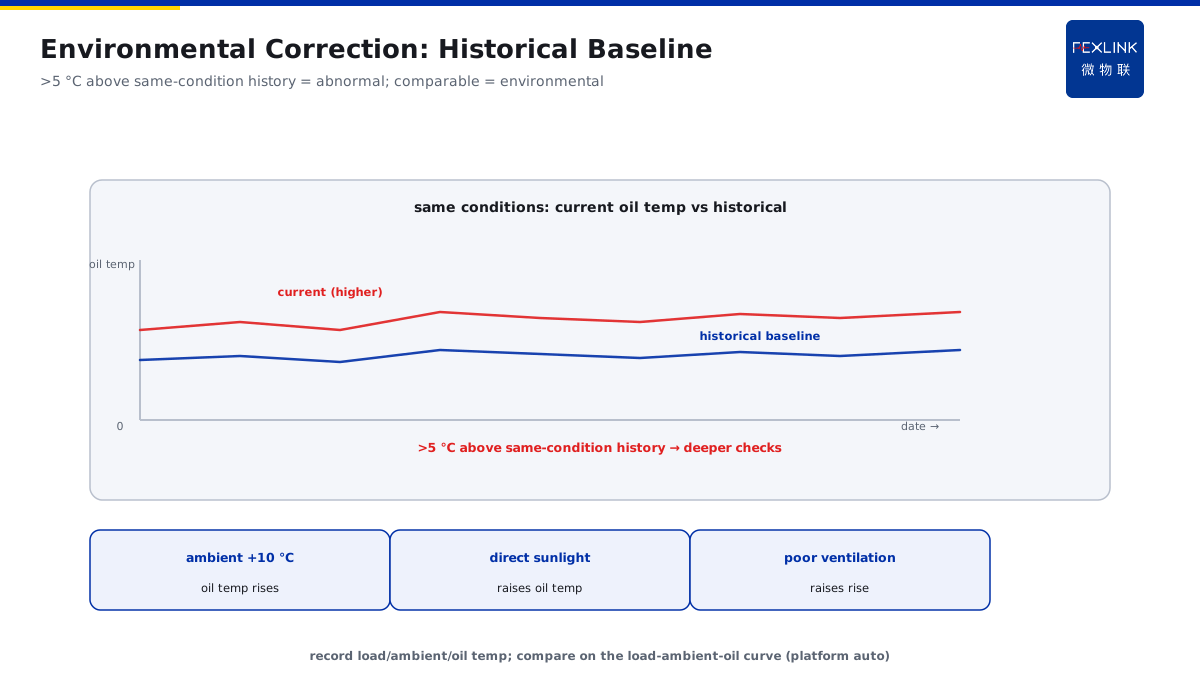
Direct Answer
At night the load is very low but the transformer oil temperature will not drop — where do you start? The answer: troubleshoot low-load high-temperature in order — first check whether the cooling devices (fans, oil pump) are operating; then check whether the oil level is low or the oil circuit is blocked; compare with the historical baseline for ambient-temperature and sunlight effects; if temperature is still high after all this, use DGA to judge internal defects. "Low load but high oil temperature" basically rules out overload and points to cooling or internal problems.
At a substation, night load was only 40% of daytime, but the transformer oil temperature stayed high; the duty engineer worried about insulation damage but did not know where to start. Following the ordered troubleshooting: cooling first — one fan was not running (cooling control circuit fault); then oil level (normal) and historical baseline (night ambient was 5 °C higher than the same period historically — an influence, but not the main cause). After the fan was restored, oil temperature dropped 8 °C at the same load. For low-load high-temperature, check the cooling device first — a fan not turning is the most common cause.
Because:
- Low load with high oil temperature rules out overload first: overload is "high load + high temperature"; low-load high temperature points to cooling or internal problems;
- Cooling devices are the first suspect: a fan not running or an oil pump stopped collapses cooling capacity — high temperature even at low load;
- Oil level and oil circuit are the second suspect: low oil level weakens circulation; blocked oil circuit hurts cooling;
- Environmental factors must be corrected: hot weather and direct sunlight raise oil temperature; only comparing with the historical baseline separates them.
Key insight: transformer low-load high temperature is "troubleshooted in order," not "internal defect from the start." Cooling → oil level/circuit → environment → internal, eliminating step by step.
A campus transformer had the same "low-load high oil temperature": cooling and oil level normal, historical baseline fine. DGA found abnormal total-hydrocarbon growth; outage inspection found slight inter-turn issues in the winding. Still high after cooling/oil-level/environment are ruled out → DGA corroborates internal defects — this step cannot be skipped.
1. Cooling-Device Checklist
For low-load high temperature, check cooling devices first — the first gate of heat dissipation:
Fan checks:
- Is the fan switched on (auto/manual state)?
- Is the fan turning (speed, direction)?
- Is the fan control circuit (thermostat, contactor) working?
- Is the fan motor faulty (overheated, seized)?
Oil-pump checks:
- Is the oil pump running (is oil circulation established)?
- Is the pump direction correct (backward = no circulation)?
- Are the pump inlet/outlet valves fully open?
Cooler checks:
- Dust on cooling fins/blockage (air-cooled radiators);
- Cooling water circuit (water-cooled) clear?
- Cooling-fan group operation normal (some groups failed)?
Check methods:
- Inspect cooling-device operation during night/low-load periods;
- Compare "cooling groups that should be on" with actual groups on;
- IR temperature measurement: radiator top/bottom difference (normal cooling shows a difference).
Key insight: cooling devices are the first check for low-load high temperature. A fan not turning, an oil pump not circulating, or clogged fins collapse cooling — the temperature naturally will not drop.
2. Oil-Level and Oil-Circuit Checks
Cooling normal but still high? Check oil level and circuit:
Oil-level checks:
- Is the oil gauge in the normal range (full-level mark)?
- Low oil level → insufficient cooling oil, weaker circulation;
- Abnormal level drop → check leaks (flanges, welds, radiators).
Oil-circuit checks:
- Is the oil-flow indicator acting (is circulation established)?
- Are oil-circuit valves open (mis-closed = circulation interrupted)?
- Blockage (impurities, sludge) affects circulation cooling.
Oil-level/circuit reading:
- Low level + high temperature → top up and check leaks;
- Normal level + high temperature → check circulation (pump/valve/blockage);
- Normal circulation + still high → proceed to environment and internal checks.
Notes:
- Oil level changes with temperature are normal (thermal expansion); correct the judgment by temperature;
- Top up with the same transformer-oil grade; do oil analysis after topping up.
Key insight: oil level and circuit are the second check. Low level → top up and check leaks; normal level → check circulation — without circulation, heat dissipation is moot.
3. Correcting Environmental Factors
Still high? Compare with the historical baseline for the environment:
Ambient-temperature effects:
- Every 10 °C rise in ambient roughly raises oil temperature by a corresponding amount — hot weather naturally means high oil temperature;
- Direct sunlight (outdoor transformers) raises oil temperature;
- Poor ventilation (indoor transformer rooms) raises temperature rise.
Comparing with the historical baseline:
- Pull up historical oil-temperature records for "the same load + the same ambient temperature";
- Compare current oil temperature vs historical same-period values;
- Clearly higher than historical same-period (same conditions) → internal issue or cooling degradation;
- Comparable to historical same-period → environmental explanation; no excessive concern.
Environmental-correction practice:
- Record load, ambient temperature, and oil temperature;
- Compare on a "load–ambient–oil-temperature" curve (the platform can draw it automatically);
- Judgment: more than 5 °C above same-condition history → continue deeper troubleshooting.
Key insight: environmental factors are corrected with the historical baseline. High oil temperature in hot weather is normal; higher than history under the same conditions is abnormal — compare with the baseline to separate environment from internal.
4. DGA Corroborating Internal Defects
Cooling, oil level, and environment all ruled out? Use DGA to look inside:
Why DGA:
- Internal discharge/overheating produces characteristic gases (H₂, CH₄, C₂H₂, C₂H₄, CO, CO₂);
- High oil temperature + abnormal characteristic gases = corroborated internal defect;
- DGA is the "lab report of internal faults."
How to read DGA:
- Total-hydrocarbon content and growth rate (fast growth = fast-developing defect);
- Three-ratio method/Duval triangle to classify the fault type (discharge/overheating/arc);
- Acetylene (C₂H₂) appearing = discharge-type fault (severe).
Disposition directions:
- DGA normal + high oil temperature → return to cooling (possible degradation);
- DGA abnormal → outage inspection (internal defect confirmed);
- DGA fast growth → schedule maintenance promptly to prevent escalation.
Supporting monitoring:
- Online DGA (large-capacity transformers) continuously monitors gas trends;
- Offline sampling (periodic) as a supplement;
- Oil temperature + DGA linked judgment (both abnormal = internal issue).
Key insight: DGA corroborates internal defects. Still high after cooling/oil-level/environment are ruled out — DGA abnormal means an internal problem; fast growth demands prompt maintenance.
5. Low-Load High-Temperature Troubleshooting Order
Chain the four steps into one order:
Troubleshooting order:
- First confirm the load is genuinely low (rule out overload);
- Check cooling devices (fan on/speed, oil pump running) — most common;
- Check oil level and circuit (level normal, circulation established);
- Compare with the historical baseline for environment (how much higher than history under same conditions);
- Still high → DGA corroborates internal defects;
- DGA abnormal → outage inspection; normal → re-check cooling degradation.
Verification for each step:
- Cooling: oil temperature drops after the fan is restored;
- Oil level: drops after topping up/clearing the circuit;
- Environment: comparable to history under the same conditions = normal;
- Internal: DGA abnormal → normal after maintenance.
Prevention:
- EST Multi-Channel Temperature Controller monitors oil temperature online;
- The platform records a "load–ambient–oil-temperature" baseline and auto-alerts on deviation;
- Cooling-device status fed into monitoring (fan-stop alarm).
Key insight: the order keeps "low-load high temperature" calm and methodical. Overload ruled out → cooling → oil level/circuit → environment → DGA — every step verified, the root cause cannot escape.
6. Product Landing: Transformer Oil-Temperature Diagnosis
FEXLINK products bring transformer oil-temperature diagnosis to the field:
- EST Multi-Channel Temperature Controller: online oil-temperature acquisition (real-time load–ambient–oil-temperature records);
- ESX Edge Computing Gateway: automatic historical-baseline comparison; auto-alerts on same-condition deviation;
- Cooling-device status monitoring: fan/oil-pump status fed in, stop alarms linked;
- DGA coordination: online/offline DGA data linked with oil temperature to judge internal defects;
- The platform auto-classifies "low-load high temperature": suspected cooling / oil circuit / environmental / internal — maintenance in order.
Design principle in one sentence: turn "I don't know where to start" into "ordered troubleshooting + baseline comparison." Cooling → oil level → environment → internal; the platform gives the order and the baseline — the root cause cannot escape.
7. Common On-Site Mistakes
- Suspicious of internal defects from the start: scheduling an outage inspection immediately for low-load high temperature. Consequence: the fan was just not running; outage wasted. Correct: troubleshoot in order; cooling first.
- Looking only at oil temperature, not load: concluding without confirming the load level. Consequence: overload missed. Correct: first confirm "the load is genuinely low."
- Skipping oil level/circuit: low oil level and a mis-closed valve unnoticed. Consequence: insufficient cooling oil, persistent high temperature. Correct: oil level and circulation are mandatory checks.
- Ignoring the historical baseline: high oil temperature in hot weather treated as abnormal. Consequence: over-reaction, wrong maintenance. Correct: compare same-condition history.
- Omitting DGA: dropping it after ruling out environment. Consequence: internal defect missed. Correct: still high after all this requires DGA corroboration.
Scope and Limitations
This article discusses diagnosing "low-load high oil temperature" (cooling devices, oil level/circuit, environmental factors, DGA corroboration) for oil-immersed transformers in service. The troubleshooting order and judgment methods are engineering experience references; actual practice follows transformer capacity, cooling type (air/water), and site environment. DGA analysis must be performed by qualified organizations; the three-ratio method/Duval triangle requires gas concentrations and historical data. Internal-defect handling involves outage maintenance and must follow procedures by qualified personnel. Online monitoring data is managed uniformly through the platform to form baseline alerts. All cases are anonymized (a certain substation / campus) and do not refer to any specific customer.