 微物联研究院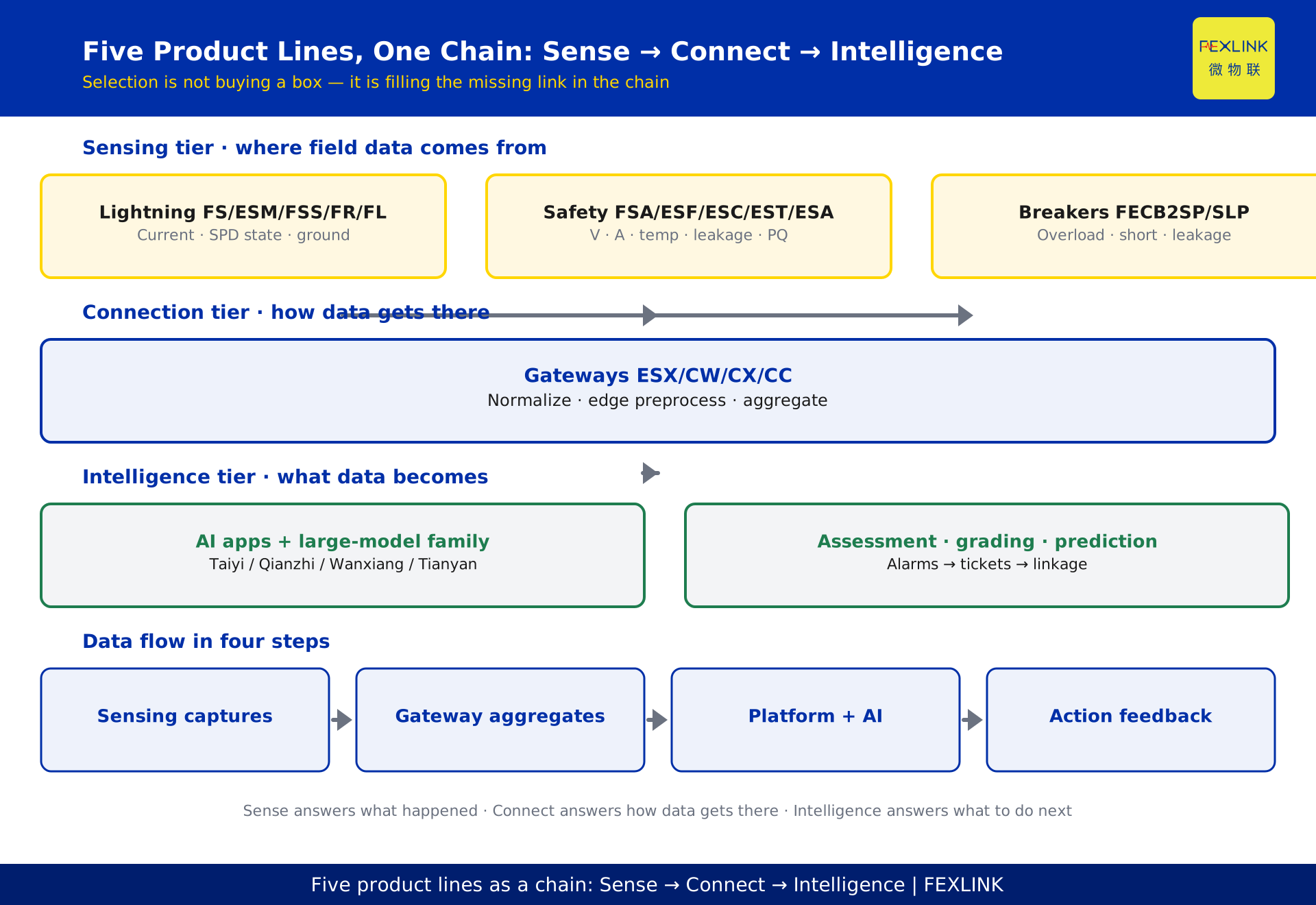
# Five Product Lines, One Chain: Sense → Connect → Intelligence
Direct Answer
FEXLINK's five product lines are not five isolated shelves but one data chain from "sense" to "connect" to "intelligence": the sensing layer (lightning protection, electrical safety monitoring, breakers) captures data, the connection layer (intelligent gateways) transports data, and the intelligence layer (AI applications and the large-model family) turns data into hazard assessment and decisions. Understanding this chain matters more than memorizing any single model: selection is not "buy a box" but "fill the missing link in the chain."
For project owners, channel partners, and engineers new to the field, this article explains three things: what role each of the five lines plays in the chain; how data flows from the field to decisions; and how a chain perspective reveals which link you are missing.
The Five Lines in One Chain
Arranged by data-flow direction, the five lines form three tiers:
- Sensing tier (three lines): intelligent lightning protection (FS/ESM/FSS/FR/FL) senses strikes and surges; digital power-use and electrical safety monitoring (FSA/ESB/ESC/EST/ESA control devices and meters) senses leakage, temperature, and power quality; smart breakers (FECB2SP/SLP) sense and execute overload, short-circuit, and leakage protection;
- Connection tier (one line): intelligent gateways/edge computing (ESX/CW/CX/CC) normalize heterogeneous protocols, aggregate data, and perform edge processing;
- Intelligence tier (one line): AI applications and the large-model family (Taiyi/Qianzhi/Wanxiang/Tianyan) perform hazard assessment, graded warning, and predictive analysis.
In one sentence: the sensing tier answers "what happened," the connection tier answers "how the data gets there," and the intelligence tier answers "what to do next."
How Data Flows Through the Chain
Break the field data-flow diagram into steps:
- Sensing end: lightning monitors record current and SPD status; control devices acquire voltage/current/temperature/leakage; breakers report open/close states and protection operations;
- Gateway aggregation: ESX/CW gateways ingest multiple sensing streams, normalize protocols, and preprocess at the edge (cleaning, buffering, preliminary rule checks);
- Platform and AI tier: data enters the Taiyi platform; Qianzhi performs multi-dimensional perception and anomaly identification; Wanxiang performs scenario linkage and impact assessment; Tianyan performs trend prediction;
- Action feedback: assessment results become alarms, work orders, and linkage commands, executing trips or linkage through breakers/control devices when necessary.
The chain's value is the closed loop: sensed data does not stay on paper but becomes executable action.
Selection from a Chain Perspective: Fill the Missing Link
Many failed selections come from "watching products, not the chain." Ask three questions from the chain view:
- Is there data? If the site has no sensing devices, fill the sensing tier first — no platform can save missing data;
- Can the data get out? If sensing devices exist but data cannot be acquired/transmitted, the missing part is the connection tier's gateway and protocol normalization;
- Is the data used? If data sits in the database unseen, the missing part is the intelligence tier's assessment and alarm grading.
Checking in this order, most "installed but useless" systems can be located at a specific break point.
How Three Typical Projects Configure the Chain
- Switch-room electrical safety project: sensing tier (control devices/leakage/temperature/power quality) plus intelligence tier (Taiyi + Qianzhi) as the core, gateways selected by on-site protocols;
- Intelligent lightning-protection project: sensing tier (lightning monitors/current/ground resistance) plus connection tier (gateway reporting) plus intelligence tier (strike statistics and SPD life assessment);
- Charging-station project: sensing tier (charging-circuit monitoring and leakage) plus connection tier (gateway aggregation) plus intelligence tier (charging-safety AI assessment and linkage), with breaker protection execution added as needed.
The principle of chain configuration: start from the business question the project must answer and back-calculate which links are needed — not copy the product catalog.
Internal Collaboration of the Three Sensing Lines
The three sensing lines do not operate in silos:
- Lightning and electrical-safety lines collaborate: a strike can cause surge damage and leakage anomalies; stacking both lines' data distinguishes "direct strike damage" from "secondary hazards after the strike";
- Breaker and control-device lines collaborate: when control devices detect sustained overload/leakage, they can link breakers to execute protection; the breaker's operation record in turn verifies the control device's judgment;
- Full chain with AI: Qianzhi places all three sensing lines' data in the same object model for cross-assessment, avoiding "each line reports its own, contradicting each other."
The value of collaboration is upgrading "point alarms" to "situational judgment."
How Channel Partners Explain the Chain
When presenting the five lines to customers, do not go by the product catalog; go by the chain:
- Draw one line first: sense → connect → intelligence;
- Place the customer's corresponding sensing devices on it (control devices in the switch room, lightning monitoring on the roof, leakage monitoring at chargers);
- Point out existing break points (devices without gateways? data nobody reads?);
- Quote a minimal plan that fills the break points instead of a full suite at once.
The chain perspective makes proposals "clear to explain and verifiable," the most direct way to improve close rates.
Seven: The Three Common Link Breaks and How to Trace Them
When a link stops working after installation, the problem almost always sits at one of three breaks:
- Sense-end break: the device is installed but never commissioned — no power, no CT connected, parameters not downloaded. It shows as "no data on the platform" or "data stuck at 0";
- Connect-end break: the device has data but it cannot get through — protocol mismatch, a full gateway channel, or network jitter. It shows as "device online but data lagging or intermittent";
- Intelligence-end break: the data is all there but nothing processes it — no assessment rules, no alarm grading. It shows as "lots of data, no conclusion."
The trace order is fixed: sense first, connect second, intelligence last. Walk segment by segment from the data source toward the platform — much faster than digging through platform logs.
Eight: How the Link Supports Three Kinds of Retrofit
- Existing-site retrofit: if breakers, meters and other devices are already on site, prioritize adding the connect layer (gateway plus protocol normalization) to bring legacy devices into the link, then add intelligence as needed — do not tear down and rebuild;
- Greenfield project: plan the full "sense → connect → intelligence" chain at once, reserve points and interfaces, and avoid trenching and rewiring in later phases;
- Capacity upgrade: add sensing points or AI capability onto the existing chain — the architecture stays, nodes are added, so expansion cost stays controllable.
The common point of all three: the chain is the skeleton; a retrofit adds flesh to the skeleton. Design the skeleton well and all three kinds of retrofit go smoothly.
Nine: Common Questions from the Chain Perspective
- Can we skip the intelligence layer first? Yes. Run sense + connect first, collect and validate the data, then add intelligence later — but reserve platform and model interfaces during selection;
- Will the gateway become a bottleneck? Size it by "point count × reporting frequency" and keep a 30% margin; edge pre-processing is done by the gateway, so platform load stays manageable;
- What is the value of explaining the chain? The chain perspective makes a proposal verifiable — every segment can be checked for "is there data, is it transmitted, is it used" — so both quoting and implementation have a basis. That verifiability is precisely what shortens the gap between a sales story and a delivered system.
A practical tip when commissioning a new link: keep a segment-by-segment checklist — for every sensing point, verify the device is powered, the transformer is connected, and the parameters are downloaded before moving to the next segment; for every gateway, verify the protocol mapping and the reporting frequency against the point count; for the intelligence layer, verify at least one rule fires on real data before declaring the link live. Projects that follow this checklist usually finish commissioning in days instead of weeks, and the data quality problems that used to surface in the first month of operation get caught during acceptance instead.
One more point worth stating plainly: the chain perspective is also the cheapest insurance against scope creep. When every requirement must be attached to a specific segment — sense, connect, or intelligence — requirements that are vague or untestable become visible during design instead of during delivery, and the final system does exactly what the chain diagram says it does.
In short: buy the missing segment, not the whole catalog.
One-Line Summary
Sense captures what happens, connect moves it, intelligence decides what to do next. Select the missing segment, keep the chain verifiable, and the system answers the business question instead of merely filling a cabinet with boxes.
Scope and Limitations
Reading page for KD-0019. The five-line division and product attribution (sensing tier: lightning FS/ESM/FSS/FR/FL, electrical safety FSA/ESF/ESC/EST/ESA, breakers FECB2SP/SLP; connection tier: gateways ESX/CW/CX/CC; intelligence tier: AI applications and the AI large-model family Taiyi/Qianzhi/Wanxiang/Tianyan) come from the FEXLINK product knowledge base (product-line map) as product-documentation conventions. The "four-step data flow," "three missing-link questions," and "three typical project configurations" are this article's chain methodology for selection reference. Chain configuration for a specific project should be confirmed by professional pre-sales staff based on site conditions; this page is not a specific project proposal.