 微物联研究院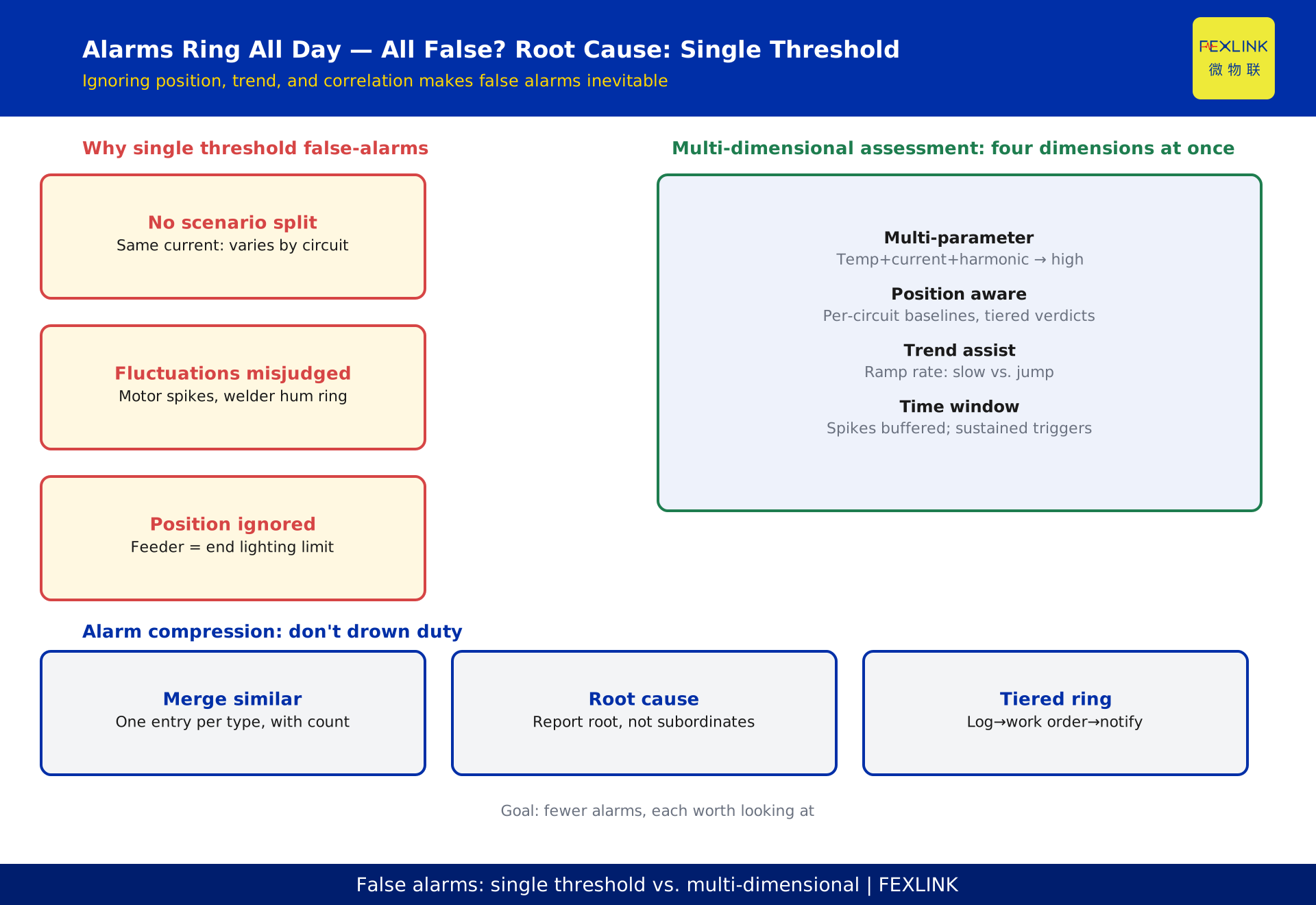
# Alarms Ring All Day — All False? The Root Cause Is "Single Threshold, Single Parameter"
Direct Answer
The root cause of false-alarm floods is "single-threshold plus single-parameter" assessment — judging continuously changing electrical quantities against one fixed limit, ignoring position differences, trends, and correlations, so false alarms are inevitable. The fix is multi-dimensional assessment: multi-parameter combination, position awareness, trend assistance, and alarm compression. Raise the assessment dimensions, and the false-alarm rate comes down.
For operations leads, safety managers, and teams drowning in alarms, this article explains four things: why false alarms are inevitable; what is wrong with "single threshold"; how multi-dimensional assessment cuts false alarms; and how alarm compression makes duty response actually feasible.
Why "Single Threshold" Inevitably False-Alarms
Electrical quantities change continuously; a single threshold has only two states: over limit, not over limit. The problems:
- Different operating conditions: the same current is normal in a fully loaded workshop but abnormal in a standby circuit — a fixed threshold ignores scenario;
- Normal fluctuations: motor-start current spikes and welder harmonics are normal conditions, but a single threshold reports them all;
- Different positions: the voltage fluctuation allowed at a transformer feeder differs from a lighting circuit at the end — position differences are ignored.
So it is not that "the system is too sensitive"; it is that the assessment is too crude.
The Second Problem with "Single Parameter"
Looking at only one parameter also misses real risk:
- A temperature rise may just be hot weather — or the companion signal of overload;
- High current may be a temporary heavy load — or a precursor of poor contact;
- Neither is certain alone; combined, they become certain.
Another pitfall: it looks only at the "current value," not "how it got there" — a slow 12-hour temperature ramp and an instantaneous jump have completely different risk, and a single threshold cannot tell them apart.
How Multi-Dimensional Assessment Cuts False Alarms
Multi-dimensional assessment changes the approach, looking at four dimensions at once:
- Multi-parameter combination: judge temperature+current+harmonic together; report high severity only when multiple signals are anomalous at once;
- Position awareness: the same parameter uses different baselines on different circuits; different distribution levels get different verdicts;
- Trend assistance: look at ramp rate, not just the instantaneous value; handle slow ramps and instantaneous jumps differently;
- Time window: short spikes go to a buffer; sustained anomalies trigger; normal fluctuations are filtered.
With all four, the false-alarm sources are blocked one by one.
Alarm Compression: Don't Drown the Duty Desk
Even with better assessment, cross-point and cross-time alarms can still be many. Add alarm compression:
- Merge similar alarms: merge the same type of problem on the same circuit into one entry with a count;
- Focus on root cause: when multiple parameters alarm together, report only the root-cause alarm, not subordinate alarms;
- Ring only what matters: low severity to logs, medium to work orders, high severity to real-time notification.
The goal is "fewer alarms, each worth looking at."
How the Qianzhi Engine and the Electrical-Hazard Early-Warning System Help
FEXLINK's Qianzhi engine uses a 7-dimension perception matrix for multi-parameter combined assessment, and 238-dimension electrical parameter evaluation for position and condition adaptation; the electrical-hazard early-warning system provides trend prediction and lead-time warning. This combination replaces "single-threshold guesswork" with an assessment system that is multi-dimensional, position-aware, trend-based, and compressed — reducing false alarms at the mechanism level.
Self-Check: Which Tier Is Your Alarm System At
- Fixed threshold, one parameter, current value only → high false-alarm tier;
- Multiple parameters but each alarms independently → improved but still duplicative;
- Multi-parameter combination + position baselines + trend + compression → usable assessment system.
Climb tier by tier; the false-alarm problem does not need rebuilding — it needs replacing the assessment method.
Seven: The Cost Ledger of False Alarms
False alarms are not a minor "extra ringing." They carry real costs:
- Duty numbness: alarms ring every day and nine out of ten are empty; duty staff gradually stop looking, and when a real alarm arrives it is treated as noise — this is the most dangerous cost;
- Wasted dispatch: every false alarm sends someone to the site to confirm; labor, time, and travel are all spent on fake events while real events queue;
- Trust erosion: leadership sees "the system rings every day and nothing is accurate," and renewal and new project funding are both affected — false alarms directly hurt the business.
Once the ledger is clear, cutting false alarms is not a nicety; it is a precondition for the system's value.
How to Initialize Multi-Dimensional Assessment Parameters
Multi-dimensional assessment is not usable on day one. Parameters go through initialize — observe — calibrate:
- Initialize: set initial thresholds and baselines from the knowledge base and experience — temperature, current, harmonic, each dimension separately — without expecting to get it right in one pass;
- Observe: for the first 2–4 weeks after go-live, do not rush to tune; collect real operating data and record false-alarm and missed-alarm samples;
- Calibrate: use the observation data to recompute reasonable baselines per circuit type, season, and load level, replacing "guessed values" with "data values."
After the three steps, the false-alarm rate usually drops noticeably — calibration is not a one-time action but a quarterly routine.
Nine: A Landing Checklist for Operations Managers
- Define the criteria: state clearly what combination and what duration counts as an alarm, written as configurable rules with no gray zone;
- Tier the notifications: high levels go by phone or SMS, low levels into logs or work orders — do not give every alarm the same volume;
- Review weekly: look at three numbers every week — false alarms, missed alarms, closed items. Improving trends mean assessment is converging; worsening trends mean parameters need tuning;
- Write back outcomes: every handling result — real or false — writes back into the system, and the write-back data is the raw material for the next calibration round.
The Trade-Off Between False Alarms and Missed Alarms
Cutting false alarms is not "the fewer, the better"; balance false against missed:
- Too many false alarms: duty numbness and wasted dispatch — the cost is "the boy who cried wolf";
- Too many missed alarms: real hazards go unreported and regret comes after the incident — the cost is "relaxed when there is no wolf, and too late when there is one";
- Balance principle: rather occasionally false than miss a real alarm. Use tiering to soften the harm of false alarms — low levels do not disturb people — and use multi-dimensional assessment to reduce their quantity. Manage both ends.
The right way to cut false alarms is not raising thresholds until nothing fires; it is making every alarm explainable, tierable, and actionable.
Eleven: Common Questions — How to Land Alarm Tiering
- How many tiers? Three is the common choice — handle immediately / handle within a deadline / observe and track. More than three and duty staff cannot remember; fewer and priority cannot be distinguished;
- How are high tiers notified? Phone or SMS directly to the owner, with circuit, parameters, and suggested actions — no need to open the platform to read the platform;
- How are low tiers handled? Into logs and the weekly summary — do not disturb people, but someone must still read them, so low tiers do not become a no-man's land.
Once tiering lands, the duty phone goes quiet, and real alarms actually ring louder.
One practical note on the calibration rhythm: the first calibration is the most important and the least comfortable, because it forces the team to admit that initial thresholds were guesses. That discomfort is exactly the point — after the first data-driven calibration, every later review is comparing data against data instead of data against assumptions. Teams that skip the first calibration to avoid the discussion usually find the false-alarm discussion returning every month, while teams that do it once find the monthly review takes ten minutes instead of an afternoon. The multi-dimensional approach pays off precisely because it makes this first calibration structural: each dimension's baseline is tuned separately, so the fix is always visible and never a black box. The end state is not silence; it is precision — every alarm that reaches a person has already earned its way through the multi-dimensional check, the tiering, and the historical calibration. The tiering table, the calibration rhythm, and the multi-dimensional criteria together form one coherent answer to the original question: alarms are not a noise problem, they are a judgment problem. Fix the judgment, and the noise resolves itself. The more precise the assessment, the fewer the alarms that reach people, and the greater the value — a virtuous loop that keeps compounding as the write-back data accumulates — fewer distractions for operators, more accurate baselines for calibration, and a monitoring system that earns trust instead of demanding it.
Scope and Limitations
Reading page for KD-0025. Product capabilities (Qianzhi engine's 7-dimension perception matrix and 238-dimension electrical parameter evaluation, electrical-hazard early-warning system trend prediction) come from the FEXLINK product knowledge base as product-documentation conventions. The "root cause = single threshold + single parameter," "four dimensions of multi-dimensional assessment," and "three alarm-compression practices" are this article's methodology for reference; specific thresholds and assessment parameters should be configured and confirmed by professional implementation staff based on site conditions. This page is not a specific project proposal.