 微物联研究院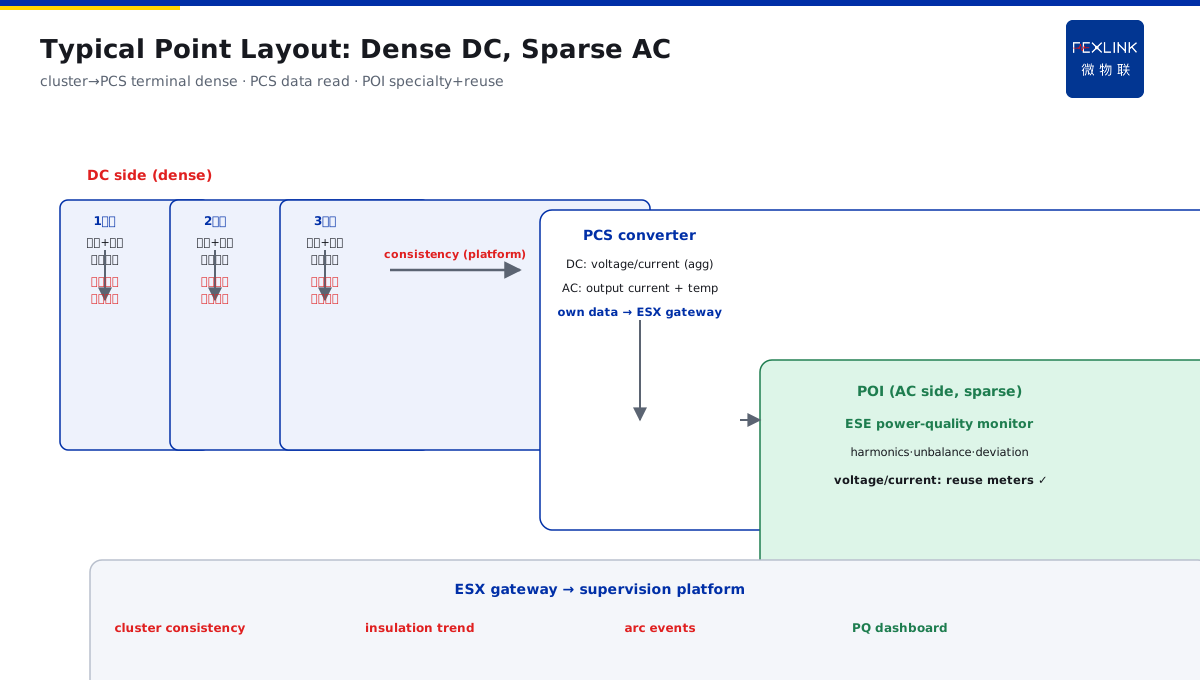
Direct Answer
During energy-storage plant design, how should DC-side and AC-side monitoring points be divided? The answer: place points by risk — the DC side focuses on cluster voltage consistency, insulation resistance, and DC arc-flash-related quantities; the AC side monitors point-of-interconnection (POI) power quality, PCS output current, and temperature. Point density leans toward the DC side and battery clusters, because DC-side faults spread fast with severe consequences; the AC side can reuse existing meters.
At a 10 MW/20 MWh energy-storage plant, the first-draft monitoring layout "split points equally between DC and AC": the DC side only measured bus voltage, and the AC side piled on meters. Review found critical gaps — no cluster voltage consistency (cluster mismatch is a precursor of capacity fade and thermal runaway), no DC insulation resistance (positive/negative-to-ground degradation is hard to detect), no DC arc-flash-related quantities (loose connections arcing can burn modules); meanwhile the AC side duplicated the existing meters' POI voltage/current. Re-planned by risk: DC side densified — per-cluster voltage/current, inter-cluster consistency, DC insulation resistance, arc signals (arc-current signature/temperature); AC side streamlined — POI power quality (ESE Power-Quality Monitor) + PCS output current and temperature, POI voltage/current reused from existing meters. Over one year, cluster-consistency monitoring flagged one cluster drifting above 3% early; balancing maintenance prevented accelerated capacity fade. Place points by risk — densify DC, reuse AC, spend where it matters.
Because:
- DC-side faults spread fast with severe consequences: cluster mismatch, insulation degradation, and connection arcing all develop silently and erupt suddenly — monitoring must be denser;
- AC-side faults are visible and reusable: POI power quality and output current/temperature are covered by existing meters + PCS's own data — no need to pile on points;
- Point density leans toward the DC side and clusters: voltage consistency, insulation resistance, and arc-flash quantities are energy-storage-specific high-risk items;
- Sensor-installation safety comes first: the DC side carries high voltage, large current, and arc risk; power take-off, insulation, and fire protection demand more.
Key insight: storage monitoring points are placed by risk, not "split equally between DC and AC." The DC side spreads fast with severe consequences — densify; the AC side is reusable — streamline.
At a campus storage retrofit into a 380 V bus, the design planned five AC meters; review reused the existing master meter and added one ESE Power-Quality Monitor, saving four meter positions. The saved budget went to the DC side — per-cluster voltage acquisition and insulation monitoring. Points lean toward risk; AC only needs to be sufficient.
1. DC-Side and AC-Side Point Checklist
List first, then discuss density:
DC-side points (battery cluster → PCS DC terminal):
- Cluster voltage/current: mandatory per cluster (basis of consistency judgment);
- Inter-cluster voltage consistency: multi-cluster comparison (mismatch = fade/fault precursor);
- DC insulation resistance: positive/negative to ground (early insulation degradation);
- DC arc-related quantities: arc-current signature/arc temperature (loose-joint arcing warning);
- Battery module temperature: thermal-runaway precursor (hot clusters prioritized).
AC-side points (POI/PCS AC terminal):
- POI power quality: voltage deviation, harmonics, three-phase unbalance (ESE monitor);
- PCS output current: three-phase current (output state);
- PCS temperature: IGBT/cooling (over-temperature protection);
- POI voltage/current: reuse existing meters (no duplication).
Checklist logic:
- DC side = storage-specific risks (consistency/insulation/arc);
- AC side = conventional electrical quantities (power quality/current/temperature);
- Density: DC densified, AC sufficient.
Key insight: split the list by risk first, then by side. The DC side measures storage-specific quantities, the AC side conventional ones — each measures what it needs, no repetition, no gaps.
2. Why the DC Side Is Densified
Point density leaning to the DC side follows storage fault characteristics:
DC-side faults "develop silently, erupt instantly":
- Inter-cluster voltage mismatch: grows slowly over operation; capacity already faded by detection;
- Insulation resistance drop: degrades gradually; exposed only at breakdown (too late);
- Loose-joint arcing: instant high temperature, burns modules/starts fire;
- Verdict: must monitor "early, continuously, densely."
AC-side faults "visible and protected":
- Power-quality anomalies: POI voltage/current fluctuation, visible on meters/protection;
- PCS over-temperature/over-current: covered by its own protection and temperature monitoring;
- Verdict: conventional means suffice; no need to densify.
How to densify:
- Each cluster acquires independently (not merged at the bus);
- Insulation monitoring: periodic inspection + online trend;
- Arc signals (current signature/arc light) into alarms;
- Module temperature key points (hot zones densified).
Key insight: DC densification guards silent faults; AC sufficiency avoids redundant waste. Risk density decides point density.
3. Reusing Existing Acquisition Points
The AC side needs no repeated investment; first inventory what can be reused:
Reusable existing resources:
- POI voltage/current: existing meter/master-meter data (no new installation);
- PCS's own data: output power, temperature, alarms (read via comms);
- Grid-cabinet protection data: overcurrent/overvoltage/undervoltage (protection records);
- Verdict: reuse AC points as much as possible, fill only the gaps.
Must-add items:
- Power-quality specialty: harmonics, three-phase unbalance (ESE Power-Quality Monitor);
- DC side: cluster voltage/current, insulation, arc (storage-specific, nothing to reuse);
- Verdict: new points concentrate on the DC side and the power-quality specialty.
Reuse vs add:
- Existing data covers it → reuse;
- Storage-specific risk → add;
- Specialty quality requirement → add (power-quality monitor).
Key insight: inventory first, then place — reuse what exists, spend new points on gaps. Reusing AC meters frees budget for the DC side.
4. Sensor-Installation Safety
DC-side sensor installation in storage demands more than conventional:
Installation safety points:
- DC side carries high voltage (cluster voltage in hundreds of volts) and large current (hundreds of amps); sensors and power take-off must meet insulation class;
- In arc-risk zones (terminals, fuse vicinity), sensor selection/installation must avoid initiating arcs;
- Inside battery clusters, fire-protection class must match the battery itself;
- Insulation-monitoring sensor installation must not lower ground insulation (pole-to-ground distance, creepage).
Selection and installation principles:
- Sensor rating ≥ measured current × 1.2–1.5; DC side uses DC-type sensors (Hall/shunt — AC types distort);
- Power-take-off circuit protected so sensor faults do not affect the main circuit;
- Avoid cooling ducts and hot spots when locating (except temperature sensors);
- Arc-monitoring sensors (current signature/arc light) near easily-loosened joints.
Safety over point count:
- Better fewer points than lowering insulation/fire protection by installation;
- After installation: insulation test and polarity check.
Key insight: DC-side points put safety before quantity. Sensor installation must not lower insulation class or initiate arcs — safety first, then points.
5. Typical Point Layout Logic
One layout logic shows where points go:
DC side (battery cluster → PCS DC terminal):
- Per cluster: voltage acquisition + current acquisition + module temperature (hot zones densified);
- Inter-cluster: consistency computed on the platform;
- Cluster outlet: insulation monitoring (poles to ground);
- Terminals/fuses: arc monitoring (current signature/arc temperature).
PCS body:
- DC terminal: DC voltage/current (cluster aggregation);
- AC terminal: output current + temperature;
- Comms: PCS's own data into the gateway (ESX Edge Computing Gateway).
AC side (POI):
- POI: power-quality monitoring (ESE) — harmonics, unbalance, voltage deviation;
- Voltage/current: reuse existing meters;
- Verdict: one ESE + existing meters suffice.
Layout logic:
- DC side: point-by-point from cluster to terminal (dense);
- PCS body: read data (medium);
- AC side: POI specialty + reuse (sparse).
Key insight: the layout is a risk map — dense DC, sparse AC. Cluster-to-terminal densification; POI specialty + reuse — one map shows the point logic.
6. Product Landing: Storage Point Scheme
FEXLINK products bring the storage point scheme to practice:
- ESE Power-Quality Monitor: POI power quality (harmonics, unbalance, voltage deviation), the AC-side specialty;
- ESX Edge Computing Gateway: unified aggregation of DC cluster voltage/current/insulation/arc signals, edge computing (inter-cluster consistency), alarm linkage;
- Cluster acquisition: voltage/current/temperature sensors into the gateway;
- Insulation and arc monitoring: insulation-resistance online trend + arc-current signature/arc-temperature alarms;
- The platform shows DC cluster consistency, insulation trends, arc events, and AC power quality; health scores auto-link deduction items.
Design principle in one sentence: turn "split points equally" into "place by risk." Densify storage-specific risks on the DC side; reuse existing meters + specialty monitoring on the AC side — cost matched to risk.
7. Common On-Site Mistakes
- Splitting points equally between DC and AC: DC only bus voltage, AC piled with meters. Consequence: critical gaps (consistency/insulation/arc) and irrelevant extras. Correct: place by risk; densify the DC side.
- No cluster points, only bus: inter-cluster mismatch undetected. Consequence: capacity fade and thermal-runaway precursors missed. Correct: each cluster acquires independently.
- Duplicating AC meters: five more meters where meters already exist. Consequence: waste. Correct: reuse existing meters + one power-quality specialty.
- AC-type sensors on the DC side: wrong Hall/shunt selection. Consequence: distorted measurement, misoperation. Correct: DC-type sensors on the DC side.
- Installation lowering insulation: ignoring creepage for power take-off. Consequence: safety hazard. Correct: safety first; insulation test and polarity check after installation.
Scope and Limitations
This article discusses DC/AC monitoring-point layout for storage PCS (cluster voltage/current, insulation, arc, power quality, output current/temperature) during energy-storage plant design. The checklist and density are engineering experience references; actual placement follows system topology, battery type, voltage class, and vendor proposals. DC-side sensor installation must meet insulation and fire-protection requirements; AC-side points should reuse existing resources. Data needs unified platform integration for trends and linkage. All cases are anonymized (a certain storage plant / campus) and do not refer to any specific customer.