 微物联研究院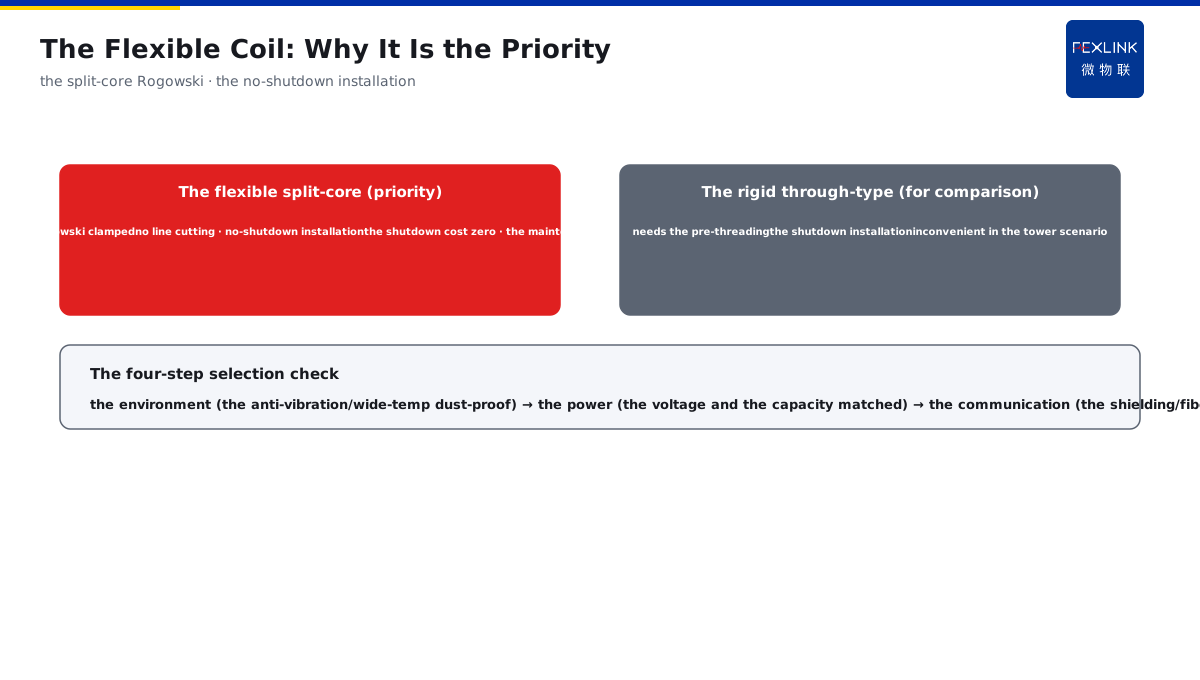
Direct Answer
In a hundred-meter tower with strong vibration, narrow space and strong electromagnetic interference, what are the special considerations for selecting the lightning-protection monitoring? The answer: the in-tower selection must pass four gates — the anti-vibration with the rail/wall-mount fixing, the wide-temperature and dust-proof, the in-tower power take-off (the lighting/UPS DC) with the shielded communication, and the open-loop installation of the earthing and the lightning-current monitoring points on the tower earthing bus; the Rogowski-coil lightning-current monitoring gives priority to the flexible split-core type for the installation without the shutdown.
At a wind farm, the monitoring equipment from the ordinary distribution cabinet was installed into the tower; after half a year, the vibration loosened it, the communication was interfered, and the power take-off was difficult, with a large amount of data missing in the lightning season. After the re-selection by the four in-tower gates: the anti-vibration wall-mount fixing, the wide-temperature dust-proof model, the lighting/UPS DC power take-off and the shielded communication, and the lightning-current monitoring changed to the flexible split-core Rogowski coil for the installation without the shutdown, the data was complete throughout the year. The key distinction: the tower is not the ordinary distribution cabinet — the selection must pass the four gates: the anti-vibration and the fixing, the wide-temperature and the dust-proof, the power take-off and the shielded communication, and the open-loop installation on the earthing bus; the flexible split-core coil lets the lightning-current monitoring be installed without the shutdown.
Why:
- The anti-vibration fixing: the rail/wall-mount reinforcement;
- The wide-temperature dust-proof: the environmental protection up to the standard;
- The power take-off and the communication: the lighting/UPS DC + the shielding;
- The open-loop installation: the open-loop monitoring point on the earthing bus.
Key insight: "The in-tower selection passes the four gates — the anti-vibration and the fixing, the wide-temperature and the dust-proof, the power take-off and the shielded communication, and the open-loop installation on the earthing bus; the flexible split-core Rogowski coil installs the monitoring without the shutdown."
At a wind farm, the in-tower monitoring equipment loosened twice under the vibration, and after the strike the data gap made the review impossible. After the re-selection by the four gates, the anti-vibration fixing and the flexible-coil open-loop installation were in place, and the data was complete throughout the year. Lesson: the ordinary cabinet equipment installed in the tower must fail — select by the four in-tower gates, with the anti-vibration, the wide-temperature, the power take-off and the open-loop all up to the standard, and the data is reliable.
Overview: run "what the tower environment constrains → how the power take-off and the communication are solved → how the earthing and the lightning-current monitoring are installed → why the flexible coil is the priority" as one in-tower selection cognition. The in-tower selection must pass the four gates: the anti-vibration with the rail/wall-mount fixing, the wide-temperature and the dust-proof, the in-tower power take-off (the lighting/UPS DC) with the shielded communication, and the open-loop installation of the earthing and the lightning-current monitoring points on the tower earthing bus; the Rogowski-coil lightning-current monitoring gives priority to the flexible split-core type. The four layers are unfolded below.
A "probe on the operating table" analogy: think of installing the monitoring in the tower as making the measurements on a beating heart. The heart (the tower and the turbine) keeps beating (vibrating), and the probe (the monitoring equipment) must be fixed firmly and must not loosen (the anti-vibration fixing); the operating area is complex (the temperature difference, the dust and the condensation), and the instruments must withstand it (the wide-temperature and the dust-proof); the operation cannot stop (the turbine not shut down), so the probe is best "clamped" from outside the blood vessel rather than cutting the vessel open (the flexible split-core coil clamped on, not open-loop and not cutting); the operating-room electromagnetic noise is high (the in-tower electromagnetic interference), and the monitoring leads must be shielded (the shielded communication). The heartbeat cannot stop and the operation cannot stop — all the in-tower monitoring selection considerations are "making the measurement in without disturbing the operation". The operating-table analogy: the tower = the beating heart, the monitoring equipment = the probe fixed firmly (the anti-vibration), the instruments withstanding the complex environment (the wide-temperature and the dust-proof), clamped from outside the vessel without the operation (the flexible coil open-loop), and the leads shielded (the anti-interference communication) — making the measurement in without disturbing the operation.
1. The Tower Environment: What It Constrains
Step one: first look at the constraints of the tower environment (the vibration/temperature-humidity/space) on the selection.
The vibration constraint:
- The tower vibrating continuously;
- The ordinary rail easily loosening;
- The anti-vibration fixing mandatory;
- The wall mount and the reinforcement.
The temperature-humidity constraint:
- The tower temperature difference large;
- The high humidity and the condensation;
- The wide-temperature model mandatory;
- The dust-proof and the moisture-proof.
The space constraint:
- The tower space narrow;
- The device size limited;
- The compact design prioritized;
- The installation position planned.
Key insight: "The environment constraints are clear — the tower vibrates continuously and needs the anti-vibration fixing (the wall mount and the reinforcement), the large temperature difference needs the wide-temperature dust-proof model, and the narrow space needs the compact design — select against the environment first, then the function."
2. The Power Take-Off and the Communication: How to Solve
Step two: the in-tower power take-off (the lighting/UPS DC) and the shielded-communication solution.
The tower power take-off:
- No independent power cabinet;
- Taking power from the lighting circuit;
- The UPS DC available;
- The take-off point planned.
The shielded communication:
- The tower electromagnetic interference strong;
- The communication-line shielding mandatory;
- The optical fiber prioritizing the anti-interference;
- The shielding earthing in place.
The take-off points:
- The voltage matched;
- The capacity calculated;
- The backup power considered;
- The communication independent.
Key insight: "The power take-off and the communication configured — the tower lighting/UPS DC take-off with the voltage and the capacity matched; the communication-line shielding mandatory, the optical fiber prioritizing the anti-interference, and the shielding earthing in place — the communication is stable under the strong electromagnetic environment."
3. The Installation: How the Earthing and the Lightning-Current Monitoring Are Installed
Step three: the installation of the earthing and the lightning-current monitoring points on the tower earthing bus.
The earthing monitoring point:
- The tower earthing bus;
- The FR open-loop monitoring;
- Not interrupting the discharge path;
- The earthing state visible.
The lightning-current monitoring point:
- The down conductor/earthing bus;
- The FL open-loop installation;
- The Rogowski coil clamped;
- Not cutting the conductor.
The open-loop points:
- The open loop not breaking the path;
- The installation without the cutting;
- The sensor clamped;
- The operation and maintenance detachable.
Key insight: "The open-loop installation is the key — the FR earthing and the FL lightning-current monitoring are installed open-loop on the tower earthing bus, not interrupting the discharge path, not cutting the conductor, with the sensor clamped and the maintenance detachable."
4. The Flexible Coil: Why It Is the Priority
Step four: the advantage of the flexible split-core type of the Rogowski-coil lightning-current monitoring.
The flexible split-core type:
- The split-core Rogowski coil;
- Clamped without the line cutting;
- The installation without the shutdown;
- The shutdown cost zero.
Compared with the rigid:
- The rigid needs the threading;
- The shutdown installation;
- The flexible advantage obvious;
- Especially suitable for the tower.
The selection points:
- The range matched;
- The opening size sufficient;
- The accuracy up to the standard;
- The installation convenient.
Key insight: "The flexible coil is the priority — the split-core Rogowski coil is clamped without the line cutting, installed without the shutdown, and the shutdown cost is zero; compared with the rigid needing the threading and the shutdown, the flexible advantage is obvious in the tower scenario, with the range and the opening size selected correctly."
5. Product Implementation: The In-Tower Monitoring Solution
WeiWuLian products bring the in-tower monitoring to the ground:
- FL flexible Rogowski-coil model: the lightning current installed without the shutdown;
- FR earthing-resistance monitor: the open-loop monitoring on the earthing bus;
- FG intelligent lightning-protection gateway: the data aggregation and the anti-interference communication;
- The anti-vibration wide-temperature design: adapted to the tower environment;
- The shielded communication: stable under the electromagnetic interference.
The design principle in one sentence: "The four gates passed and the open-loop installed — the in-tower monitoring selection passes the four gates of the anti-vibration/wide-temperature/power take-off/open-loop, the FL flexible coil is installed without the shutdown, and the data is complete throughout the year."
6. Common Understanding Misjudgments
- "The ordinary cabinet equipment directly installed": wrong. The tower vibration/temperature difference/electromagnetic are all different.
- "The power take-off randomly connected": wrong. The lighting/UPS DC take-off needs the voltage and the capacity matched.
- "The communication line unshielded": wrong. The tower electromagnetic is strong, and the shielding/fiber is mandatory.
- "The monitoring must be installed with the shutdown": wrong. The flexible split-core coil does not shut down.
- "The earthing monitoring must cut the conductor": wrong. The open-loop installation does not interrupt the discharge path.
Scope and Limitations
This article explains the lightning-protection monitoring selection inside the wind-turbine tower (the environment constraints, the power take-off and the communication, the open-loop installation, and the flexible coil), applicable to the in-tower monitoring-solution design. The specific models and the installation follow the product manuals and the turbine-manufacturer requirements; this article explains only the selection logic. All cases are anonymized (a wind farm) and do not refer to any specific customer.