 微物联研究院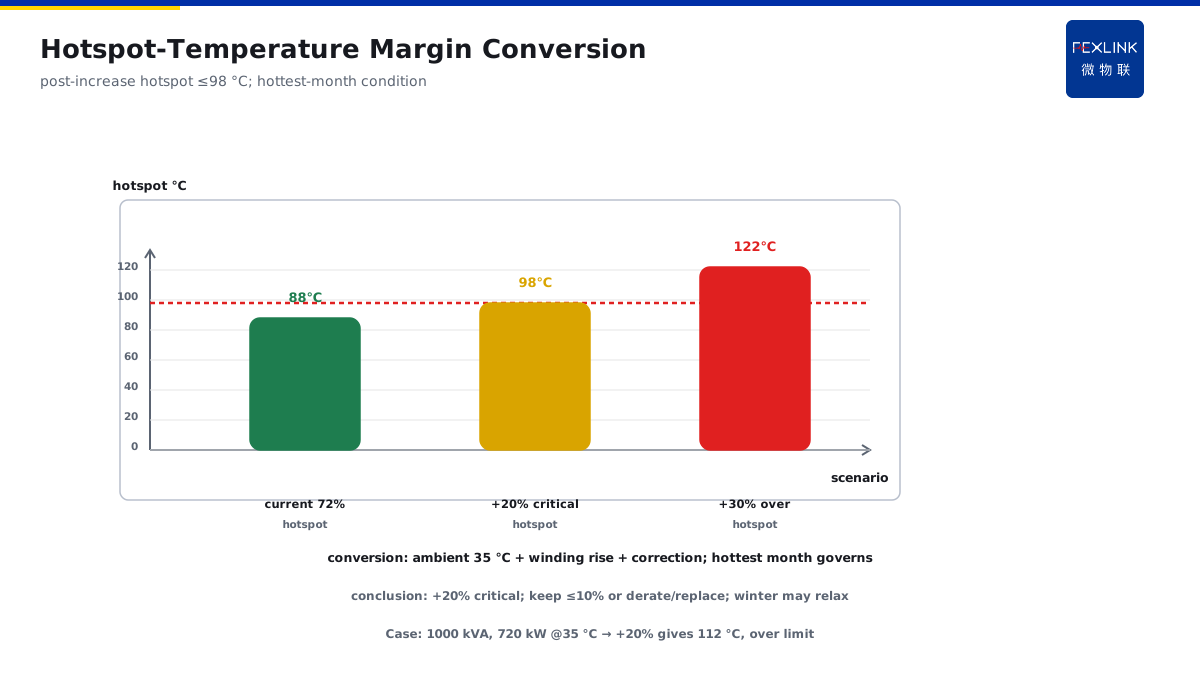
Direct Answer
A plant adds new equipment and wants to rely on an existing transformer to increase capacity. How should safety be assessed? The answer: assessment in three steps — collect the current load curve and convert it to hotspot-temperature margin; check historical oil chromatography and oil-temperature trends; strengthen online monitoring (oil temperature, load, and PD if needed). If the hotspot margin is sufficient and the insulation trend is stable, capacity can be increased within limits; otherwise, recommend replacement or derated operation. The scheme outputs a quantified "how much can be added" conclusion.
A plant added a new production line (planned +20% load) and wanted to rely on its existing 1000 kVA transformer. Assessed in three steps: three months of load-curve data collected; hottest-month max load 720 kW at 35 °C ambient — converted with the hotspot model, +20% load gives a hotspot temperature of about 112 °C (over the 98 °C limit); historical oil chromatography checked (acetylene zero, total hydrocarbons stable), oil-temperature trend normal. Conclusion: direct +20% is not recommended; instead operate derated or replace within a deadline, while adding oil-temperature + load online monitoring; if capacity must be added, keep it within 10%. The core of an old-transformer capacity-increase assessment is "three-step assessment + quantified conclusion": the load curve gives the hotspot margin, oil chromatography shows the insulation trend, online monitoring strengthens it — how much can be added is decided by data, not by gut feel.
Because:
- Old transformers already have aged insulation: direct capacity increase pushes the hotspot temperature over limit, accelerating aging or even burnout;
- Hotspot temperature is the core constraint: more load → more current → higher hotspot temperature — over limit means risk;
- Oil chromatography is the "physical exam" of insulation condition: only a stable trend provides the premise for adding capacity;
- A quantified conclusion gives decision basis: how much to add and whether to replace, decided by data.
Key insight: increasing the capacity of an old transformer is an assessment decision, not "just add load." Load curve + hotspot margin + oil-chromatography trend + online-monitoring strengthening — four steps, and the increase has a basis.
At one plant, the transformer's total hydrocarbon rose slowly for three months (80 to 120 ppm); the assessment found a slowly deteriorating insulation trend — even with enough hotspot margin, the recommendation was to find the cause before considering an increase; inspection found a bushing oil leak; after repair the trend stabilized. When the oil-chromatography trend is abnormal, even sufficient hotspot margin does not allow direct capacity increase — insulation-degradation risk comes first.
1. Load Curve and Hotspot-Temperature Margin Conversion
Step one: how large is the current load and how much margin remains.
Load-curve collection:
- Collection period: at least one full annual cycle (including the hottest month);
- Data content: daily load curve, maximum load, ambient temperature;
- Key data: hottest-month maximum load (worst-case condition);
- Tools: load monitoring / power-use records (hourly precision).
Hotspot-temperature conversion:
- Hotspot temperature = ambient temperature + winding temperature rise + hotspot correction;
- Inputs: load factor, ambient temperature, transformer thermal characteristics;
- Reference: oil-immersed transformer hotspot limit 98 °C (GB/T 1094);
- Margin judgment: consider an increase only if post-increase hotspot ≤ 98 °C.
Conversion example:
- Current: 35 °C ambient in the hottest month, 72% load factor, hotspot about 88 °C;
- +20% load: 86% load factor, hotspot about 98 °C (critical);
- +30% load: hotspot over limit (> 98 °C) — not feasible.
Meaning of the margin:
- Quantifies "how much can be added" (hotspot temperature is the hard constraint);
- Distinguishes seasonal margin (more in winter, limited in summer);
- Increase scheme derived backward from margin (safety ceiling).
Key insight: hotspot margin is the ceiling of capacity increase. Load curve + hotspot conversion — only with post-increase hotspot ≤ 98 °C is there room to discuss.
2. Historical Oil-Chromatography and Oil-Temperature Trend Check
Step two: what is the insulation condition.
Oil-chromatography analysis:
- Indicators: H₂, CH₄, C₂H₂, C₂H₄, C₂H₆, CO, CO₂ characteristic gases;
- Reading: acetylene (discharge signature), total-hydrocarbon trend (slow rise = deterioration);
- Reference: three-ratio / characteristic-gas methods (per DL/T 722);
- Requirement: at least 6 months–1 year of history (for trend judgment).
Oil-temperature trend:
- Indicator: oil temperature vs load curve;
- Role: whether cooling is normal (poor cooling = higher hotspot);
- Reference: deviation of the oil-temperature–load relationship from baseline = anomaly;
- Trend: continuous rise = insulation deterioration / cooling problem.
Check criteria:
- Oil-chromatography trend stable (no significant rise in total hydrocarbons) → premise for increase exists;
- Oil chromatography abnormal (acetylene appears / total hydrocarbons rising fast) → find the fault first;
- Oil-temperature trend normal (matches load) → cooling is fine;
- Oil temperature high (above history at same load) → cooling problem first.
Meaning of the check:
- The insulation trend is the "physical exam" (decides the premise for increase);
- With abnormal oil chromatography, sufficient hotspot margin still means no increase;
- Oil-temperature trend exposes cooling risks (affecting hotspot).
Key insight: oil chromatography is the insulation physical exam. Characteristic gases + oil-temperature trend — only a stable trend gives the premise; anomalies mean finding the fault first.
3. Online-Monitoring Strengthening Items
Step three: what to strengthen during the assessment.
Mandatory monitoring:
- Oil-temperature monitoring: continuous top-oil temperature (indirect hotspot judgment);
- Load monitoring: real-time load curve (precise load-factor tracking);
- Purpose: the operating boundary after an increase is visible in real time.
On-demand additions:
- PD monitoring: mildly abnormal oil chromatography / old equipment (early insulation defects);
- Oil level/pressure: bushing and oil-level anomaly monitoring (mechanical risks);
- Vibration/sound: mechanical-state auxiliary (core loosening, etc.).
Meaning of strengthening:
- Post-increase operating risk visible in real time (not relying on periodic inspection);
- Hotspot indirectly monitored (oil temperature + load conversion);
- PD finds insulation defects early (pre-increase hidden-risk screening);
- Data accumulation (continuous basis for the increase decision).
Strengthening configuration principles:
- Configure per assessment conclusion (high risk, high configuration);
- Oil temperature + load are the baseline (mandatory);
- PD on demand (old / abnormal chromatography).
Implementation rhythm:
- Step 1: collect load data (1–3 months, including the hottest month);
- Step 2: send oil chromatography for testing in parallel (sampling analysis + historical trend);
- Step 3: install online monitoring (oil temperature + load first);
- Step 4: assessment analysis (hotspot conversion + trend check + conclusion output);
- Step 5: execute per conclusion (increase/derate/replace + monitoring follow-up);
- Time reference: assessment cycle about 1–2 months (including data accumulation).
Key insight: online monitoring is the sentinel after the increase. Oil temperature + load mandatory, PD on demand — post-increase risk visible in real time.
4. Increase / Derate / Replace Decision
How the assessment result is decided:
Decision logic:
- Margin sufficient + insulation trend stable → increase within limits (derived back from margin);
- Margin sufficient + insulation trend abnormal → find the deterioration cause first;
- Margin insufficient + short-term need → derated operation (limit load);
- Margin insufficient + long-term need → replace the transformer (or retrofit).
Four-quadrant decision table:
- Margin OK + trend stable → increase within limits (ideal);
- Margin OK + trend poor → postpone the increase (check insulation first);
- Margin poor + trend stable → derate or limit load (short-term transition);
- Margin poor + trend poor → replacement first (highest risk).
Increase limits:
- Increase derived back from hotspot margin (if margin allows 10%, add 10%);
- Post-increase load factor not above the long-term operating ceiling (per thermal characteristics);
- Seasonal increase may be relaxed (winter);
- Monitoring continues after the increase (operational verification).
Derated operation:
- Limit maximum load (e.g., to 80% of rating);
- Stagger peak-hour operation;
- Add ventilation/cooling (improve hotspot margin);
- Derating is a transition scheme (relieves short-term need).
Economic comparison (replace vs retrofit vs derate):
- Replace: large one-time investment but ample capacity + margin (optimal long term);
- Retrofit: lower cost (e.g., add cooling / change fans), limited by original equipment condition;
- Derate: zero investment but loses capacity (unattractive when downtime losses are large);
- Comparison dimensions: investment, usable capacity, risk, downtime loss, life impact;
- Decision advice: compare on 5–10-year total cost (not just initial investment).
Common-question clarifications:
- "+20% load" does not mean 120% of nameplate long-term operation — the actual increase is computed from hotspot margin;
- Winter increase ≠ summer increase — the hottest month is the boundary;
- Normal oil chromatography ≠ unlimited increase — hotspot temperature remains the hard constraint;
- One non-overload event after the increase ≠ sustained safety — long-term monitoring is required.
Replacement decision:
- Long-term insufficient hotspot margin → replace (capacity per long-term need);
- Severe insulation aging (continuous oil-chromatography deterioration) → replacement first;
- Economic comparison: replacement vs retrofit vs derating loss;
- Derated operation transitions during the replacement period.
Key insight: the decision is data-driven. Margin + trend, four quadrants — increase/derate/replace, chosen by data.
5. Outputting the Quantified Capacity-Increase Conclusion
What the scheme outputs:
Quantified-conclusion content:
- Current load and hotspot margin (current-state data);
- Addable capacity (ceiling derived back from margin);
- Post-increase hotspot-temperature prediction (vs limit);
- Operating constraints (season, load-factor ceiling);
- Monitoring requirements (oil temperature/load/PD strengthening items).
Conclusion examples:
- "Hottest-month increase ceiling 10%; hotspot 95 °C (within limit)";
- "+20% load gives 112 °C hotspot, over limit — not feasible";
- "Derate to 80%; winter may temporarily allow +10%";
- "Recommend replacing with 1250 kVA; +25% with margin left."
Oil-change/oil-top-up impact: if the oil level is abnormal, top up first before the assessment so that low oil level does not distort cooling and insulation findings.
Summer/winter difference: hotspot margin is computed for the hottest month; a winter assessment is reference only and cannot replace hottest-month data — the increase ceiling follows the hottest month.
Meaning of the conclusion:
- Decisions are executable (not vague advice);
- The increase has a boundary (no exceeding the hotspot limit);
- The scheme is landable (monitoring + operating constraints as a package).
Conclusion delivery forms:
- Assessment report: load/hotspot/oil-chromatography data + conclusion + recommendations;
- Conclusion table: current margin, addable capacity, hotspot prediction, operating constraints;
- Monitoring list: mandatory/on-demand items + acceptance criteria;
- Review mechanism: re-examine at 3/6/12 months after the increase (verify the conclusion).
Key insight: the quantified conclusion is the decision deliverable. Addable capacity + hotspot prediction + operating constraints — the increase assessment can be stated in one sentence.
6. Product Landing: Transformer Capacity-Increase Assessment Scheme
FEXLINK products bring the assessment scheme to the field:
- EST Multi-Channel Temperature Controller: continuous oil-temperature monitoring (indirect hotspot judgment);
- ESX Edge Computing Gateway: load + oil-temperature convergence, hotspot conversion, baseline comparison;
- Predictive-Maintenance Scheme: platform trend analysis, oil-chromatography data management, increase-decision support;
- Load monitoring: real-time load curve (precise load-factor tracking);
- PD monitoring (on demand): early insulation defects (supplemented on old equipment).
Design principle in one sentence: turn "gut-feel capacity increase" into "data-driven decision." Load curve + hotspot margin + oil-chromatography trend + online monitoring — how much to add, decided by data.
7. Common Scheme-Design Mistakes
- No load curve: judging load by impression. Consequence: distorted margin estimate. Correct: collect the full load curve (including the hottest month).
- No hotspot-temperature computation: load factor only. Consequence: hotspot-over-limit risk missed. Correct: hotspot-temperature model conversion.
- Ignoring oil chromatography: margin only. Consequence: insulation-deterioration risk ignored. Correct: oil-chromatography + oil-temperature trend check.
- No online-monitoring addition: done after the assessment. Consequence: post-increase risk invisible. Correct: oil temperature + load mandatory monitoring.
- Unquantified conclusion: only "you can add capacity." Consequence: no boundary, hard to execute. Correct: output addable capacity + operating constraints.
Scope and Limitations
This article provides an overall framework for assessing and monitoring an old transformer before capacity increase (load curve and hotspot margin, oil chromatography and oil-temperature trends, online-monitoring strengthening, increase/derate/replace decision, quantified conclusion output) for assessment projects that rely on existing plant/campus transformers for additional load. Hotspot-model parameters should be determined with the nameplate, operating years, and OEM data; oil-chromatography interpretation must be performed per DL/T 722 and other procedures by qualified personnel; post-increase operating monitoring must continue, with anomalies handled immediately. Transformer safety operations (de-energizing, maintenance, replacement) must be performed by qualified personnel per procedures. Online monitoring data is managed uniformly through the platform to form trend alerts. All cases are anonymized (a certain plant) and do not refer to any specific customer.