 微物联研究院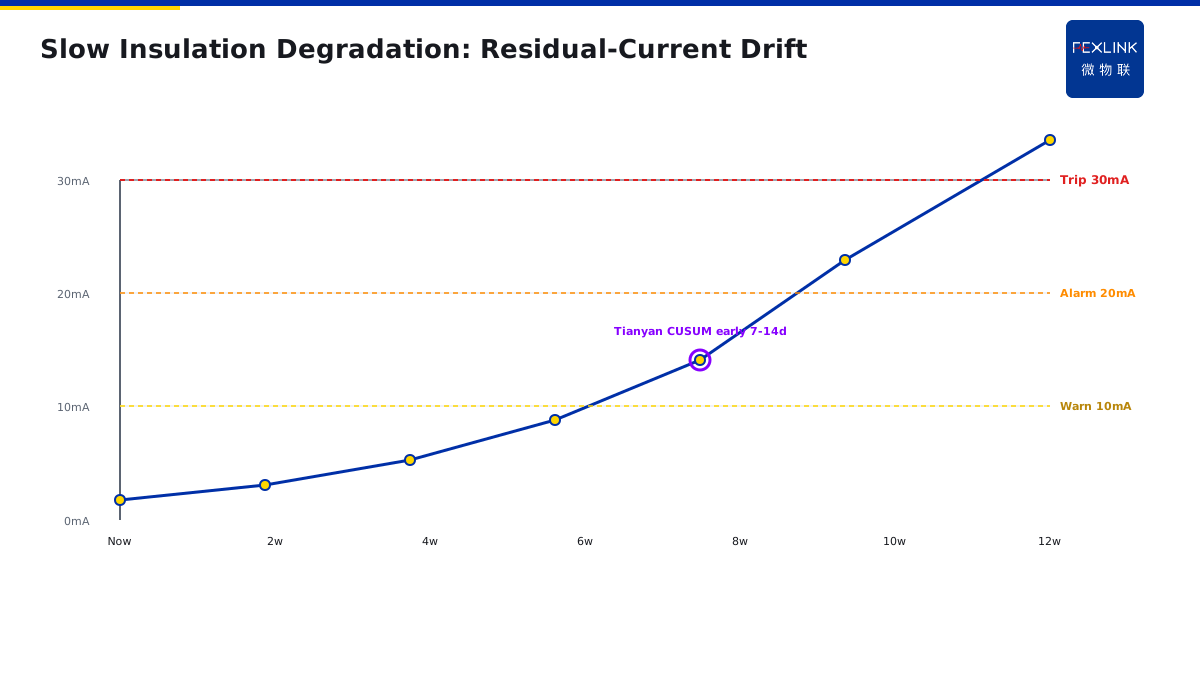
Direct Answer
When an RCD will not reset, the first step is neither to disconnect the neutral nor to swap the breaker. The first step is to recall *when* it trips.
- Trip the instant you switch it on — there is a hard fault: direct earth leakage, a live-to-frame short, N-PE cross-connection, or a dead RCD. You must power off and trace it.
- Trip after running for minutes/hours/days — the fault is soft: insulation is slowly degrading in damp conditions, capacitive leakage is drifting upward, or harmonics from VFDs/SMPS are interfering. You need trend data, not a screwdriver on the neutral.
The veteran line "just disconnect the neutral and try" only isolates one cause: whether the fault lies on the N side or is an N-PE cross-connection. It does nothing for live-to-frame faults, wiring errors, or slow insulation drift. Treating it as a universal fix is gambling.
1. What the RCD Is Actually Measuring
Before diagnosing, understand the zero-sequence current transformer (ZCT) inside the RCD.
The RCD's core is a toroidal magnetic core through which both line (L) and neutral (N) pass. Under normal operation, current flowing out on L equals current returning on N; the two fluxes cancel, and the secondary winding sees nothing. When a person touches live parts or equipment leaks, part of the current returns via PE/earth rather than N, and the vector sum of L and N currents is no longer zero. That difference is the residual current IΔ. When IΔ exceeds the setting (e.g. 30 mA), the RCD trips.
This physics fixes two facts:
- The RCD only sees current that "left but did not come back". It ignores overload and short-circuit—that is the MCB's job.
- If N is accidentally bonded to PE somewhere downstream, normal load current is treated as residual, because part of the N current escapes via PE. This is exactly why N-PE cross-connection always trips an RCD.
With these two facts, every fault below can be reasoned out.
2. Instant Trip on Switch-On: Four Hard Faults
2.1 Live-to-frame short (most common)
Internal insulation breakdown puts the L conductor directly against the metal enclosure. If the enclosure is earthed, fault current flows L → frame → PE, bypassing N. Residual current may be hundreds of mA or even amps, and the RCD trips instantly.
Test: disconnect all downstream loads and switch on with no load. If it holds empty but trips when a specific device is plugged in, the fault is inside that device.
2.2 N-PE cross-connection (the one "disconnect the neutral" catches)
Wherever N is bonded to PE where it should not be—in a socket box, by a previous installer—part of the working current escapes via PE. Even without an actual fault, normal load current is flagged as residual.
This is the case the veteran trick catches: disconnecting the output-side N line physically separates N from PE downstream, the cross-connection path is broken, and the RCD holds. But this only proves "some N current is escaping downstream"; it tells you nothing about *where*, and reconnecting N restores the trip.
2.3 Wiring errors
- L and N reversed: RCD may hold but downstream equipment can burn.
- L and PE reversed: instant trip.
- Shared N across circuits: one N passes through multiple RCDs, and each RCD sees N current that belongs to other circuits—false residual is guaranteed.
2.4 Dead RCD itself
After a decade in service, the tripping mechanism fatigues, ZCT characteristics drift, or surge damage kills the electronics. The RCD trips on its own even with no leakage. Test: remove all downstream wires and try to switch on the bare RCD. If it still will not hold, replace it.
3. Mid-operation Trip: Soft Faults the Neutral Trick Cannot Fix
If the RCD holds on switch-on but trips after 30 minutes to several hours under load, the physics is different.
3.1 Damp insulation degrading over time
Cable-trench water, plum rain season, ageing outdoor gland seals: insulation resistance drifts from hundreds of MΩ down to a few MΩ. Earth leakage IΔ = U / R_insulation. At 220 V:
- R = 2.2 MΩ → IΔ = 0.1 mA (fine)
- R = 22 kΩ → IΔ = 10 mA (approaching)
- R = 7.3 kΩ → IΔ = 30 mA (trip)
This may take weeks. Nobody sees it on site; the breaker trips on a damp night.
3.2 Rising capacitive leakage
Long cables and many VFDs/SMPS mean large distributed capacitance. Capacitive leakage IΔ = 2πf·C·U. Higher frequency and longer cable both increase leakage. In wet seasons, capacitive and resistive leakage add up and easily breach 30 mA.
3.3 Harmonics and DC component
VFDs, LED drivers and SMPS produce pulsating DC residual current. A plain Type AC RCD may be blind to it; a Type A RCD, sensitive to pulsating DC, may nuisance-trip. Old breakers should be upgraded to Type A.
For these three causes, disconnecting the neutral forever changes nothing: the fault is not a wiring error, it is the cable slowly getting worse.
4. The Correct Troubleshooting Sequence
Step 1—empty switch-on. Disconnect every downstream load and branch, leave only the RCD itself.
- Will not hold empty → RCD is dead; replace.
- Holds empty → go to step 2.
Step 2—energize branches one by one. With all branches off, switch them on one at a time. Whichever branch trips when switched on is the faulted branch.
Step 3—bisect the faulted branch. Disconnect all loads on that branch and energize empty:
- Holds empty but trips when a load is connected → internal live-to-frame fault in that load.
- Trips even empty → cable fault (insulation breakdown or N-PE cross-bond). Megger L-N, L-PE and N-PE.
Step 4—for mid-operation trips, a Megger reading is not enough. It tells you insulation today, not next month. This is where online residual-current monitoring earns its place.
5. How Online Monitoring Catches a Circuit "About to Fail"
A traditional RCD only acts at 30 mA; the previous 29 mA are invisible. The FEXLINK ESF electrical-fire monitor continuously measures residual current:
- Threshold alarms: warn at 10 mA, pre-alarm at 20 mA—notify O&R long before the 30 mA trip point;
- Tianyan S-02 CUSUM trend: residual current rises 0.2 mA per day; each day looks normal, but two weeks of accumulation reaches 30 mA. CUSUM flags this slow drift 7–14 days ahead;
- FECB2SLP smart breaker is itself an RCD with communications. It not only trips—it uploads *when* it tripped and *what IΔ was just before*.
A basement distribution circuit in one park was seen by ESF climbing from 2 mA to 18 mA. The trend alarm raised a Taiyi work order; on opening the gland box, O&R found a cable chewed by a rat—outer sheath only, not yet through. The fault was fixed in a non-outage window.
6. Three Forbidden Actions
- Shorting the test button / bypassing the trip mechanism—this disables the RCD entirely; injury or fire downstream is on you.
- Replacing an RCD with a plain MCB—omitting residual-current protection on domestic, wet-location or hand-tool circuits violates GB/T 13955.
- Repeated force-resetting—each failed attempt drives fault current through the contacts; a small fault is turned into a major short.
Scope and Limitations
Applies to end-circuit RCD troubleshooting in 0.4 kV LV systems. HV, IT systems and medical operating rooms require dedicated standards. "Disconnect the neutral" is a useful first-cut heuristic but not a substitute for the systematic sequence above. ESF/FECB2SLP descriptions are FEXLINK capability references; selection follows the latest catalogue.