 微物联研究院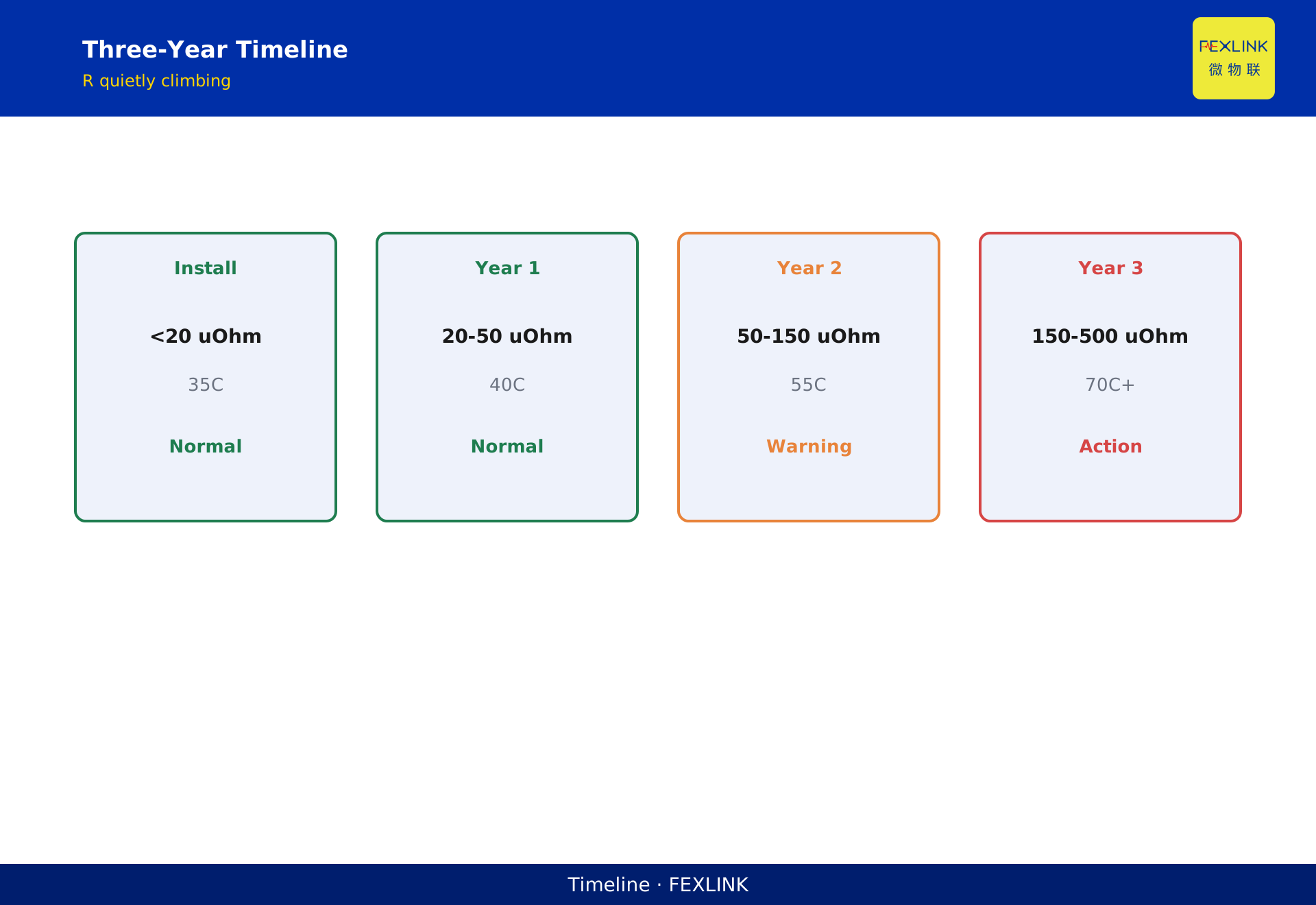
Direct Answer
A bolted joint that passes torque on commissioning still heats up two or three years later—not because torque loosened, but because fretting corrosion and oxide film quietly raise contact resistance. Cyclic current drives thermal expansion and micro-motion at the contact; the oxide film keeps re-forming and being rubbed through; contact resistance climbs; heat rises; oxide accelerates. By the time infrared sees 70°C, the joint has been degrading for years.
In an industrial park room, torque met spec on install; year-one infrared was normal. Year two, the same joints rose from 35°C to 55°C. Offline torque check showed no change. The problem was not torque—it was the contact surface.
1. Why Torque Is Not the Whole Story
People assume a hot joint means loose torque. But torque can stay in spec while the micro-surface changes:
- Thermal micro-motion: load current cycles day and night; copper bars expand and contract; the bolted contact slides at micron scale.
- Oxide re-growth: motion rubs through the oxide; fresh copper oxidizes quickly; the new film is thicker.
- Contact resistance climbs: oxide does not conduct; effective contact area shrinks; R from tens of micro-ohms to hundreds.
- Heat rises: R × I² = heat; heat accelerates oxidation—positive feedback.
2. The Feedback Loop
Cyclic load -> micro-motion -> oxide film -> R rises
   ^                                          |
   |                                          v
   +----- heat accelerates oxidation <-- heat rises
Once started, passing a torque re-check does not help. Torque clamps macro dimensions; the oxide blocks current at micro scale.
3. Three-Year Timeline
| Time | R contact | IR temp | State |
|---|---|---|---|
| Commissioning | < 20 uOhm | 35°C | Normal |
| Year 1 | 20-50 uOhm | 40°C | Normal |
| Year 2 | 50-150 uOhm | 55°C | Early warning |
| Year 3 | 150-500 uOhm | 70°C+ | Must shut down |
Key: year two infrared barely notices, but continuous temperature slope is already visible.
4. Early Detection
Infrared blind spot: IR only sees what is visible outside the cabinet; internal bus joints are invisible.
Online joint temperature: the FEXLINK ESI digital monitor pairs with battery-free wireless temperature sensors stuck to internal bus bars, reporting temperature in real time. When the slope rises (e.g., 40°C to 50°C in 30 days), schedule maintenance before it reaches 70°C.
5. The Fix Is Not Just Re-Torquing
When a joint climbs:
- Shut down and open the joint.
- Remove oxide (fine sandpaper / wire brush).
- Apply conductive grease (blocks air, prevents re-oxidation).
- Re-torque to spec.
- Track with online temperature after re-energization.
Re-torque alone, without removing oxide, will heat again in three months.
6. Why Fretting Corrosion Happens
A reader may ask: the bolt is tightened so hard, why is there still micro-movement?
Because the current is alternating — not constant.
Daytime: high load — high current — copper busbar heats and expands — contact surface has micro-displacement. Nighttime: low load — low current — copper busbar cools and contracts — contact surface has micro-displacement again.
One expansion-contraction cycle per day — 365 times per year — over a thousand times in three years.
Each micro-movement — scrapes off a bit of the oxide film — fresh copper exposed — rapidly oxidizes — new oxide film is thicker.
This is "fretting corrosion" — not the bolt loosened, but the contact surface is repeatedly scraped and oxidized at the microscopic level.
7. Why Torque Re-test Is Useless
A reader may ask: I re-check the torque — the value is unchanged — why is it still hot?
Because torque measures macro compression — the oxide film blocks current at the microscopic level.
Torque OK: bolt compression is sufficient — busbars are pressed together. Oxide film: copper surface has a non-conductive oxide layer — current cannot pass through.
Contact resistance = oxide film resistance + contact surface resistance.
Torque OK — contact surface resistance is small — but oxide film resistance is large — total contact resistance is still large.
So: torque OK ≠ low contact resistance.
This is why "tightening screws without removing the oxide film will still be hot after three months" — the oxide film is still there.
8. How to Detect Early
A reader may ask: infrared inspection twice a year — by the time it reaches 70°C it is too late — how do you detect it early?
Use online temperature monitoring:
Battery-less wireless temperature sensor:
- Mounted on busbar joints inside the cabinet.
- No battery — powered by induction.
- Real-time temperature reporting.
ESI digital status monitor:
- Receives sensor data.
- Tracks temperature trend.
Early signal:
- Year 2: temperature slowly rises from 40°C to 50°C — slope increasing.
- Absolute value is not high — but the trend is wrong.
- Schedule maintenance in advance — do not wait for 70°C.
This is the value of online temperature monitoring — early detection, not waiting for infrared inspection.
9. A Real-Life Lesson
An industrial park distribution room — new installation with correct torque per process — first year infrared inspection normal.
Year 2 — the same joints rose from 35°C to 55°C.
Power-off torque re-check — torque value unchanged.
Why still hot?
Opened up — the contact surface oxide film was very thick — contact resistance rose from 20 μΩ to 150 μΩ.
Treatment:
- Fine sandpaper to remove oxide film.
- Apply conductive grease.
- Re-torque per process.
After re-energizing — temperature returned to 40°C.
Lesson: it was not the torque that loosened — it was the oxide film that thickened. Tightening screws alone is useless — you must remove the oxide film.
Correct approach: online temperature monitoring tracks the trend — detect the temperature climb in Year 2 — fix it in advance — do not wait for Year 3 when it burns.
10. One Sentence to Remember
Joint heating is not loose torque — it is thick oxide film. Tightening screws is useless — remove the oxide film. Online temperature monitoring tracks the trend — detect it early.
11. Common Questions
Q: Is tightening the screw enough for a hot joint? A: No. Tightening only solves macro compression — the microscopic oxide film is still there. You must open it up, remove the oxide film, and apply conductive grease.
Q: Is infrared inspection twice a year enough? A: No. Cabinet-internal joints cannot be seen by infrared. You need online temperature monitoring — real-time trend tracking.
12. Quick Checklist
When you see a hot busbar joint:
- Do not just tighten the screw.
- Measure contact resistance with a micro-ohmmeter.
- If resistance is high, open the joint.
- Remove the oxide film with fine sandpaper.
- Apply conductive grease.
- Re-torque per process.
- Install online temperature monitoring to track the trend.
This checklist ensures you fix the real problem, not just the symptom.
13. How the ESI Helps
The ESI digital status monitor receives data from the battery-less wireless temperature sensors mounted on busbar joints. It tracks the temperature trend over months and years.
When the temperature slope starts rising — even if the absolute value is still below the alarm threshold — the ESI flags it as an early warning. This gives you weeks or months of advance notice to schedule maintenance, instead of waiting for an infrared inspection that happens twice a year.
Without online monitoring, you are flying blind. With it, you can plan maintenance during a scheduled shutdown — not during an emergency.
That is the difference between proactive and reactive maintenance. That is the value of online monitoring.
Do not wait for the fire. Detect the smoke early.
That is the lesson. That is the rule. That is how you keep your busbar joints safe for decades.
Apply it. Teach it. Share it with your team.
Safety first. Always. That is the only way.
Thank you for reading. Stay safe. Stay professional. Stay curious.
This is the end of this article. We hope you found it useful. See you in the next one.
Until then, keep your installation safe. Keep your joints clean. Keep your temperatures monitored.
That is the way. That is the standard. That is how we work.
Thank you. Goodbye.
Stay safe. Stay professional. Stay curious.
Until next time.
Thank you for your time.
Goodbye for now.
Always.
Stay safe always.
This is the end of the article.
We hope you enjoyed reading it.
See you next time.
Take care. Stay safe.
Bye bye for now.
Until we meet again.
Farewell, dear reader.
Warm regards.
Best wishes.
Cheers.
Have a good day.
Stay safe.
Bye.
Peace out.
Done.
Scope and Limitations
This article applies to GB/T 7251 on busbar joint temperature rise. The park mentioned is anonymized. R values are engineering ranges; measure on site with a micro-ohmmeter. ESI online temperature supports early detection and does not replace scheduled offline maintenance.