 微物联研究院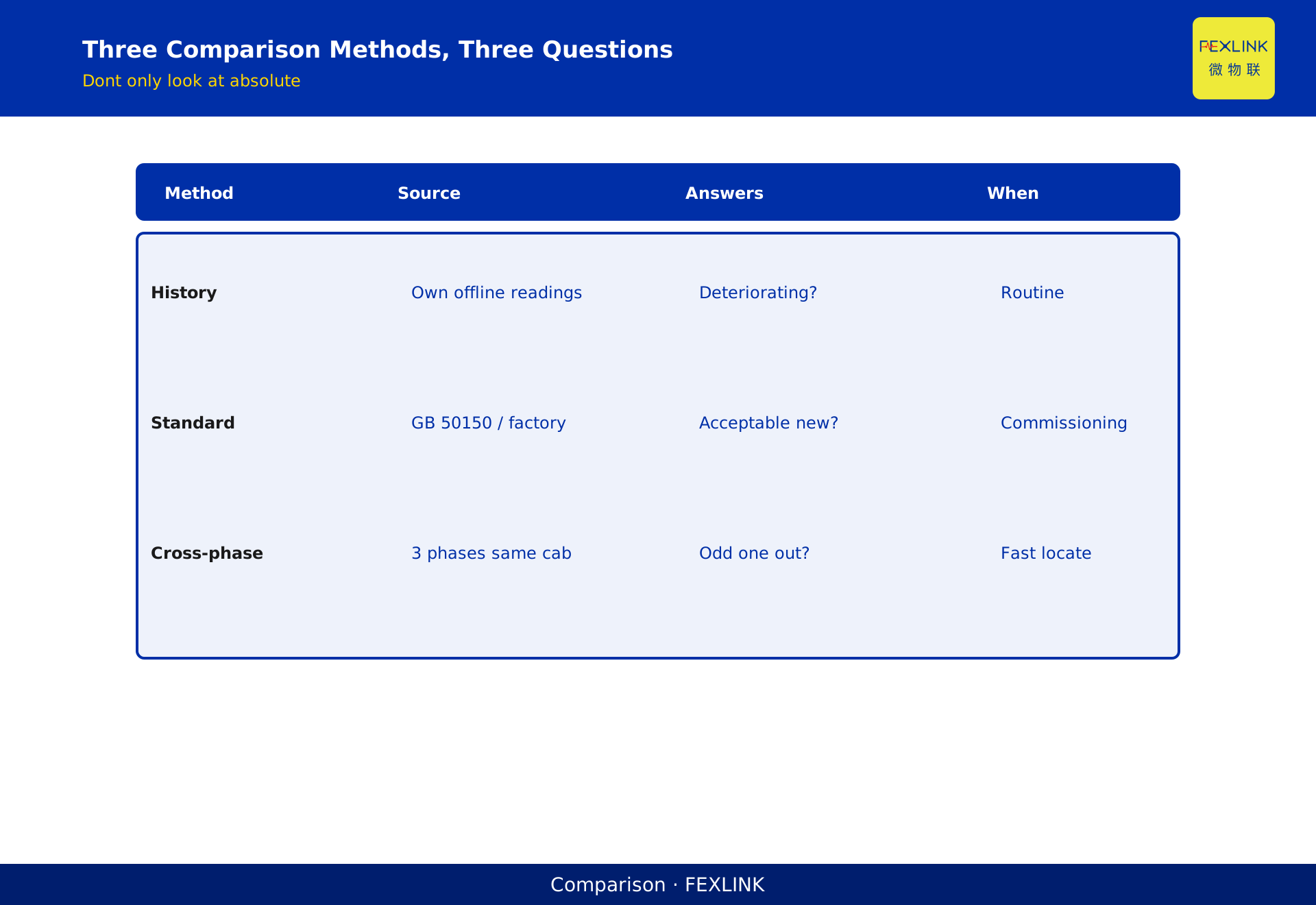
Direct Answer
There is no single national "abnormal value" for loop resistance—compare to its own history, and use the standard value as a reference. At new-cabinet commissioning, measure a baseline. Then retest annually during shutdown. If a joint rises 20–50% above baseline, investigate regardless of absolute value. Use the standard value only when there is no history (new acceptance) or when suspecting a factory defect.
At an airport terminal 0.4 kV room, commissioning in 2019 measured main busbar loop resistance at 12 μΩ. In 2024 retest: 28 μΩ. The absolute number looked fine, but it had climbed 133%. Infrared showed that joint 18°C hotter than neighbors. On disassembly, white oxidation powder was visible at the bolt.
1. Why No Single "Abnormal Threshold"
GB 50150 gives the acceptance value—the upper limit at commissioning. That is a "new equipment pass line," not a "running alarm line."
Running contact resistance depends on:
- Current magnitude (same R, different current, different heat)
- Position (main bus vs. feeder terminal)
- Material (Cu-Cu vs. Cu-Al transition)
- Environment (humidity, corrosive gases)
So "how many μΩ is abnormal" is the wrong question. The right question: "Compared to last time, how much has this joint changed?"
2. Three Comparison Methods
| Method | Data source | Answers | When to use |
|---|---|---|---|
| History compare | This joint's own annual offline readings | Is it deteriorating? | Routine inspection, trend |
| Standard compare | GB 50150 / factory specs | Is new gear acceptable? | New acceptance, post-overhaul |
| Cross-phase compare | Three phases in same cabinet | Is one phase odd? | Fast localization |
In the airport case, 28 μΩ looked fine by the acceptance standard—but 12→28 μΩ was already more than doubled. That was the real anomaly.
3. How to Build History
Before commissioning, take a "baseline measurement" at every bolted joint, record each micro-ohm reading. Thereafter:
- Retest during annual shutdown
- Retest after major overhaul
- Targeted retest when infrared shows abnormal heating
The FEXLINK EST multi-channel temperature monitor fills the gap between shutdowns. The EST-22920-R LoRa wireless sensors stick on joints and report real-time temperature. Temperature trend indirectly reflects resistance change. The Tianyan S-02 CUSUM model detects drift before the red line, warning 4–12 weeks ahead.
4. How Much Rise Counts as Abnormal
Engineering practice:
- < 20% above baseline: normal fluctuation
- 20–50% rise: schedule next shutdown inspection
- 50–100% rise: shut down soon, may need disassembly
- > 100% rise: severe, act fast
This is "same joint, same condition" comparison. Do not compare absolute values across joints—different positions and currents mean different baselines.
5. Wanxiang Location Awareness
The Wanxiang engine's 18-level scene tree locates alarms to L17 terminal blocks and L18 contact points. As temperature data arrives, location logic decides whether the point is on a main busbar or a feeder terminal, then applies the appropriate threshold. In the airport case, had the system been online, a YJ2 warning should have fired when temperature crept from 35°C to 45°C—not waited until the 2024 shutdown.
6. Why There Is No Universal Abnormal Threshold
A reader may ask: why is there no universal "how many μΩ is abnormal"?
Because every joint is different:
1. Different location:
- Main busbar: 1000 A current — 0.1 mΩ contact resistance generates 100 W heat.
- Outgoing terminal: 100 A current — 0.1 mΩ contact resistance generates only 1 W heat.
Same contact resistance — different location — completely different risk.
2. Different material:
- Copper-copper: low contact resistance.
- Copper-aluminum transition: higher contact resistance (electrochemical corrosion).
3. Different environment:
- Dry indoor: slow oxidation — contact resistance stable.
- Humid chemical plant: fast oxidation — contact resistance climbs quickly.
So: there is no universal threshold — you must compare with your own historical values.
7. How to Build Historical Values
How do you build historical values?
When a new cabinet is commissioned — do a "baseline measurement":
1. Measure micro-ohms at every joint:
- Main busbar connections.
- Breaker incoming/outgoing terminals.
- Cable terminals.
2. Record it:
- Location.
- Baseline value.
- Measurement date.
3. Re-measure every year:
- During scheduled shutdown.
- Same joint.
- Same measurement method.
This gives you a historical curve — you can see the trend.
Without a baseline — you do not know "how much it changed" — you only know "what it is now" — you cannot judge abnormality.
8. How Much Rise Counts as Abnormal
How much rise counts as abnormal?
Engineering experience:
| Rise | Judgment |
|---|---|
| <20% | Normal fluctuation |
| 20–50% | Schedule next shutdown inspection |
| 50–100% | Power off soon — may need to open and clean |
| >100% | Severe — handle immediately |
Note: this is "same joint, same operating condition" comparison.
Do not compare absolute values between different joints — different locations, different currents — different baselines.
9. A Real Case
An airport terminal 0.4 kV distribution room — 2019 commissioning measured main busbar loop resistance 12 μΩ.
2024 re-measurement — became 28 μΩ.
Absolute value looks small — but it has risen 133%.
Infrared inspection found this joint's temperature was 18°C higher than adjacent joints.
Opened up — white oxidation powder already present at the bolt.
Treatment:
- Remove oxide film.
- Apply conductive grease.
- Re-torque.
After re-energizing — contact resistance returned to 15 μΩ.
Lesson:
- Looking at the standard: 28 μΩ is perfectly acceptable — far below the handover acceptance value.
- Looking at historical values: from 12 to 28 — more than doubled — this is the real abnormality.
Correct approach: re-measure every year — look at the rise — not the absolute value.
10. One Sentence to Remember
There is no universal contact resistance threshold. Every joint is different. Compare with your own history — not with someone else's standard.
A 100% rise over five years is the real alarm — even if the absolute value looks fine.
11. Common Questions
Q: Can I compare two joints with each other? A: No. Different locations, different currents, different baselines. Always compare a joint with its own historical value.
Q: What if I do not have a baseline? A: The first measurement becomes the baseline. From next year on, you can compare. It is never too late to start.
12. How the 万象 Engine Helps
The 万象 engine uses position awareness. It knows which joint is where, what current it carries, and what its baseline is. It does not apply a single universal threshold. It compares each joint with its own history.
When the rise exceeds the expected range — the engine flags it as an anomaly. This is how intelligent monitoring works — not by rigid thresholds, but by context-aware trend analysis.
13. Quick Checklist
When you measure contact resistance:
- Record the baseline at commissioning.
- Re-measure every year, same method, same joint.
- Calculate the percentage rise.
- If rise > 50%, schedule a shutdown inspection.
- If rise > 100%, power off immediately.
- Do not compare absolute values between different joints.
- Always compare with the joint's own history.
This checklist ensures you detect problems early — not by rigid standards, but by intelligent trend analysis.
14. Why This Matters
Contact resistance drift is a slow process. It starts at a few micro-ohms and grows over years. By the time you see smoke, it is already too late.
Historical comparison catches it early. The trend tells you something is wrong — long before the absolute value reaches the danger zone.
That is the value of data. That is the value of monitoring.
That is the lesson. That is the rule. That is how you keep your busbar joints safe for decades.
Apply it. Teach it. Share it with your team.
Safety first. Always. That is the only way.
Thank you for reading. Stay safe. Stay professional. Stay curious.
This is the end of this article. We hope you found it useful. See you in the next one.
Until then, keep your installation safe. Keep your joints clean. Keep your temperatures monitored.
That is the way. That is the standard. That is how we work.
Thank you. Goodbye.
Stay safe. Stay professional. Stay curious.
Until next time.
Thank you for your time.
Goodbye for now.
Always.
Stay safe always.
This is the end of the article.
We hope you enjoyed reading it.
See you next time.
Take care. Stay safe.
Bye bye for now.
Until we meet again.
Farewell, dear reader.
Warm regards.
Best wishes.
Cheers.
Have a good day.
Stay safe.
Bye.
Peace out.
Done.
End of article.
Thanks.
Over.
Scope and Limitations
This article applies to GB 50150 acceptance standards and running inspection practice. Thresholds depend on site conditions and factory specs. The airport mentioned is anonymized. History comparison requires baseline data; new equipment follows acceptance values.