 微物联研究院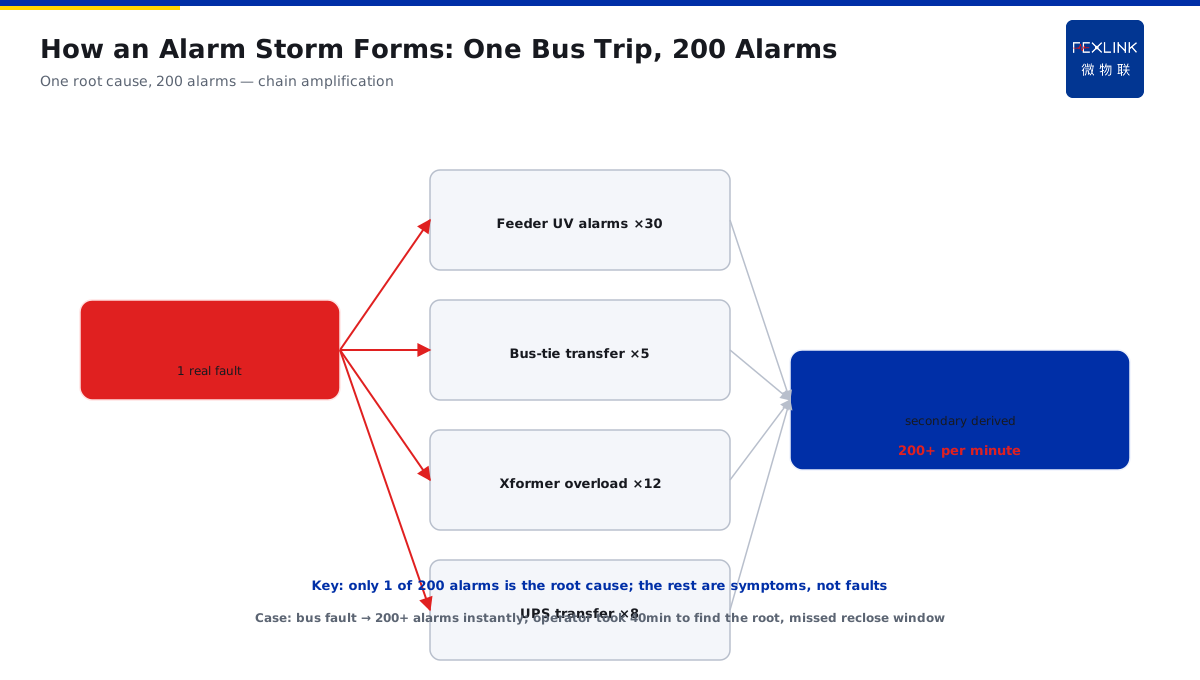
Direct Answer
Alarm storm means: the more monitoring you install, the fewer alarms anyone actually reads — because alarm volume explodes, operators are overwhelmed, and the truly important one gets buried.
Many factories install smart monitoring systems, thinking that once installed, everything is fine. Result: first week after go-live, alarms go from a few per day to hundreds per day. Operators cannot keep up, start "confirm all," and the truly important alarm gets missed.
- Alarm volume: how many alarms you receive per day — maybe 500;
- Effective alarms: how many actually need human action — maybe 5;
- The other 495: repeats, correlations, false alarms, no action needed.
Key insight: the problem is not "too many alarms," but "not compressing correlated alarms into one event". One transformer fault triggers temperature alarm, current alarm, oil level alarm, vibration alarm — four alarms are actually one fault, should be one event.
At one industrial park, after the monitoring system went live for a month, the shift lead complained: hundreds of alarms per day, impossible to review. Then the platform did correlation compression — alarms from the same device within the same time window merged into one event. Alarm volume dropped from 500/day to 20/day. Not a single important alarm was lost.
1. How Alarm Storm Forms
Alarm storm does not form in a day, it worsens step by step:
Step 1: More sensors keep getting added
- Temperature, current, voltage, vibration, humidity...
- Every sensor has a threshold;
- Threshold exceeded = alarm.
Step 2: Alarm volume starts rising
- Each sensor sends a few alarms per day;
- 100 sensors = hundreds per day;
- Operators start falling behind.
Step 3: False and repeat alarms pile up
- One fault triggers multiple alarms;
- Sensors themselves false-alarm;
- Alarm volume further balloons.
Step 4: Operators go numb
- Cannot keep up, start "confirm all";
- Truly important alarms also get "confirmed away";
- System gets "deafer" the more you install.
Key: the essence of alarm storm is "one fault = multiple alarms," no correlation compression done.
2. Alarm Volume vs Effective Alarm Volume
Why look at "effective alarms" not just "alarm volume"?
Because most alarms do not need human action:
- Temperature exceeded by 0.5°C — no action needed;
- Same device repeated alarms — no need to handle twice;
- Sensor false alarm — no action needed;
- Instantaneous fluctuation — no action needed.
Alarms that truly need human action may be only 1%.
Example:
- One park gets 500 alarms per day;
- 400 of them are the same transformer temperature repeatedly exceeding (one problem, 400 alarms);
- 50 are sensor false alarms;
- 45 are instantaneous fluctuations;
- Only 5 truly need action.
Key: do not look at total alarm volume, look at effective alarm rate. When effective volume drops, operators can actually focus on what matters.
3. Why Correlation Compression Reduces Alarm Volume
What is correlation compression? Merging "multiple alarms from the same fault" into one event.
Example:
- One transformer fault;
- Triggers temperature alarm, current alarm, oil level alarm, vibration alarm — four alarms;
- After correlation compression: merged into one "transformer fault event," containing four dimensions of info.
Effect:
- Was 4 alarms, now 1 event;
- Operators see "one problem," not "four problems";
- Alarm volume down 75%.
FEXLINK Wanxiang engine does exactly this: 18-level scenario tree, correlates alarms across sensors and dimensions, auto-merges into events. Alarm volume drops, effective alarms not a single one lost.
4. Why Threshold Sensitivity Causes Alarm Storm
Why not set thresholds too sensitive?
Because:
- Threshold too sensitive — slight exceed = alarm;
- Alarm volume explodes;
- Operators cannot keep up;
- Truly important alarms buried.
Correct approach:
- Do not alarm on single-point exceed alone;
- Combine "exceed + duration + trend" three conditions;
- E.g., temperature exceeds by 2°C and lasts 10 minutes = alarm;
- This way alarm volume drops, and they are all real problems.
FEXLink Tianyan engine S-02 does this: CUSUM trend warning, not single-point exceed, but trend change. Trend abnormal = alarm, not instantaneous fluctuation.
5. Health Score vs Single-Point Threshold
Why is "health score" better than "single-point threshold"?
Because single-point threshold has a problem:
- Each metric has a threshold;
- Metrics are isolated from each other;
- One metric slightly exceeds = alarm;
- But actually may be normal fluctuation.
Health score is different:
- Combine all metrics, calculate one "health score";
- Health score 90+ = normal;
- 70-90 = watch;
- Below 70 = alarm.
Benefits:
- No alarm on single metric fluctuation;
- Comprehensive judgment, more accurate;
- Alarm volume down, effective rate up.
This is FEXLINK Taiyi Zhikong's approach: not looking at single-point exceed, but overall health. Health drops, then alarm.
6. A Real Case
One hospital, after monitoring system went live:
- Week 1: 300 alarms per day;
- Nurses cannot keep up, start "confirm all";
- Week 2: truly important fire alarm was "confirmed away";
- Almost a major incident.
Then did three things:
- Correlation compression: same device same time alarms merged into events;
- Threshold optimization: single-point exceed not alarm, sustained exceed = alarm;
- Health score: comprehensive judgment, not single-point.
Result:
- Alarm volume from 300/day to 15/day;
- Effective alarm rate from 2% to 80%;
- Operators can finally focus on what matters.
7. Three Common On-Site Mistakes
Mistake 1: more sensors = better. No. More sensors without correlation compression = alarm storm.
Mistake 2: more sensitive thresholds = better. No. Too sensitive = alarm storm, truly important alarms buried.
Mistake 3: only look at alarm volume, not effective rate. High alarm volume does not mean good system. High effective rate means good system.
8. One Sentence to Remember
Alarm storm essence is "one fault = multiple alarms," no correlation compression. Correlation compression + trend warning + health score — three moves, alarm volume down, effective alarms not one lost.
Do not let the system get "deafer" the more you install. Make it "smarter."
9. Common Questions
Q: How many alarms per day is normal? A: Key is not the number, but effective alarm rate. If 20 alarms per day, 80% effective, that is good. If 500 per day, only 2% effective, that is alarm storm.
Q: Will correlation compression miss important alarms? A: No. Correlation compression merges multiple alarms into one event, the event contains all dimensions of info, not deletes. Actually because info is more concentrated, operators see the focus easier.
10. Why This Is Becoming More Important
Facilities used to have a few alarms per day, operators could review each one. Now with smart monitoring, hundreds of alarms per day is common. Without correlation compression, operators drown in alarms.
That is why alarm management is not just a feature, it is a critical system capability. A monitoring system that gives you 500 alarms a day is worse than one that gives you 20. Because the 500 one trains you to ignore everything.
Stay safe. Stay professional. Stay curious.
11. Quick Checklist
Before you go live with your next monitoring system, run through this checklist:
- Have you planned for correlation compression, not just sensor count?
- Have you set thresholds with duration and trend, not just single-point exceed?
- Have you measured effective alarm rate, not just total alarm volume?
- Have you thought about operator fatigue from too many alarms?
- Have you tested what happens on day one of go-live, not just in the demo?
If you answered "no" to most of these, your system is about to become another alarm storm. You will spend more money on sensors, and operators will ignore everything.
The FEXLINK platform is built to avoid this. Wanxiang engine correlates alarms across dimensions. Tianyan S-02 does trend-based warning, not single-point. Taiyi Zhikong calculates health scores, not just thresholds. The result: fewer, better alarms that operators actually read.
12. How to Build a Routine
A good alarm management routine starts before go-live. Spend time tuning thresholds with real historical data. Do not just use the default values. Set up correlation rules for known fault patterns. Define what counts as an event, not just an alarm.
After go-live, review alarm data weekly. Which alarms are repeats? Which are false? Tune them. Over time, the system gets sharper. Alarm volume drops, effective rate climbs. Operators trust the system again.
This is not a one-time project. It is an ongoing tuning process. The systems that work well are the ones that someone is actively tuning. The ones that fail are the ones that go live and get forgotten.
Start today. Look at your last week of alarms. How many were repeats? How many were false? How many truly needed action? Start there.
Final Thoughts
Alarm storm is the silent failure mode of monitoring systems. Nobody plans for it. It creeps up slowly. First you add sensors, then alarms grow, then operators numb out, then real incidents get missed.
But it is solvable. Correlation compression. Trend-based warning. Health scoring. These are not optional features anymore. They are what separates a monitoring system that works from one that just generates noise.
Do it smart. Do it early. Do it with data.