 微物联研究院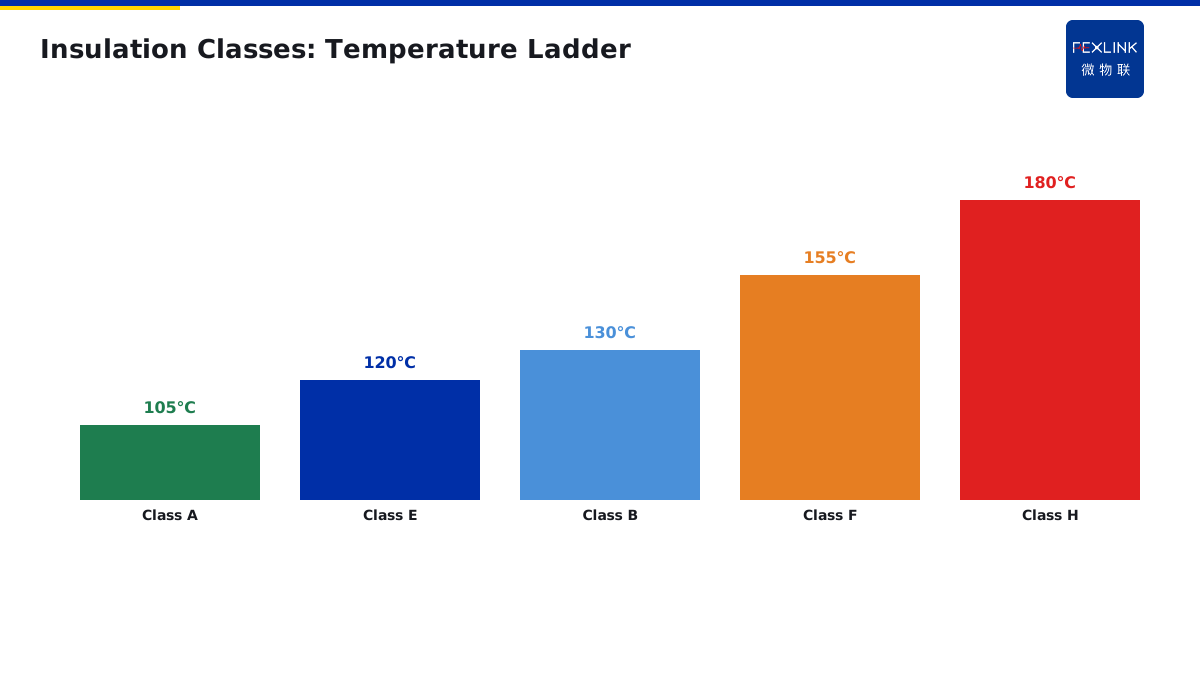
Direct Answer
Insulation class is graded by the long-term temperature limit of insulating materials: Class A 105°C, E 120°C, B 130°C, F 155°C, H 180°C. This is the basis for temperature-rise limits and alarm thresholds.
The same motor may have Class F windings but Class B bearing grease. Temperature alarms must be derived from the lowest-rated component, not one number for the whole machine.
1. The Five Classes
| Class | Max temp | Typical materials |
|---|---|---|
| A | 105°C | Varnished wire, cotton |
| E | 120°C | Polyester film, epoxy |
| B | 130°C | Mica tape, glass ribbon |
| F | 155°C | Modified epoxy, polyimide |
| H | 180°C | Silicone resin, polyimide |
LV motors are commonly Class F today, but usually tested against Class B rise (with 25°C margin).
2. The 10°C Halving Rule
Insulation life scales exponentially with temperature. Every 8–10°C rise halves insulation life.
Class F insulation at 155°C is designed for ~20 years life. Running at 165°C cuts that to 10 years; at 175°C, 5 years. That is why temperature monitoring must catch rising trends early, not wait for the alarm.
3. Different Parts, Different Classes
A 75 kW motor:
- Stator winding: Class F (155°C);
- Bearing grease: Class B (130°C);
- Terminal-box seal: Class A (105°C).
If you set one alarm at 150°C, the bearing may already be running at 140°C—grease ageing accelerates while the winding looks safe.
Correct practice: set per-component thresholds from the lowest-rated part. EST-22920-R supports 8 independent temperature channels with independent thresholds.
4. Reading Temperature-Rise Limits
"Rise 80 K" on the nameplate means: at 40°C ambient, winding max = 120°C (40+80). That 80 K is set for Class B.
Class F motors typically allow 100 K rise (40+100=140°C), but many manufacturers test against Class B (80 K), keeping a 20 K margin—the industry convention of "Class F insulation, Class B rise."
5. Field Case
One pump motor ran at 135°C year-round. The crew saw "Class F, under 155°C" and felt safe. Opening it, the bearing grease had already dried—the bearing is Class B (130°C), exceeded by 5°C. Per-component thresholds (winding 140°C, bearing 120°C) would have alarmed long before.
6. Why F-Class Insulation Is Tested at B-Class Rise
You may ask: if the insulation is F-class (155°C), why test temperature rise at B-class (130°C)?
The answer is: leave margin.
F-class insulation is designed for 20-year life at 155°C. But in real operation, temperature is not constant — load fluctuates, ambient temperature changes, cooling conditions vary.
If you set the threshold at 155°C, the motor frequently runs at 140–150°C — long-term, insulation life drops from 20 years to 10 years.
Testing at B-class (130°C) means the motor typically runs at 110–120°C — leaving 25–35°C margin. This margin is what protects the life.
This is why industry practice is "F-class insulation, B-class rise" — materials upgraded, but test standard does not follow, trading margin for life.
7. Three Stages of Insulation Aging
Insulation does not fail suddenly — it ages progressively:
Stage 1: Slow aging (0–5 years). Insulation slowly becomes brittle, mechanical strength drops, but electrical performance still normal.
Stage 2: Accelerated aging (5–10 years). Insulation resistance starts to drop, partial discharge begins. If you do an insulation resistance test at this point, the reading is 30–50% lower than when new.
Stage 3: Rapid failure (10+ years). Insulation resistance drops sharply, partial discharge becomes frequent, finally breakdown.
Higher temperature accelerates all three stages. F-class insulation at 155°C lasts 20 years total; if it actually runs at 165°C, it may reach stage 3 in only 10 years.
The value of temperature monitoring: catch problems in stage 2 — insulation resistance dropping, partial discharge increasing — schedule maintenance early, do not wait for stage 3 breakdown.
8. Transformer Insulation Classes Are Different from Motors
You may ask: do transformers also use A/E/B/F/H classes?
Transformer insulation systems are more complex, because transformers contain oil — oil-immersed transformer insulation classes are based on oil temperature rating:
- Class A oil: 105°C.
- Class B oil: 130°C.
- Class F oil: 155°C.
Dry-type transformer insulation classes are the same as motors: A/E/B/F/H.
But transformer temperature monitoring is more complex — you need to measure top-oil temperature, winding temperature, and core temperature, three points. WB-TM-01/02 wireless temperature nodes measure transformer top-oil temperature.
9. Why Temperature Monitoring Must Be by Location
You may ask: can't you just measure one temperature per motor? Why by location?
Because different parts of the motor have different temperature ratings, and different failure modes:
- High winding temperature: overload or insulation aging.
- High bearing temperature: grease aging or bearing wear.
- High core temperature: core insulation damage (increased eddy currents).
- High terminal box temperature: loose connection terminals.
Each part's high temperature has different causes and different treatments. If you only measure one total temperature, you do not know where the problem is.
EST-22920-R multi-channel temperature controller supports 8 independent channels — 2 winding, 2 bearing, 2 core, 2 terminal box. Each point has its own threshold and independent alarm.
This is why "multi-point temperature" beats "single-point temperature" — single point only tells you "the motor is hot", multi-point tells you "where it is hot and why".
10. How to Set Temperature Thresholds for Your Equipment
Setting temperature thresholds on site: three steps.
- Check nameplate: see which insulation class (F or B).
- Check location: each part has different temperature rating; bearings and seals may be lower than windings.
- Leave 20% margin: maximum allowable temperature × 0.8 = alarm threshold.
Example: F-class winding (155°C), set alarm threshold at 125°C (not 155°C). B-class bearing (130°C), set alarm at 105°C.
Leaving 20% margin gives you reaction time for sudden temperature rise — the motor will not burn the moment it hits threshold; you have time to schedule maintenance.
11. One Sentence to Remember
Insulation class is not just a nameplate number — it is a lifetime budget. Every 10°C above rating halves the life. Leave 20% margin on thresholds, and monitor temperature by location, not just one point.
12. Common Questions
Q: My motor is F-class — can I run it at 155°C? A: You can, but you are spending your lifetime budget. At 155°C continuous, the motor lasts 20 years. At 165°C, it lasts 10 years. At 175°C, it lasts 5 years. Every 10°C above rating halves the life.
Q: What if I measure only one temperature? A: You will know the motor is hot, but you will not know where. Winding hot means overload; bearing hot means lubrication; terminal box hot means loose connection. Different problems, different solutions.
13. Quick Checklist
When setting up temperature monitoring:
- Check nameplate — insulation class (F or B).
- Check each part — bearings and seals may have lower rating.
- Set threshold at 80% of max — leave margin.
- Monitor by location — winding, bearing, core, terminal box.
- Use multi-channel controller — EST-22920-R for 8 channels.
- Set separate thresholds per channel — not one global threshold.
- Document settings — for future maintenance.
This checklist covers the main points. Do not skip any.
14. Why This Matters
Insulation temperature is the single most important factor in motor life. Every 10°C above rating halves the life. This is not a rule of thumb — it is physics, confirmed by decades of insulation research.
Every year, motors fail because they ran too hot for too long. The winding insulation breaks down, the phases short together, and the motor burns out. Replacement is expensive, plus production downtime.
These are not rare events. These are everyday events. And they are preventable.
The problem is that most people do not understand insulation classes. They see a motor nameplate, see "Class F", and think "great, 155°C, we have margin". They do not realize that running at 155°C means the motor only lasts 20 years — and if it actually runs at 165°C, it only lasts 10 years.
That is why you need to understand insulation classes. That is why you need to leave margin. That is why you need to monitor temperature by location, not just one point.
Insulation life is a budget. You spend it by running hot. Spend it wisely, and your motor lasts 20 years. Spend it recklessly, and you will be replacing it in 5 years.
This article gave you the fundamentals. Apply them to your next motor. Teach them to your team. Share them with your colleagues.
Stay safe. Stay professional. Stay curious.
Thank you for reading. Goodbye. Stay safe. See ya later.
Peace out now. Goodbye now. Take care now. Bye bye now.
Until next time. Over and out. Done now. End now.
Farewell now. Bye now. Peace now.
See ya. Done.
Done.
Scope and Limitations
Applies to LV motor and transformer insulation-class interpretation. EST series are FEXLINK references; parameters follow the latest catalogue.