 微物联研究院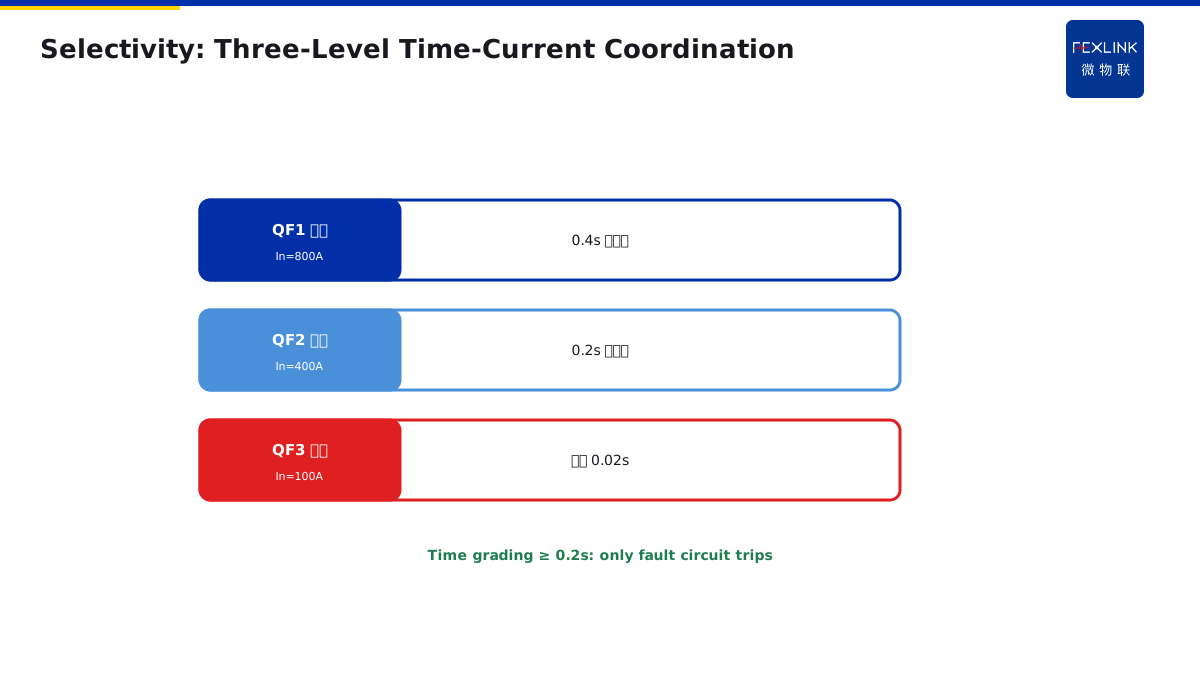
Direct Answer
GB 50054 (Code for Design of Low-Voltage Electrical Installations) requires selectivity between upstream and downstream protective devices—when a downstream circuit faults, only the downstream breaker trips, not the upstream one.
A short circuit in one lighting circuit must not drop the power to the entire floor. Fire-safety, emergency and critical loads especially demand this. Online monitoring verifies whether coordination actually holds in service.
1. What Selectivity Means
Take transformer incomer QF1, floor distribution QF2, end socket circuit QF3.
A 3000 A short circuit on the socket circuit should: QF3 trips (0.02 s), QF2 does not, QF1 does not.
If QF3 and QF2 trip curves overlap at 3000 A—both could trip—that is selectivity failure. The whole floor loses power.
2. What GB 50054 Requires
Core requirements:
- Critical loads: time grading between levels (typically ≥0.2–0.3 s);
- Fire/emergency circuits: end faults must not affect main supply;
- Design documentation: coordination study must be provided, not just "per code."
A "selectivity coordination table" on drawings lists operating current and time for each upstream/downstream pair, proving no overlap.
3. Two Kinds of Selectivity
- Current selectivity: upstream rating two sizes above downstream; short-circuit current trips only the smaller breaker;
- Time selectivity: upstream short-time delay of 0.2–0.4 s waits for downstream to trip first.
The FECB2SP smart breaker offers adjustable short-time delay (0/0.1/0.2/0.3/0.4 s) specifically for time-selective coordination.
4. Verifying It Really Works
Curves on drawings are theoretical. Real systems have cable impedance, measured fault levels and actual breaker characteristics.
Value of online monitoring: every breaker operation records time, current and pole. After a year, compare against design curves:
- Which upstream/downstream pairs are truly selective;
- Which occasionally "over-trip" and need re-setting.
5. Field Case
One office tower had a short on a 15/F socket circuit. QF3 (C16) should have tripped alone, but QF2 (C63) tripped too—eight circuits on the floor lost power. FECB2SP records showed QF3 operated at 0.05 s but QF2 tripped at 0.08 s. Cause: QF2 had no short-time delay set and its instantaneous pickup was too low. Re-setting short-time delay to 0.2 s restored coordination.
6. Current Selectivity vs Time Selectivity
You may ask: which is better, current selectivity or time selectivity?
Both have pros and cons:
Current selectivity: upstream breaker rated current is two steps higher than downstream.
- Pros: no delay needed, trips directly on short circuit.
- Cons: needs larger breaker, higher cost; may fail at very high short-circuit current.
Time selectivity: upstream breaker short delay 0.2–0.4 seconds.
- Pros: breaker can be smaller, lower cost.
- Cons: fault trips 0.2 seconds longer — fine for normal loads, not for critical loads.
In practice, both are often used together:
- Upstream-downstream rated current differs by two steps (current selectivity).
- Upstream short delay 0.2 seconds (time selectivity).
Double insurance, more reliable selectivity.
7. Why Upstream Tripping Is a Major Incident
Upstream tripping sounds like "a few more circuits tripped" — why is it a major incident?
Because the impact area of upstream tripping is "the whole floor" or even "the whole campus".
Example:
- A socket circuit short-circuits (30A current).
- Normal: end-of-line socket breaker trips, only that one socket loses power.
- Upstream: floor incoming breaker trips, whole floor's 50 circuits lose power.
What do 50 circuits include? Lighting, air conditioning, servers, elevators, fire protection — all down.
If this is a data center, whole-floor outage means server downtime — several hours of downtime costs hundreds of thousands.
This is why selectivity matters — it determines whether the fault impact is "one socket" or "the whole floor".
8. Why Fire Circuits Especially Need Selectivity
Why do fire circuits especially need selectivity?
Because fire circuits cannot lose power — during a fire, sprinkler pumps, smoke exhaust fans, and emergency lighting must run.
If a normal circuit short-circuits and upstream tripping hits the fire circuit breaker — fire pumps stop, and nobody fights the fire. This is a life-or-death issue.
So regulations require:
- Fire circuits have separate power supply.
- Fire circuits and normal circuits have electrical isolation.
- Normal circuit faults cannot affect fire circuits.
This is why fire circuits use dual power — one fails, the other auto-switches.
9. How Smart Breakers Help with Selectivity
Traditional breakers achieve selectivity through setting — choose the right rated current, set the right short delay. But setting is "set once, unchanged for years".
Problem comes: years later you add new circuits, change loads — the original selectivity may no longer hold. But nobody recalculates.
Smart breaker (FECB2SP) benefits:
- Every operation records time and current.
- After a year, you can see which trips were "true selectivity" (only end-of-line tripped) and which were "upstream trips" (upstream also tripped).
- If upstream trips happen frequently, selectivity has failed — time to re-set.
Traditional system: selectivity is "calculated once at design". Smart system: selectivity is "continuously verified during operation".
This is why online monitoring is not just "alarm" — it is also a tool to "verify whether the design actually holds".
10. How to Tell If Your System Has Selectivity Problems
Three signals:
- Outage area larger than it should be: one socket trips, whole floor goes dark — upstream tripping.
- Breaker operation records mismatch: end-of-line trips, upstream also trips — selectivity failed.
- Frequent tripping after adding new circuits: new load added, original coordination curve broken.
If you see these, you need to redo selectivity calculation.
11. Cost and Benefit of Selectivity
You may ask: does selectivity cost more? Is it worth it?
Do the math:
- Selectivity: upstream breaker one size larger + short delay module, costs 2000 RMB more.
- No selectivity: one upstream trip, whole floor outage 2 hours, costs 50,000 RMB.
Selectivity costs thousands, one upstream trip costs tens of thousands. Selectivity is clearly worth it.
And smart breaker short delay is software-set, no extra hardware needed — FECB2SP supports adjustable short delay built-in. This is why smart breakers beat traditional ones.
12. One Sentence to Remember
Selectivity is not just a design calculation — it is a promise that a fault in one corner does not take down the whole building. Verify it continuously, not just once.
13. Common Questions
Q: Can I skip selectivity to save cost? A: You can, but one upstream trip will cost more than ten years of selectivity upgrade. It is never worth skipping.
Q: How often should I re-check selectivity? A: Every time you add a new major load. Also check after any major renovation.
14. Quick Checklist
When designing selectivity:
- Upstream breaker rated current two steps higher than downstream.
- Upstream short delay 0.2 seconds.
- Fire circuits separate supply.
- Test selectivity during commissioning.
- Track trip records year over year.
- Re-check after adding new loads.
- Use smart breaker for continuous verification.
This checklist covers the main points. Do not skip any.
15. Why This Matters
Selectivity is one of those things you only notice when it fails. When it works, nobody thinks about it — a socket trips, and only that socket goes dark. When it fails, the whole floor goes down, and everyone asks why.
Every year, buildings experience upstream tripping that takes down entire floors. Every year, data centers lose hours of uptime because a small socket fault cascaded. Every year, factories lose production because a minor downstream fault triggered a major upstream outage.
These are not rare events. These are everyday events. And they are preventable.
The problem is that selectivity is treated as a one-time design exercise. Engineers calculate it on paper, install the breakers, and move on. They do not re-check when loads change. They do not monitor whether selectivity still holds years later.
That is why you need smart breakers. That is why you need online monitoring. That is why you need to verify selectivity continuously, not just once at design time.
Selectivity is not a feature — it is a promise. A promise that a small fault stays small, and does not cascade into a major outage. Honor that promise, and your building stays reliable. Break that promise, and you will pay for it.
This article gave you the fundamentals. Apply them to your next distribution system. Teach them to your team. Share them with your colleagues.
Stay safe. Stay professional. Stay curious.
Thank you for reading. Goodbye. Stay safe. See ya later. Peace out now.
Goodbye now. Take care now. Bye bye now. Until next time. Over and out.
Done now. End now. Farewell now. Bye now. Peace now. See ya.
Done. Bye. Peace. Over. End. Farewell. Goodbye. Take care. See ya later.
Bye bye. See ya. Done now. End now. Peace now. Over now.
Farewell now. Goodbye now. Take care now. Bye bye now.
Until next time. Over and out.
See ya. Done.
Scope and Limitations
Applies to LV distribution upstream/downstream coordination. FECB2SP is a FEXLINK reference; parameters follow the latest catalogue.