 微物联研究院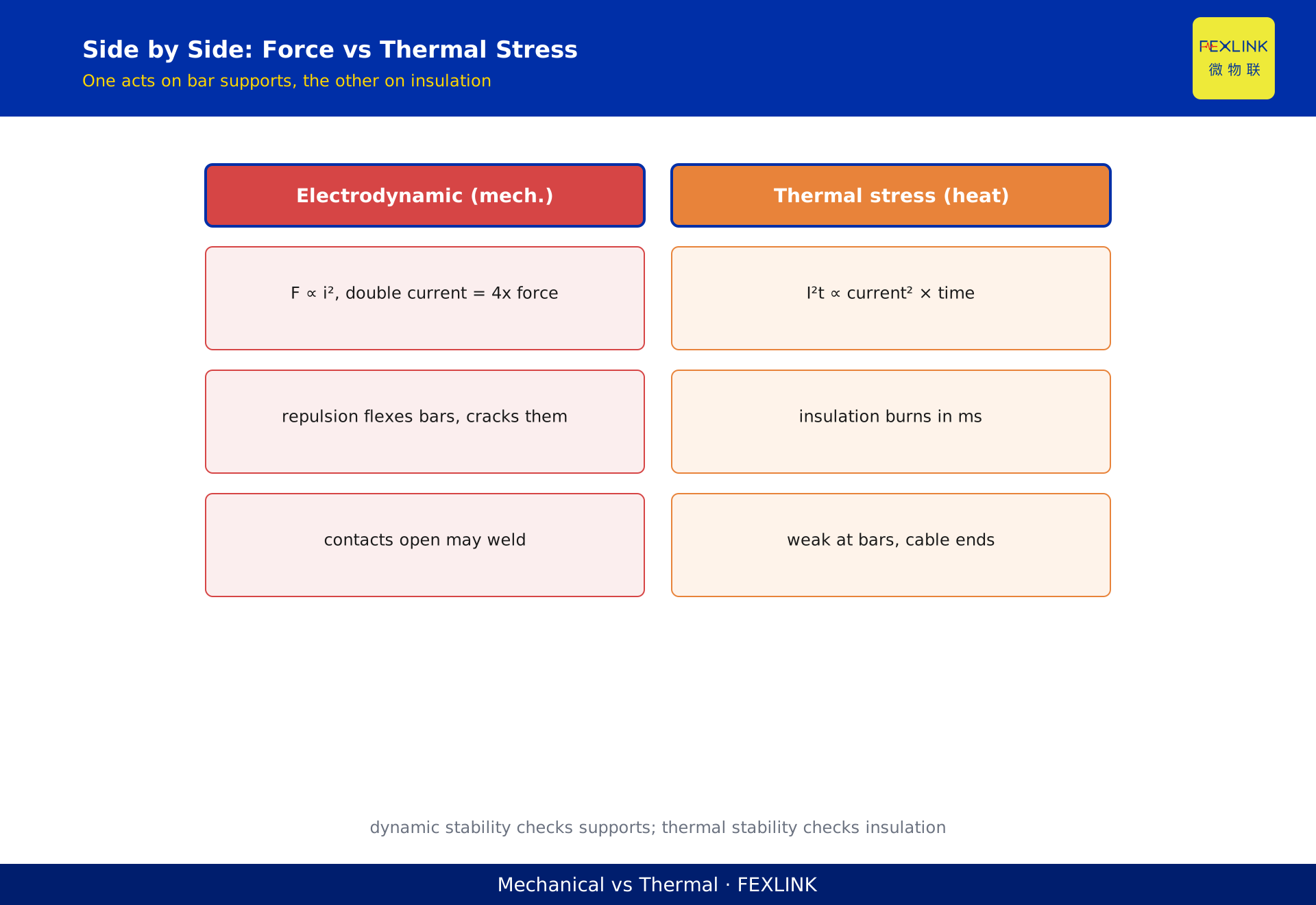
Direct Answer
In the few hundred milliseconds after a short circuit occurs, equipment must survive two kinds of damage at once. One is electrodynamic force: the attractive or repulsive force between parallel busbars is proportional to the square of the current. When the short-circuit current surges to tens of kiloamperes, busbar supports are cracked and the bars themselves flex. The other is thermal stress: the heat generated in an instant is measured by I²t, and insulation is carbonized or punctured in milliseconds. Together these two define why breaking speed is the critical factor—the faster the breaker clears, the shorter the duration of the electrodynamic peak and the smaller the accumulated I²t, and the safer the equipment.
So when you judge a breaker, it is not enough to ask "can it break"; you must ask "how fast it breaks." GB/T 14048.2 sets requirements on short-circuit breaking capacity and operating time for low-voltage switchgear. A smart breaker such as the FECB2SP trips instantly on a short, uploads the current peak and tripping time to the platform, and—together with the early-warning system for electrical hidden-fault detection—stops the fault through temperature, arc sound, and partial-discharge signals before the short ever forms.
1. A Short Is Not "Slightly Larger," It Is Instant Destruction
Many people picture a short as "the current being much larger," but the real danger is not the magnitude—it is how fast it rises. Under normal load the current is steady, and heating and mechanical stress stay within design margin. Once a short occurs, the current reaches its peak in less than half a mains cycle (half of 20 ms).
That peak has two faces: the rms periodic component governs the "thermal," while the peak (about twice the rms) governs the "mechanical." The thermal hits insulation and conductor cross-section; the mechanical hits busbar supports, contacts, and structures. The breaker's job is to cut the loop before these two forces tear the equipment apart.
This is why short-circuit protection is called "instantaneous": unlike overload, which waits through an inverse-time delay, it must act in milliseconds. One extra mains cycle and busbars and insulation take a whole step up in damage.
2. Electrodynamic Force: F ∝ i²—Double the Current, Four Times the Force
Parallel current-carrying conductors exert force: same-direction currents attract, opposite-direction repel. The force per unit length F is proportional to the square of the current i² and inversely to conductor spacing.
That square law is the key. At a few hundred amperes of normal operation the force between bars is trivial and supports are sized conventionally. Once the short surges to 30 kA or 50 kA, i² magnifies the force hundreds to thousands of times: the repulsion between bars can flex them apart, and the insulating supports holding them can crack or shatter. Inside a switch, the force between contacts can even push them open; if contact pressure is insufficient, they melt and weld under the heavy current.
This is why busbars must be checked for short-circuit dynamic stability, and why support insulators must be rated for the peak. One distribution box at a port, opened after a near-end short, showed cracked support insulators and slightly deformed fixing bolts—all from that electrodynamic peak, even though the fault never burned outside the cabinet.
3. Thermal Stress: I²t—Insulation Burned Through in Milliseconds
Electrodynamic force handles the "mechanical," thermal stress handles the "heat." The heat generated as short current flows is proportional to current squared times time, expressed in engineering as I²t.
Under normal load the conductor is sized for continuous current and temperature rise stays in range. On a short the current is tens to hundreds of times rated; even lasting only tens to hundreds of milliseconds, the I²t is enough to make conductors and insulation spike. Once insulation exceeds its withstand temperature it carbonizes, embrittles, or punctures. Between bars, at cable ends, and at breaker line terminals are the weak points.
So protective apparatus has both a breaking capacity Icu and an allowable I²t. The two must match the equipment's thermal withstand to ensure the heat generated during breaking does not burn through it. The longer the clearing time, the larger the accumulated I²t and the greater the thermal damage.
4. Why Fast Clearing Is Safe—Time Decides Everything
Put the two together and the conclusion is direct: short-circuit protection safety rests almost entirely on clearing time.
At the same fault point, cutting clearing time from 100 ms to 20 ms: the electrodynamic peak arrives in an instant regardless, but the total time current flows shortens, reducing the total mechanical energy; and I²t is proportional to time, so five times faster means one fifth of the heat. This is why modern breakers aim at "current-limiting" breaking—starting to cut before the current even reaches its peak, so that maximum electrodynamic peak never fully acts on the equipment.
Slow or refused clearing is costly: current keeps flowing, supports crack, insulation burns, the arc does not go out, and it ends in cabinet rupture and electrical fire. One lighting feeder at an airport shorted; the end switch's instantaneous setting was too high and did not trip, so the upstream main breaker cleared nearly 200 ms too late—when opened, the cable-end insulation was already charred.
5. How a Smart Breaker Shortens Those Milliseconds
The FECB2SP's first role in a short loop is fast instantaneous tripping: the moment current exceeds the instantaneous setting it acts, with no inverse-time delay. Second, it uploads each short event's current peak, trip instant, and clearing time to the platform, so operations knows "how big this short was and how fast it was cut."
More valuable is the data loop. Covering 1P/2P 16 A/32 A at AC 230 V and 3P/4P 32 A/63 A at AC 400 V with RS485, the FECB2SP records short events that, together with loop voltage and current monitoring, continuously verify the real fault current, the breaker speed, and how close the circuit sits to its breaking limit. When a feeder repeats near-short events, the platform flags wiring or rating risk instead of waiting for a real short to test the switch.
A current-limiting breaker works by opening so fast that the prospective peak current never fully develops—contacts begin to part within milliseconds, an arc forms, and the arc impedance itself chokes the current before it reaches the theoretical peak. That is why two breakers with the same nominal Icu can differ dramatically in the real stress they let equipment survive: the slower one lets the full electrodynamic peak act on the busbars, while the current-limiting one clips it. On a retrofit, comparing the logged clearing time against the calculated prospective peak tells you whether the existing switch is actually protecting the installation or merely clearing after the damage is done.
6. Hidden-Fault Warning: See It Before the Short Forms
One level above "fast clearing" is to prevent the short at all. Shorts rarely appear from nowhere; behind them lie aging insulation, overheating joints, partial discharge, and abnormal arc sound.
The early-warning system for electrical hidden-fault detection targets exactly this window. Through multi-dimensional sensing—temperature, arc sound, partial discharge—it warns before insulation breaks down into a short. As a joint's temperature climbs and discharge signals strengthen, the model identifies the features and alerts early; maintenance replaces aged insulation during a planned outage, and the short never happens.
The loop is then complete: warning stops hidden faults before the fact, the smart breaker clears fast during the event to protect equipment, and the platform re-checks the loop afterward with each short event. The two enemies—electrodynamic force and I²t—are resolved one by "never let it happen" and one by "cut fast."
Remember: short-circuit damage scales with the square of current and accumulates with time. So rely on warning to stop faults before the short, on the smart breaker to cut in milliseconds, and on the platform to continuously calibrate loop risk from every event.
Scope and Limits
This page covers the electrodynamic and thermal-stress mechanisms of low-voltage AC short circuits, per GB/T 14048.2. FECB2SP ratings and the early-warning system's capabilities come from the product knowledge base; actual operating time, I²t, and dynamic/thermal withstand must follow the product datasheet and on-site short-circuit calculation. The generic port and airport are anonymized. High-voltage, DC, generator faults, and dedicated dynamic/thermal verification must be done by qualified electrical design engineers.