 微物联研究院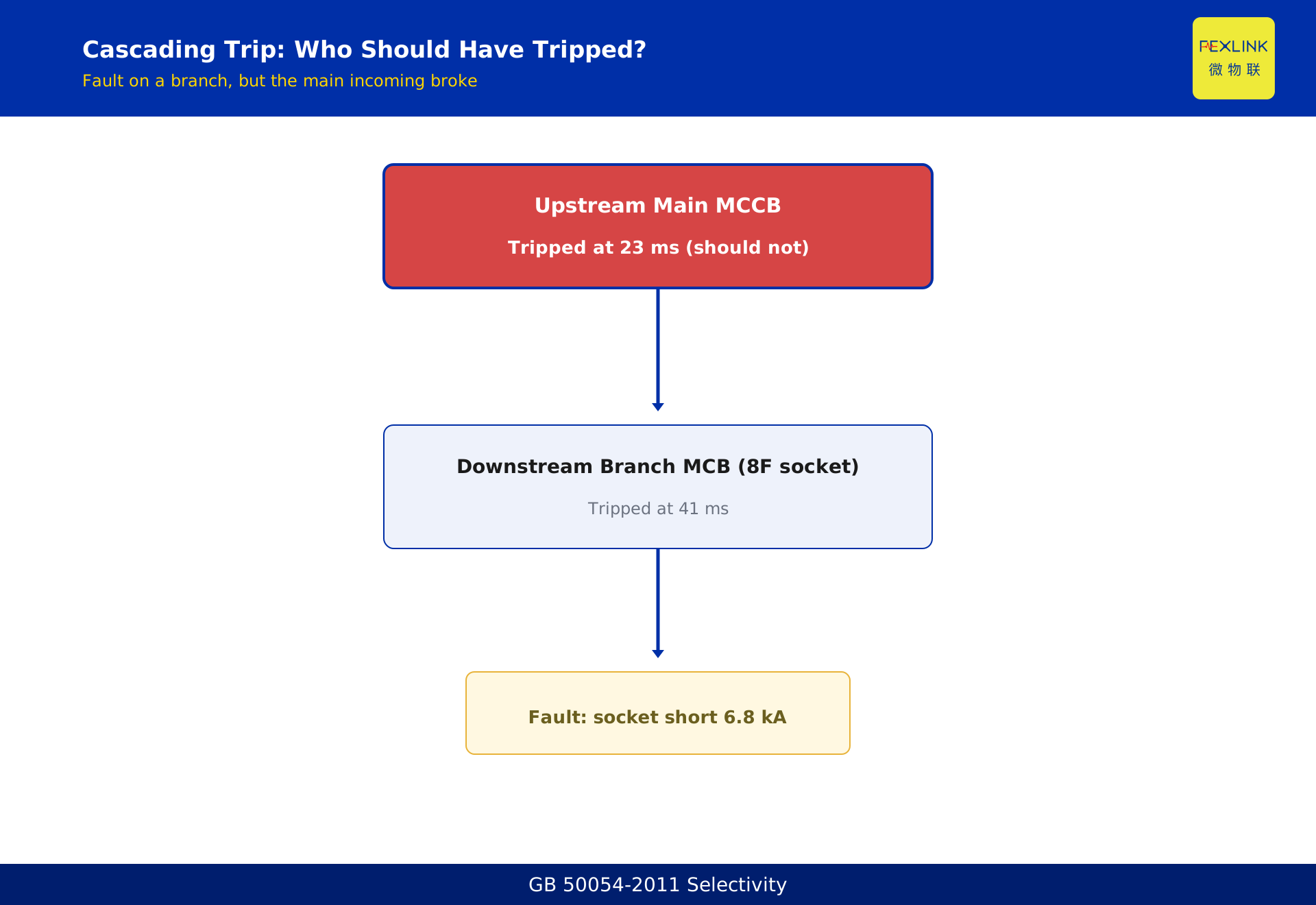
Direct Answer
Overcurrent selectivity failure = a downstream branch short-circuits, but the upstream incoming breaker trips first, darkening a whole floor or building. The root cause is not a "broken switch" but lost selectivity between upstream and downstream protection. The diagnostic order is fixed: first check whether the downstream breaker can actually interrupt the fault current, then check the time and current grading between upstream and downstream. Replacing a switch without fixing coordination means the next event will cascade again.
In a Grade-A office building, a socket circuit on the 8th floor shorted out—but the breaker that tripped was the basement incoming MCCB. The entire building was dark for two hours. Maintenance replaced the incoming breaker. Three months later it happened again. The real problem was never the breaker: the 8th-floor MCB's instantaneous threshold and the upstream MCCB's short-time delay were never coordinated.
1. What Is Selectivity—and What Is Cascading Trip?
A distribution system looks like an upside-down tree: transformer → main incoming breaker → floor distribution → branch breaker → end load.
Normal (selective coordination): only the segment closest to the fault trips; upstream stays energized. If an 8th-floor socket shorts, only the MCB in the 8th-floor distribution box should trip. Floors 1–7 and 9+ stay up.
Cascading trip (lost selectivity): the breaker closest to the fault does not trip; a much farther upstream breaker trips instead. The outage footprint expands from "one socket" to "a whole floor, a whole building."
GB 50054-2011, the Code for Design of Low-Voltage Electrical Installations, requires selective coordination between upstream and downstream protective devices.
2. Three Most Common Causes
Cause 1: downstream instantaneous setting overlaps upstream. A downstream MCB trips instantaneously at 5–10× In (Type C); the upstream MCCB's instantaneous pickup may land in the same band. When fault current falls in the overlap, both move—or the upstream one moves first.
Cause 2: downstream clears slower than upstream. The downstream breaker itself is slow to open, contacts part late, and the upstream has already tripped. Common when old, poor current-limiting breakers are used downstream.
Cause 3: both sides are instantaneous, no time grading. Downstream trips instantaneously, upstream trips instantaneously; who wins depends on hardware. There is deliberately no 0.2–0.4 s time margin.
3. Diagnostic Sequence (Follow This; Do Not Randomly Swap Breakers)
Step 1: locate the fault point. Use event records from the FECB2SP smart breaker or the ESI digital status monitor to identify which segment faulted, the fault current magnitude, and the operating time in milliseconds. Without data, send power segment by segment.
Step 2: check the downstream breaking characteristic. Does the fault current exceed the downstream instantaneous threshold? Is the downstream Icu adequate? If the downstream cannot clear at all, cascading is inevitable.
Step 3: check upstream/downstream time grading. Is the upstream on short-time delay (typically 0.2–0.4 s)? Is the downstream instantaneous? The operating time difference should be ≥ 0.2 s.
Step 4: check current grading. Is the upstream pickup clearly larger than the sum of downstream rated currents? When current grading is insufficient, fault current falls in the overlap band.
4. Where FECB2SP and ESI Fit
Post-event review of a cascading trip is hardest because nobody knows who tripped first, for how long, or what the fault current was.
The FEXLINK FECB2SP smart breaker sits on end branches. At the instant of opening, it records the current peak and operating time and uploads via RS485. The ESI digital status monitor sits on incoming lines and key nodes, collecting switch position, trip signals, and remote-change events. Together they reconstruct the full timeline:
- t = 0 ms: fault occurs;
- t = 12 ms: a branch FECB2SP sees the current peak;
- t = 38 ms: upstream MCCB trips (while the branch breaker has not yet reached its trip time).
With the timeline laid out, it is obvious whether the downstream was slow or the settings overlapped.
5. A Real Diagnosis in an Industrial Park (Anonymized)
In an industrial park factory building, an injection-machine branch shorted and cascaded to the workshop main incoming.
- FECB2SP record: branch fault current 6.8 kA; branch MCB was Type C 32 A, instantaneous threshold 160–320 A—it should have tripped.
- ESI record: workshop main MCCB tripped at 23 ms; branch MCB only began tripping at 41 ms.
- Conclusion: branch MCB breaking speed was slow (old model, poor current-limiting); upstream MCCB was instantaneous with no short-time delay.
- Fix: branch MCB upgraded to a high-breaking fast type; upstream MCCB short-time delay set to 0.3 s. No recurrence since.
6. One Sentence to Remember
Cascading trip is not a breaker-quality issue; it is a coordination issue. Swapping breakers treats the symptom; resetting time/current grading cures the cause.
7. How to Solve Upstream Tripping
A reader may ask: once upstream tripping is found, how do you fix it?
Three approaches:
1. Add a short delay on the upstream breaker:
- Upstream MCCB gets a short-time delay (0.2–0.4 s).
- Downstream breaker trips instantaneously.
- Time gap ≥ 0.2 s — downstream trips first, upstream does not.
2. Upgrade the downstream breaker to a faster type:
- Downstream MCB replaced with a high-breaking fast type.
- Clearing time drops from 40 ms to 10 ms.
- Downstream clears first — upstream stays closed.
3. Increase the current grading margin:
- Upstream setting = sum of downstream rated currents × 1.6.
- Fault current falls in the downstream instantaneous zone, not the upstream one.
These three can be combined — choose based on site conditions.
8. How to Set the Time Gap
How large should the time discrimination be?
Per GB 50054:
- Upstream–downstream time gap ≥ 0.2 s.
Why 0.2 s? Because:
- Downstream breaker takes 10–40 ms to clear.
- Upstream breaker delays 200 ms — giving downstream enough time to trip first.
If both are instantaneous:
- Who trips first depends entirely on hardware.
- Upstream tripping happens frequently.
If upstream delays 200 ms:
- Downstream has 200 ms to trip first.
- Downstream trips, upstream stays.
- Only if downstream fails to trip does upstream trip.
This is time selectivity — using a time gap to guarantee downstream trips first.
9. Common Questions
Q: Can I just replace the breaker to fix upstream tripping? A: No. Replacing the breaker treats the symptom, not the coordination problem — it will happen again. You must re-adjust the time/current grading.
10. A Real-Life Case
An industrial park had a recurring problem: a short on a small lighting circuit would trip the main incoming MCCB, cutting power to the entire building.
Investigation showed:
- Downstream breaker: C16 MCB, instantaneous threshold 80–160 A.
- Upstream breaker: 250 A MCCB, instantaneous threshold set to 5× = 1250 A.
- Calculated short-circuit current at the fault point: 800 A.
The problem: 800 A fell below both the downstream upper threshold (160 A) and the upstream lower threshold (1250 A)? No — wait, 800 A is above 160 A, so the downstream should have tripped. But the downstream MCB clearing time was 40 ms, while the upstream MCCB instantaneous response was only 20 ms. The upstream hardware was faster.
The fix:
- Upstream MCCB was reconfigured with a 200 ms short-time delay.
- Downstream MCB was replaced with a fast-clearing type (10 ms).
- Time gap: 200 ms − 10 ms = 190 ms — well above the 200 ms requirement.
After the fix, a similar downstream short tripped only the local breaker. The main incoming stayed closed. Entire-building outages stopped.
11. One Sentence to Remember
Upstream tripping is not a broken breaker — it is a coordination problem. Replacing breakers treats the symptom; re-adjusting time and current grading fixes the root cause.
12. How the FECB2SP Helps
The FECB2SP smart breaker records every trip event: peak current, clearing time, and trip type (long-delay vs instantaneous). When upstream tripping happens, you can pull the records from both breakers and see exactly what happened:
- Did the downstream breaker try to trip?
- How long did it take?
- Did the upstream trip before or after?
This turns a guesswork diagnosis into a data-driven one. Instead of swapping breakers blindly, you can verify the coordination problem with actual event records.
13. Quick Checklist
When diagnosing upstream tripping:
- Check if the downstream breaker actually tripped — or did the upstream trip first?
- Compare clearing times of both breakers.
- Verify the time gap is ≥ 0.2 s.
- Check if fault current falls in the downstream instantaneous zone.
- Re-adjust settings before replacing hardware.
This checklist ensures you fix the real problem, not just swap parts.
Scope and Limitations
This article applies to GB 50054-2011, low-voltage distribution design, regarding upstream/downstream selectivity. The office building and industrial park mentioned are anonymized examples. FECB2SP and ESI event records support post-event diagnosis, but specific grading calculations still require an electrical engineer to verify against site impedance and fault current.