 微物联研究院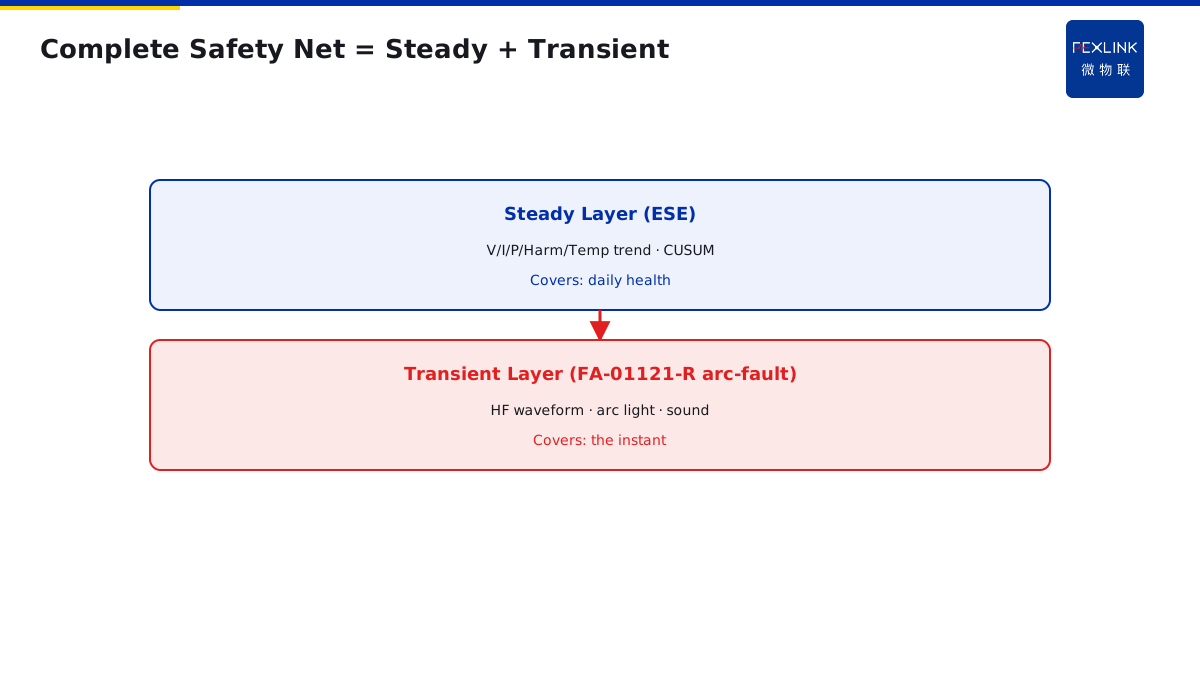
Direct Answer
Steady-state monitoring keeps the system healthy day to day; transient monitoring catches the instant an event happens. A complete electrical safety net = steady-state parameters + transient events, layered.
Switching, arc ignition, surge intrusion all appear as transients. Only measuring steady state means you see drift after the fact.
1. Steady State vs Transient
Steady state: averages of voltage, current, temperature, leakage—slow variation. Transient: microsecond-to-millisecond events—switching, arcs, surges, transient overvoltages.
Steady state is heart rate; transient is premature beats. Heart rate alone misses the beats.
2. Why Steady State Alone Is Not Enough
- Temperature can still be normal 5 minutes before an incident;
- An arc first ignites in tens of milliseconds;
- Surge intrusion lasts microseconds.
By the time a steady-state parameter trips, the event has already happened.
3. How the Two Layers Work Together
Steady layer (ESE power-quality monitor):
- Long-term trends of V/I/P/harmonics/temperature;
- CUSUM trend early warning;
- Catches "slow drift" issues.
Transient layer (FA-01121-R arc-fault module):
- HF current waveform (kHz–MHz);
- Arc light / sound;
- Captures the event instant.
Together: you know both daily health and what happened at the instant of fault.
4. Common Mistakes
- Steady-state meters only: post-incident history shows no event;
- Transient modules only: no daily health data;
- Layers not correlated: steady-state alarms and transient events live in separate silos.
5. What Steady-State Monitoring Detects
Steady-state monitoring tracks "slow variables" — temperature, current, voltage, leakage — these parameters change slowly.
Problems steady-state detects:
- Overload: current continuously exceeds rating — cable heats.
- Insulation aging: leakage current slowly increases — insulation resistance drops.
- Poor contact: temperature slowly rises — terminal oxidation.
- Power factor decline: reactive load grows — capacitor aging.
Characteristic of these problems: slow — develops over hours, days, weeks.
Value of steady-state: detect before it worsens — schedule planned maintenance.
6. What Transient Monitoring Detects
Transient monitoring tracks "fast variables" — microsecond to millisecond events.
Problems transient detects:
- Arc fault: high-frequency spikes from poor contact (kHz level).
- Surge intrusion: overvoltage from lightning or switching (μs level).
- Transient overvoltage: switching surge from breaker operation.
- Short-circuit event: waveform at the moment of short circuit.
Characteristic of these problems: fast — happens in an instant, then gone.
Steady-state cannot catch these — because steady-state is average, transients get averaged out.
7. Why Steady State Alone Is Not Enough
You may ask: steady-state monitoring is so comprehensive, why need transient?
Example:
A cabinet terminal comes loose — starts arcing.
Each arc lasts tens of milliseconds — to steady-state monitoring:
- Temperature: still 60°C (no change).
- Current: still 100A (no change).
- Leakage: still 50mA (no change).
Steady-state: all normal.
But in reality: arcing has already started — each arc erodes the terminal a little — slowly expands — finally burns through insulation, short circuit.
By the time steady-state sees "temperature rose to 85°C" — already half burned.
Transient monitoring: each arc event captured as high-frequency spike — alarms on the first arc.
This is why steady-state alone is not enough — steady-state is "look at drift after the fact", transient is "catch the event as it happens".
8. How the Two Layers Link
How do the two layers work together?
Steady layer detects slow trend: temperature slowly rises from 60°C to 70°C — CUSUM trend warning. Transient layer simultaneously catches events: during this period, any arcs? Any surges?
If steady warning + transient finds arc — temperature rise caused by arcing — schedule maintenance.
If steady warning + transient finds nothing — temperature rise caused by overload — reduce load.
Two layers linked, you can determine "why is temperature high" — arc? overload? poor contact?
Look at only one layer, you only know "temperature is high" — not why.
9. Why Arc Fault Requires Transient
You may ask: why can't arc faults be detected by steady-state monitoring?
Because arc faults are "intermittent" — not continuous.
A loose terminal:
- Normal: current flows, nothing.
- Vibration: terminal jumps open, arc forms (few milliseconds).
- Vibration stops: terminal contacts again.
This arc lasts only milliseconds — to steady-state monitoring:
- Average current: still 100A (no change).
- Average temperature: still 60°C (no change).
But in reality: each arc erodes the terminal — slowly expands.
FA-01121-R arc fault monitor module: sampling rate several hundred kHz — can catch millisecond high-frequency spikes.
This is why arc fault requires transient monitoring — steady-state cannot catch it.
10. A Real-Life Lesson
One factory installed ESE power quality monitor (steady-state) — voltage, current, temperature all measured.
Ran for one year, all normal — temperature 60°C, current 100A, leakage 50mA.
Then one night, the cabinet caught fire.
Afterward, looking at historical curves: temperature and current both normal — cannot see any problem.
Why? Because arc fault is transient — steady-state cannot catch it.
Lesson: steady-state alone is not enough — also need transient monitoring (FA-01121-R arc fault module).
Correct approach: steady-state (ESE) + transient (FA-01121-R) layered — both normal health and event capture.
11. Cost of Two-Layer Monitoring
You may ask: does two-layer monitoring cost a lot?
Steady-state (ESE power quality monitor): 5K per unit. Transient (FA-01121-R arc fault module): 3K per unit.
Two layers combined: 8K per cabinet.
Sounds like a lot.
But one electrical fire incident: burn one cabinet = 100K; one-day production loss = 200K.
One incident loss 300K vs two-layer monitoring 8K — the math is clear.
And two-layer monitoring is not "must install everywhere" — tier by risk:
12. Common Questions
Q: Can I upgrade from steady-state to two-layer later? A: Yes. Start with steady-state monitoring on all cabinets. Then add transient monitoring (arc fault modules) to critical cabinets as budget allows.
Q: What is the sampling rate requirement for arc fault detection? A: At least 10 kHz, preferably 100 kHz or higher. Below 10 kHz, you will miss the high-frequency spikes that characterize arc faults.
13. Quick Checklist
When planning monitoring layers:
- Identify critical cabinets — fire pumps, main transformers, incoming.
- Install steady-state on all cabinets — temperature, current, leakage.
- Install transient on critical cabinets — arc fault, surge, transient overvoltage.
- Link the two layers — correlate slow trends with fast events.
- Use trend warnings for slow problems, event alarms for fast problems.
This checklist covers the main points. Do not skip any.
14. Why This Matters
Two-layer monitoring is one of the most important concepts in modern electrical safety. Most facilities install sensors, set alarms, and call it done. They think monitoring is enough.
But monitoring without both layers is half-done. You see a slow trend. You do not know what caused it. You see a fast event. You do not know if it will cause a slow trend.
Every year, facilities experience electrical fires that could have been prevented with arc fault monitoring. Every year, temperature warnings go unheeded because operators do not know if it is overload or arc fault. Every year, maintenance teams waste hours troubleshooting because they only have one layer of data.
These are not rare events. These are everyday events in facilities that only invested in steady-state monitoring. And they are preventable.
The problem is that two-layer monitoring sounds expensive. It sounds like double the cost. It sounds like something you can skip.
But one fire event costs more than ten years of monitoring. One cabinet burned down costs more than a lifetime of sensors. One production stoppage costs more than all your monitoring equipment combined.
That is why you need both layers. That is why you need steady-state for slow problems and transient for fast problems. That is why you need to link them together.
This article gave you the fundamentals. Apply them to your next safety audit. Teach them to your team. Share them with your fire safety officer.
Stay safe. Stay professional. Stay curious.
15. Final Thoughts
Two-layer monitoring is one of those topics that sounds technical but has a very practical bottom line: safety. Whether you are protecting a factory, a data center, or a hospital, you need both layers.
The good news is that you do not need to install everything at once. Start with steady-state on all cabinets. Add transient on critical cabinets as budget allows.
Remember: your electrical system is only as safe as your weakest monitoring layer. Invest in both layers, and you will sleep better at night.
Start today. Audit your monitoring system. Are you only measuring steady state? If yes, you are missing half the picture. Add transient monitoring on critical cabinets, and you will be surprised how many events you catch.
Thank you for reading. Stay safe. Goodbye.
Keep learning. Keep improving. Stay curious.
Bye bye for now. See you soon.
Thank you. Goodbye.
Stay safe. Bye.
Goodbye now.
See you.
Bye.
Scope and Limitations
Applies to monitoring architecture design. ESE / FA-01121-R are FEXLINK references; parameters follow the latest catalogue.