 微物联研究院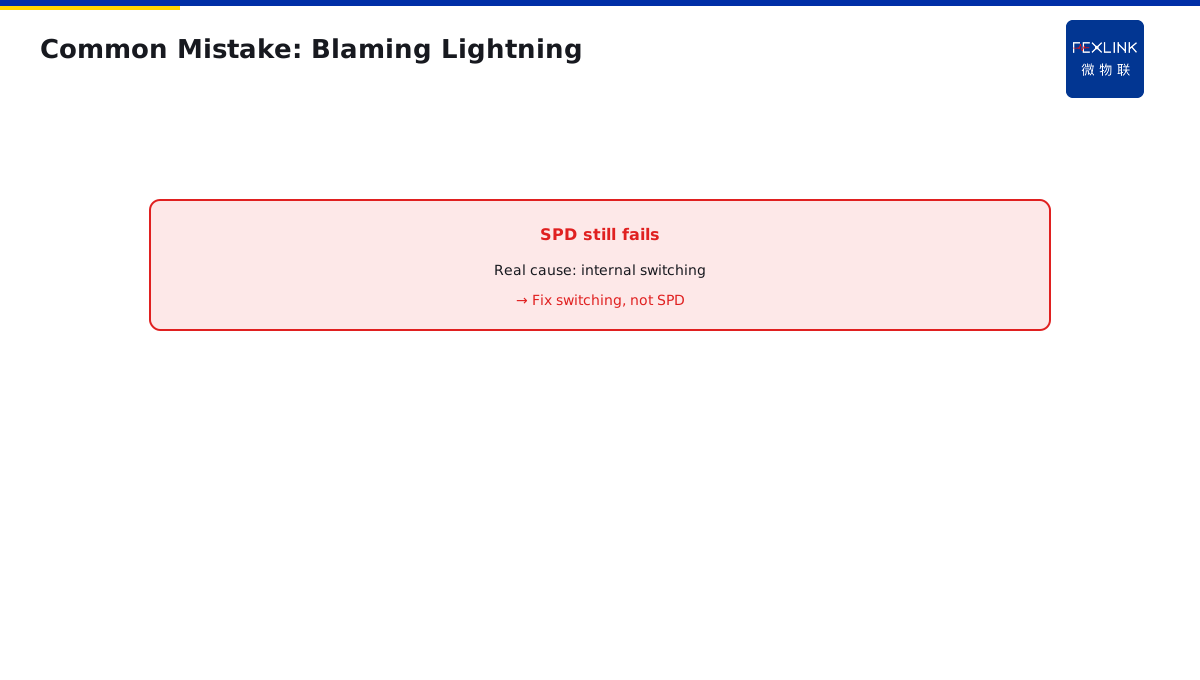
Direct Answer
Transient overvoltage splits into two sources, with different protection:
- Lightning surge: external, high amplitude, thunderstorm, protected by SPD;
- Switching surge: internal, from breaker / capacitor switching.
Don't lump them together. Correlate the event timestamp with weather logs and operating logs to tell which source it was.
1. Lightning Surge
- Source: direct or induced lightning;
- Timing: during thunderstorm;
- Amplitude: high (kV to tens of kV);
- Protection: SPD.
2. Switching Surge
- Source: local breaker / capacitor bank / VFD start;
- Timing: synchronized with a switching operation;
- Amplitude: moderate (a few times rated);
- Protection: soft-start, closing resistor, RC snubber.
3. How Monitoring Tells Them Apart
ESE power-quality monitor and ESP zero-to-ground monitor timestamp each transient. Cross-reference weather log (thunderstorm?) and operating log (any switching?) to attribute the source.
4. Common Mistakes
- Treating every transient as lightning: SPD fails again because the real cause is internal switching;
- Looking at amplitude but not timestamp: no idea if external or internal;
- No weather / operating correlation: post-incident analysis has no evidence.
5. How to Protect Against Lightning Surge
How does lightning surge enter?
Lightning strikes near the building — induces high-voltage pulse on power lines — travels along cable to cabinet — damages electronic equipment.
How to protect? Answer: SPD (surge protective device).
SPD installed at distribution cabinet incoming — normally high impedance, does not affect power use; when surge arrives, becomes low impedance — diverts surge current to ground.
SPD is staged:
- Level 1 SPD (Class B): installed in incoming cabinet, high current capacity (100kA).
- Level 2 SPD (Class C): installed in floor cabinet, medium current capacity (40kA).
- Level 3 SPD (Class D): installed in terminal cabinet, low current capacity (10kA).
Progressive diversion — if level 1 cannot block, level 2 blocks; if level 2 cannot block, level 3 blocks.
FS surge protective device monitor is for monitoring SPD status — see if SPD is aging, needs replacement.
6. How Switching Surge Is Generated
Where does switching surge come from?
Not lightning — generated by your own equipment.
Typical scenarios:
- Capacitor bank switching: at capacitor closing instant, resonates with system inductance — generates overvoltage.
- No-load transformer opening: current suddenly cut — inductance produces back EMF — overvoltage.
- VFD switching: IGBT high-frequency switching — produces spike overvoltage.
Characteristics of switching surge:
- Relatively low amplitude (2-3x rated voltage).
- High frequency (kHz level).
- Frequent occurrence (several switching operations daily).
Although amplitude is lower than lightning, frequency is high — long-term accumulation, equipment insulation slowly ages.
This is why switching surge also matters — not destroyed at once, but slowly aged.
7. Why Distinguish the Source
You may ask: both are overvoltage, why distinguish lightning vs switching?
Because protection approach is different:
Lightning surge: external — use SPD to divert. Switching surge: internal generated — treat at source (soft start, RC snubber).
If you think all overvoltage is lightning — installed SPD still fails — because it is internal switching surge, SPD cannot block it (SPD only blocks external surge).
Conversely: if you think all overvoltage is switching — do not install SPD — when real lightning hits, all equipment destroyed.
This is why distinguish source — treat the right cause.
8. How to Tell Lightning vs Switching
How to determine if transient overvoltage is lightning or switching?
Look at three dimensions:
1. Timing:
- Thunderstorm weather → lightning.
- Switching operation time → switching.
2. Amplitude:
- High amplitude (several kV to tens of kV) → lightning.
- Low amplitude (2-3x rated) → switching.
3. Frequency:
- A few times a year → lightning.
- Several times a day → switching.
ESE power quality monitor records timing and amplitude of each transient event — compare with weather records and operation logs, you can determine the source.
9. Why SPD Fails
You may ask: SPD installed, why does it still fail?
Because SPD is consumable — each time it diverts surge, it ages a little.
Inside SPD is a varistor — each overvoltage impulse, varistor performance drops a little.
After ten years: varistor ages — current capacity drops — next surge arrives, cannot block.
This is why monitor SPD status:
- FS surge protective device monitor measures SPD leakage current in real time.
- Leakage current increases → SPD aging → alarm.
- Replace SPD in advance — do not wait until it fails.
Consequence of not monitoring: SPD ages without you knowing — next surge cannot be blocked — all equipment destroyed.
10. A Real-Life Lesson
One data center installed SPD — thought lightning protection was fine.
Ran for two years, servers kept crashing — could not find cause.
Later used ESE power quality monitor to capture waveform — found switching overvoltage every night — caused by capacitor bank switching.
SPD only blocks lightning — does not block switching overvoltage. So servers were slowly tortured by switching overvoltage — finally crashed.
Lesson: installing SPD is not enough — must also distinguish overvoltage source.
Correct approach:
- Lightning surge: install SPD.
- Switching overvoltage: add RC snubber circuit.
- Use ESE to monitor all transient events — analyze source.
11. Cost of Transient Overvoltage Protection
Calculate the math:
- Level 1 SPD: 5K.
- Level 2 SPD: 2K.
- ESE power quality monitor: 5K.
- FS surge protective device monitor: 2K.
Total investment: 14K.
Sounds like a lot.
But one lightning strike destroying servers: loss 500K. One switching overvoltage causing equipment insulation aging: early equipment replacement 100K.
Protection investment 14K vs one incident 500K — the math is clear.
12. One Sentence to Remember
Transient overvoltage has two types: lightning comes from outside, switching is generated internally. Protection approach is different — do not install the wrong one.
13. Common Questions
Q: Can SPD block switching overvoltage? A: No. SPD is designed for external lightning surges. Switching overvoltage is internal — you need RC snubbers, soft starters, or filters.
Q: How often should I inspect SPD? A: At least once a year. Use FS monitor to track leakage current continuously. If leakage exceeds threshold, replace SPD immediately.
14. Quick Checklist
When planning overvoltage protection:
- Install SPD at incoming — level 1 for lightning.
- Install SPD at floor cabinets — level 2.
- Install SPD at terminal cabinets — level 3.
- Monitor SPD status with FS — track leakage current.
- Monitor all transients with ESE — analyze source.
- Add RC snubbers for switching overvoltage.
This checklist covers the main points. Do not skip any.
15. Why This Matters
Transient overvoltage protection is one of the most misunderstood topics in electrical engineering. Most facilities install SPD, check the box, and move on. They think lightning protection is done.
But lightning protection is not enough. Switching overvoltage is an invisible killer — it does not flash, it does not bang, it just slowly degrades insulation year after year. By the time you see the damage, it is too late.
Every year, data centers suffer mysterious server crashes that turn out to be switching surges. Every year, factories experience premature equipment failures that turn out to be accumulated insulation aging from daily switching. Every year, maintenance teams replace capacitors and contacts that should have lasted ten more years.
These are not rare events. These are everyday events in facilities that only protected against lightning. And they are preventable.
The problem is that transient overvoltage sounds abstract. It sounds like something only power engineers care about. It sounds like something you can ignore.
But one surge can destroy a thousand-dollar sensor. One surge can corrupt a PLC program. One surge can crash a production line.
That is why you need both layers of protection. That is why you need SPD for external lightning and RC snubbers for internal switching. That is why you need monitoring to tell the difference.
This article gave you the fundamentals. Apply them to your next power quality audit. Teach them to your maintenance team. Share them with your electrical engineer.
Stay safe. Stay professional. Stay curious.
16. Final Thoughts
Transient overvoltage is one of those topics that sounds technical but has a very practical bottom line: equipment lifespan. Whether you are protecting a data center, a factory, or a hospital, you need both layers.
The good news is that you do not need to spend a fortune. Start with SPD at incoming. Add RC snubbers where needed. Monitor everything.
Remember: your electrical system is only as reliable as your weakest protection layer. Invest in both layers, and your equipment will last longer.
Start today. Audit your SPD. Check your switching events. Stay safe.
Thank you for reading. Goodbye. Stay safe.
Bye bye. See you soon.
Stay curious. Goodbye.
See you. Bye.
Bye. Now.
Bye.
Scope and Limitations
Applies to transient overvoltage source attribution. ESE/ESP are FEXLINK references; parameters follow the latest catalogue.