 微物联研究院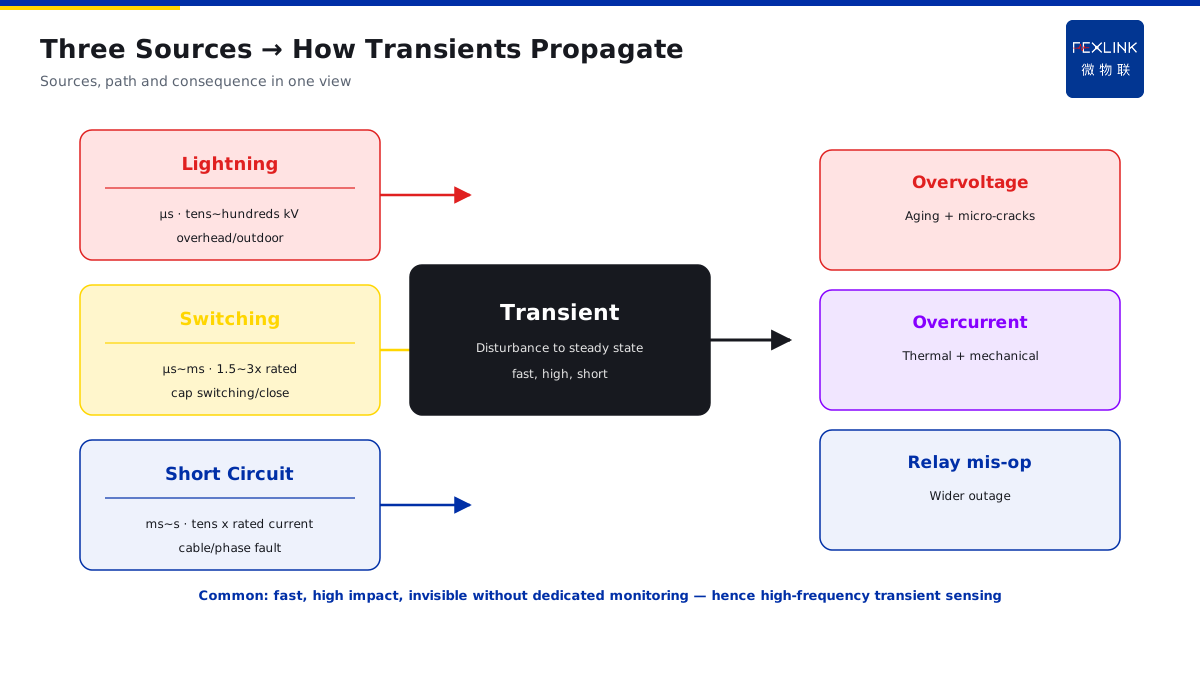
Direct Answer
Steady State is the system's stable operating condition — voltage and current are essentially constant, repeating every cycle. Transient State is the process of moving from one steady state to another — such as closing a breaker, tripping, or sudden load change. Transient Event is an extremely short transient (microseconds to milliseconds) — such as lightning strikes or switching overvoltages.
When engineers say "transient disturbance," they mean events that break the steady state and briefly push the system away from its normal operating point. Key insight: steady state is normal, transients are risk — most equipment damage and insulation aging happen during transients, not during steady-state operation.
At one 110kV substation, daily voltage and current looked normal, and the duty officer thought the system was healthy. Then a routine power quality check found: in the past month, the 10kV bus recorded 47 transient overvoltage events, the highest reaching 2.3 times rated voltage. All events happened at switching moments — closing, opening, capacitor switching. Because each lasted only tens of microseconds, relays did not trip, and on the surface everything was fine. But these overvoltages repeatedly stressed cable terminals and arresters, slowly degrading insulation. Without monitoring, a breakdown might have happened in another year or two.
1. How to Distinguish the Three States
Many engineers mix up "transient state" and "transient event," but their time scales are very different:
Steady State
- Time scale: seconds and above, constant.
- Characteristic: voltage and current amplitude and phase are essentially constant, repeating each cycle.
- Example: a fan running steadily at 100A for hours.
Transient State
- Time scale: milliseconds to seconds.
- Characteristic: the system transitions from one steady state to another, with a clear "process."
- Example: a large motor starting — current rises from 0 to 600A, then slowly settles to 100A.
Transient Event
- Time scale: microseconds to milliseconds.
- Characteristic: extremely short pulse or oscillation, far shorter than one power cycle (20ms).
- Example: lightning inducing a 10μs overvoltage pulse on a line.
Simple rule: steady state means "always like this," transient state means "changing now," transient event means "flashed once."
2. Why Transients Are More Dangerous Than Steady State
Intuition says steady state runs longer, so it should be more dangerous? Wrong.
In steady state, equipment is "comfortable" — voltage within rating, current within ampacity, insulation sees constant electric field. Equipment is designed for steady state, and running for tens of thousands of hours is fine.
In transients, equipment is "under impact" —
- Closing overvoltage can reach 2-3 times rated voltage, stressing insulation.
- Short-circuit current can reach tens of times rated current, creating enormous electrodynamic force.
- Lightning overvoltage can reach tens of times rated voltage, directly puncturing weak insulation.
Worse: most transients last extremely short, and conventional relays cannot react in time. You see "voltage normal, current normal, no trip," but equipment has already been impacted dozens of times. Insulation is "beaten" like this, one impact at a time.
3. Three Major Sources of Transient Disturbance
Engineering transients mainly come from three sources:
1. Lightning
- Time scale: microseconds.
- Characteristic: steep pulse, high amplitude (tens to hundreds of kV).
- Impact: punctures insulation, damages arresters.
- Scenario: outdoor substations, overhead lines, high-altitude areas.
2. Switching
- Time scale: microseconds to milliseconds.
- Characteristic: oscillatory wave, typically 1.5-3 times rated voltage.
- Impact: accelerates insulation aging, damages electronics.
- Scenario: capacitor switching, transformer energization, breaker operations.
3. Short Circuit
- Time scale: milliseconds to seconds.
- Characteristic: current surges, voltage sags.
- Impact: electrodynamic damage, protection trips.
- Scenario: cable breakdown, equipment short, phase-to-phase fault.
These three have different amplitudes and durations, but share one trait: they happen fast — you cannot see them without dedicated monitoring.
4. How to Monitor Transients
Conventional voltmeters and ammeters cannot see transients — their sampling rate is too low (a few to tens per second), and the transient has already passed.
To capture transients, you need a power quality monitor:
- Sampling rate ≥10kHz (one sample every 100μs).
- Records waveforms (not just RMS values).
- Triggers waveform capture (automatically saves when transient detected).
The FEXLINK ESE power quality monitor does exactly this. Installed at the 10kV bus or 0.4kV incoming line, it continuously monitors voltage waveform. When a transient overvoltage is detected (exceeding threshold), it automatically records several cycles before and after, and uploads the event to the platform.
The key is not "record one waveform" but continuous recording and trend analysis —
- How many transient events this month?
- Is amplitude rising or stable?
- What is the waveform signature of each event (lightning or switching)?
FEXLINK TianYan S-02 engine performs CUSUM trend analysis on transient events: if transient frequency or amplitude keeps rising, something in the system is degrading (arrester aging, worsening switching overvoltage), and it gives early warning.
5. Three Common On-Site Mistakes
Mistake 1: "Voltage is normal, so the system is fine." Normal RMS voltage only means steady state is fine. Transient overvoltages may already be stressing insulation, but RMS meters cannot see them. You need a power quality monitor dedicated to catching transients.
Mistake 2: "Lightning is the weather bureau's problem." Many people think lightning is God's will, impossible to prevent. Wrong. Installing an arrester does not mean you are done — arresters age, have residual voltage, and have an operating count limit. You need to know how many times the arrester operated and what its residual voltage was, to judge if it still works.
Mistake 3: "Switching overvoltage is normal, ignore it." Switching does produce overvoltage, but if it keeps getting bigger and more frequent, what does that mean? It means the breaker is degrading or system parameters are changing. Ignore it, and insulation will slowly fail.
6. A Real Case
A commercial complex, 10kV incoming line, installed with ESE power quality monitor.
Month 1 record:
- Transient overvoltage events: 12.
- Maximum amplitude: 1.8 times rated voltage.
- Main source: capacitor switching (one event per switching).
Month 3 record:
- Transient overvoltage events: 31.
- Maximum amplitude: 2.2 times rated voltage.
- Source: capacitor switching + new "no-operation events" (overvoltage appeared without any switching).
TianYan S-02 triggered a trend warning: transient frequency and amplitude both rising.
Maintenance team inspected on site:
- Found one 10kV arrester already aged (operating count exceeded limit).
- Capacitor switch closing resistor damaged, causing higher overvoltage.
- Those "no-operation events" were actually induced by nearby pile driving.
After replacing the arrester and fixing the switch, transient events dropped to 8 per month, amplitude back to 1.5 times.
Without monitoring, this complex might have suffered an insulation breakdown outage in another six months to a year.
7. Engineering Grading of Transient Events
Not all transients are alarming. Engineering grading by severity:
- <1.5 times rated voltage: mild. Mostly normal switching, annual tracking.
- 1.5-2.0 times: moderate. Watch trend, check arrester status.
- 2.0-3.0 times: significant. Plan outage, check insulation and switches.
- >3.0 times and frequent: severe. Emergency investigation, prevent breakdown.
The key is not single amplitude but trend — a single 2x may be normal, but if it slowly rises from 1.5 to 2.5, it is degrading.
8. One Sentence to Remember
Steady state is normal, transients are risk. Transients are invisible, but they are slowly eating your insulation.
That is why you need power quality monitoring — not to see if voltage is normal, but to catch those dangerous "flashes."
9. Common Questions
Q: Are transient and surge the same thing? A: Surge is a type of transient, usually referring to lightning or switching overvoltage pulses. Transient is a broader concept, including surges, short circuits, motor startup, and all transition processes.
Q: I installed arresters, do I still need transient monitoring? A: Yes. Arresters are "passive protection" — they discharge overvoltage to ground. But arresters themselves age and fail. You need to know how many times they operated and what residual voltage was, to judge if they still work. Transient events recorded by the ESE monitor are the arrester's "health check report."
10. Why This Matters
Transient disturbance is one of those topics that sounds academic but has a very practical bottom line: insulation life. Most facilities install voltmeters, ammeters, and maybe a power quality monitor, then assume their electrical system is "monitored." But if that monitor only reads RMS values once a second, it is blind to the most damaging events in the entire system.
Every year, facilities experience mysterious insulation failures with no obvious cause. Every year, transformers and cable terminals break down without any warning in the steady-state readings. Every year, maintenance teams waste hours chasing phantom voltage problems that turn out to be repeated transient overvoltages from a degrading switch.
These are not rare events. These are everyday events in facilities that do not monitor transients. And they are preventable.
The problem is that transient monitoring sounds expensive. It sounds like something only transmission utilities care about. It sounds like something you can skip.
But one insulation breakdown can take out a whole switchroom. One switchroom outage can stop a whole production line for days. One production line stoppage can cost more than a year of monitoring equipment.
That is why you need transient monitoring. That is why you need trend analysis. That is why you need CUSUM to catch the slow, invisible degradation.
This article gave you the fundamentals. Apply them to your next power quality review. Teach them to your maintenance team. Share them with your electrical engineer.
Stay safe. Stay professional. Stay curious.
11. Final Thoughts
Transient disturbance is one of those topics that sounds simple but has a very practical bottom line: fire prevention. Whether you are running a factory, a data center, or a hospital, you need to get it right.
The good news is that you do not need fancy equipment. A power quality monitor, a CUSUM algorithm, and a little bit of discipline will get you 90% of the way.
Remember: your insulation is only as healthy as your weakest transient record. Track the trend, not just the event. Act early, not after breakdown.
Start today. Review your last power quality report. Stay safe.