 微物联研究院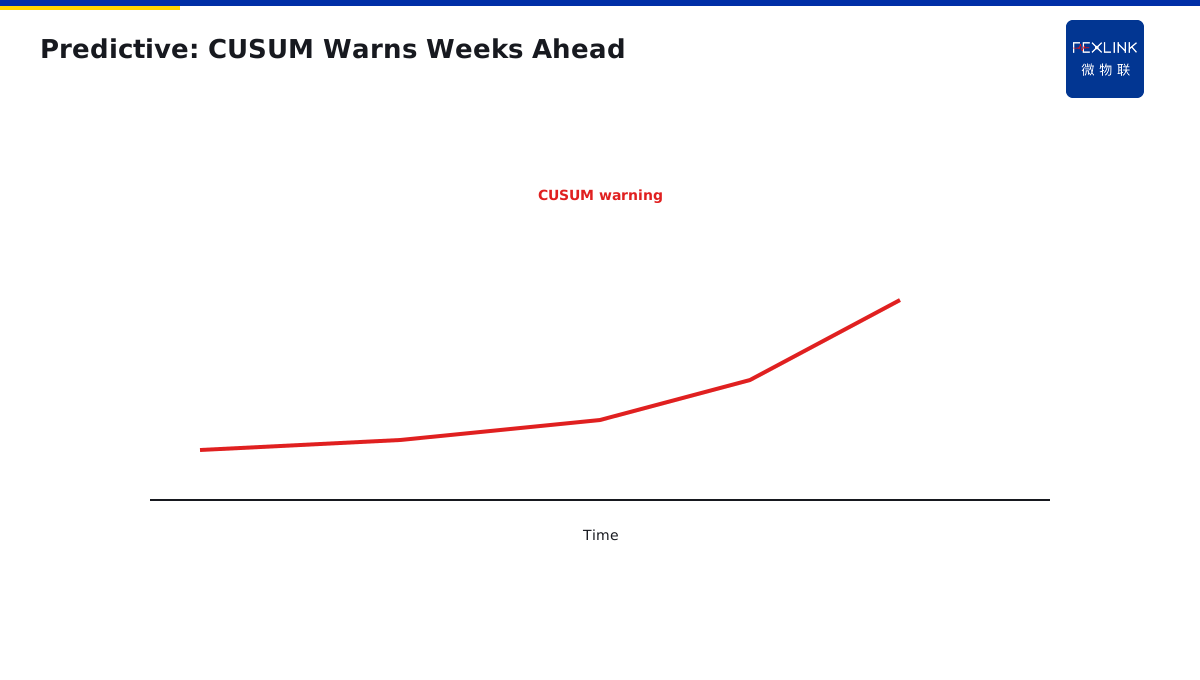
Direct Answer
The three maintenance strategies differ not in *whether* you fix, but in what signal tells you when to fix:
- Reactive Maintenance: wait until the failure happens. Signal = "it's down."
- Preventive Maintenance (PM): act on a fixed schedule. Signal = "it's that day."
- Predictive Maintenance (PdM): act on the equipment's real condition. Signal = "data says it's about to fail."
None is universally better; each fits a different tier of equipment. Predictive care for a cheap light fixture is waste; reactive care for a 10 kV main bus is gambling.
A 2023 incident at an industrial park: a 10 kV busbar joint overheated, ignited the adjacent cable, and shut down the whole line for 36 hours. Direct losses exceeded 8 million RMB. Yet 11 days before the event, the joint temperature had already climbed from 62°C to 78°C. The operator had data—he just wasn't looking at the trend, only waiting for the "90°C alarm." This is exactly "managing a PdM problem with a reactive mindset."
1. Reactive: When It Makes Sense, When It Is a Disaster
Reactive is not primitive. It is the cheapest choice for specific equipment.
Three traits fit reactive care:
- The device is cheap to replace;
- A spare can take over instantly, no production stop;
- Failure causes no secondary hazard (no fire, no cascade).
Corridor lighting, general exhaust fans, office AC terminals—replacing them costs a few hundred RMB and doesn't stop production. One company once put online monitors on all its light fixtures. The sensors cost 120k RMB a year. 90% of "detected faults" were just end-of-life bulbs that had to be replaced anyway—monitoring changed nothing.
Reactive becomes a disaster when equipment is expensive, downtime is costly, or failure cascades. 10 kV incoming cabinets, transformers, busbar joints, fire pumps, data-center UPS—for these, one failure costs decades of monitoring investment.
A rough rule of thumb: one critical failure under reactive care costs 50–200× the annual monitoring budget. Reactive is not "saving money" on critical circuits; it's trading a small cost for a large bet.
2. Preventive: How to Set the Interval, Why It Often Over-Maintains
Preventive care is "by the calendar"—annual overhaul, semi-annual infrared, quarterly tightening. It is more reliable than reactive, but has two structural problems.
Problem 1: tear apart equipment that wasn't broken. At a port, 10 kV switchgear was inspected annually. Each shutdown took three electricians, two days, and one berth offline. Over eight years, the annual inspection found no real defect. The teardown itself is a "human disturbance"—loosened terminals, nicked insulation—introducing new problems. This is over-maintenance.
Problem 2: equipment fails before the next scheduled visit. Preventive care schedules by average life, but individuals vary. One transformer lasts 25 years; an identical unit may degrade at 12. On a five-year cycle, the 12-year unit could fail in year four, with the next inspection in year five—a one-year blind gap.
How to set a reasonable interval:
- Criticality (shorter for critical circuits);
- Historical failure rate (MTBF from the last five years);
- Ambient conditions (shorten for heat, humidity, dust).
Even so, preventive care cannot see individual variation. It schedules by the average, not by which unit is actually degrading.
3. Predictive: Where Data Comes From, Why Most Companies Fail at It
Predictive care is the most expensive strategy, but the most valuable for critical equipment. The logic: no shutdown, no calendar—continuously stream condition data and use trend algorithms to estimate time-to-failure.
Data comes from four sensor families:
- Temperature: joints, busbars, cable terminals (wireless node WB-TM-01/02);
- Current/voltage: load, harmonics, unbalance (ESE power-quality monitor);
- Residual current: insulation degradation precursor (ESF electrical-fire controller);
- Partial discharge: internal insulation defects.
Sensors alone are not enough; the key is the trend algorithm. Threshold alarm is "at 90°C we beep." Predictive care is "temperature rises 1.5°C/day for two weeks; at this rate, 90°C in 11 days." That is what the Tianyan S-02 CUSUM engine does. It finds not "the accident that happened," but "the trend heading toward one."
Yet most companies with sensors never actually do PdM, for three reasons:
- They read the live value, not the trend—62°C feels fine until 90°C;
- Data is siloed—temperature on Platform A, current on Platform B, nobody correlates;
- No closed loop—an alert goes out, but no work order, no follow-up, no post-mortem.
The Taiyi control layer closes loop 3: an alert auto-generates an evidence card (which device, which point, when the trend started, which other parameters correlate), auto-dispatches a work order, and archives on resolution. Without this loop, sensors are just a digital spectator.
4. How to Choose per Equipment
Not every device needs PdM. A practical decision table:
| Equipment class | Typical examples | Recommended strategy |
|---|---|---|
| Critical, high-value, high downtime cost | 10 kV main, main transformer, busbar, fire pump, UPS | Predictive |
| General power, has spare, short stop OK | Fans, pumps, workshop distribution | Preventive |
| Cheap swappable, no secondary risk | Lighting, sockets, AC terminals | Reactive |
An airport once inventoried 1,200+ electrical assets. Fewer than 80 actually needed predictive care (main transformer, 10 kV incoming, busbars, fire circuits, approach-light power). The other 900+ were fine with preventive or reactive. Focusing resources on those 80 beat sensors everywhere.
Three questions to classify a device:
- One failure—direct + indirect cost?
- Will failure cascade to other equipment?
- Is there a spare?
If all three say "severe" → predictive. If all say "minor" → reactive. In between → preventive.
5. Three Common Field Mistakes
Mistake 1: annual inspection for everything. Critical and low-value equipment on the same cycle means critical devices wait too long between checks (missing individual degradation), while cheap devices are over-serviced (pure labor waste). Inventory first, then assign strategy by criticality.
Mistake 2: reactive on critical equipment. "Our gear has always been stable, never failed" is itself a red flag. Never failed ≠ won't fail; it just hasn't reached its failure year. 10 kV equipment sees elevated failures at 8–12 years. Staying reactive at that age is waiting for an accident.
Mistake 3: sensors installed, trend never read. An operator at a park read "current temperature" on the dashboard, never the trend curve. Temperature rose from 60°C to 85°C over two weeks; the dashboard showed "normal" (below the 90°C threshold) until one day it jumped to 95°C and alarmed. Those two weeks of trend could have scheduled a planned outage 10 days early. The sensor wasn't broken; the method was—using a PdM sensor as a threshold alarm.
Scope and Limitations
Applies to maintenance strategy selection in industrial and building electrical systems. FEXLINK-BMS busbar monitor, ESE power-quality monitor, ESF electrical-fire controller, WB-TM-01/02 wireless temperature node, Tianyan S-02 engine, and Taiyi control are FEXLINK references. Cases are anonymized as "a park / a port / an airport"; figures are engineering rules of thumb. Actual selection requires an on-site asset inventory and risk assessment.