 微物联研究院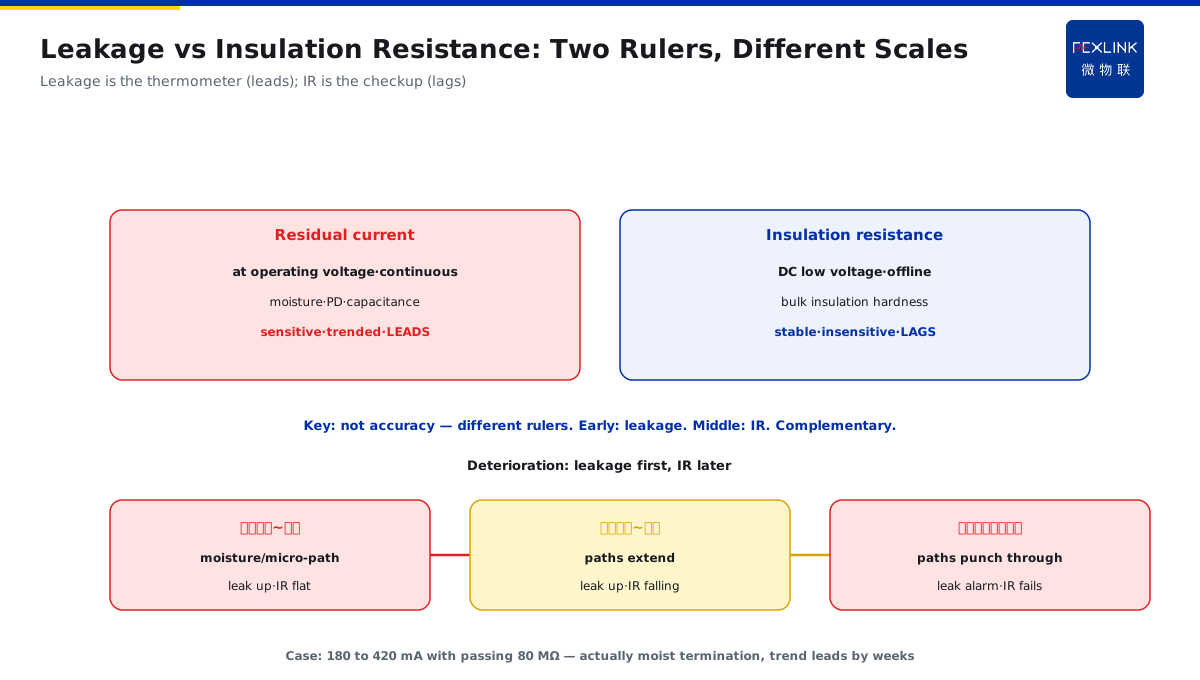
Direct Answer
Residual current is rising, but the insulation-resistance test still passes — whom do you trust? The answer: the two indicators measure insulation health at different scales — residual current is continuous leakage at operating voltage, sensitive to moisture and distributed capacitance; insulation resistance is overall resistance under low-voltage DC, stable but insensitive. When leakage rises while insulation resistance still passes, that is usually early localized deterioration — watch the leakage trend, do not wait for insulation resistance to fall below its threshold.
A distribution room's cable circuit drifted from 180 mA to 420 mA residual current, near the 500 mA alarm line. An insulation-resistance test with a 2500 V megger read 80 MΩ — "fully qualified" (the standard asks for ≥1 MΩ). Operations were confused: leakage rising this far while the insulation test passes — is there a problem or not? A leakage-trend analysis answered it: the rise started with the rainy season and continued for 6 weeks, with daily variation strongly correlated to humidity — an early signal of a moist cable termination. Insulation resistance cannot see it while "the bulk is still hard," but leakage catches it. Conclusion: a passing insulation resistance does not mean the insulation is fine; the leakage trend leads the insulation-resistance decline.
Because:
- Different measurement principles: insulation resistance uses low-voltage DC to measure bulk resistance — "macro insulation hardness"; residual current measures continuously at operating voltage — "micro leakage paths";
- Different sensitivity: leakage is extremely sensitive to moisture, partial discharge, and capacitance changes; insulation resistance cannot "feel" these early changes;
- Different sequence: early localized deterioration → leakage rises first → deterioration spreads → insulation resistance falls only later — leakage is the leading indicator;
- Cross matrix: leakage up + insulation pass = early deterioration (watch); leakage up + insulation fail = confirmed deterioration (act now); both normal = healthy; leakage flat + insulation pass = normal.
Key insight: "insulation resistance passes" answers "is the bulk still hard"; "leakage is rising" answers "is a leak path forming." One is the checkup report; the other is the thermometer — the thermometer moves first, the report catches up later.
A data center's UPS output cable showed residual current climbing from 300 mA to 480 mA over 5 days (alarm at 500 mA), while an insulation-resistance test still read a passing 150 MΩ. The platform's leakage-trend + humidity-correlation analysis classified it as "early moisture signal in the cable termination"; infrared and PD re-checks confirmed moisture inside the termination, replaced during a maintenance window — relying only on insulation resistance would have found it a month or two before breakdown.
1. Why the Two Measurements Differ in Principle
To decide "whom to trust," first clarify what each one measures:
Residual current (leakage) — continuous leakage at operating voltage:
- The vector sum of three-phase current is non-zero — that is residual current;
- Measured under real operating voltage (e.g., 220 V/380 V/10 kV), so the leak path is truly energized;
- Captures: moisture, insulation aging, partial discharge, distributed-capacitance changes, harmonic superposition;
- Continuous online measurement — trends are visible.
Insulation resistance — bulk resistance under low-voltage DC:
- A megger applies 500 V/1000 V/2500 V DC and measures overall insulation resistance;
- Reflects the insulation medium's macroscopic resistance (volume + surface resistance);
- Sensitive to "bulk deterioration," insensitive to "early localized paths";
- Offline measurement, periodic checks (typically every 1–6 months).
Key differences:
- At operating voltage, the leak path is driven by the electric field, so even tiny deterioration shows; under low-voltage DC, many early paths are "out of reach";
- Residual current is "real-time + trend"; insulation resistance is "point-in-time + pass line."
Key insight: it is not that one is more accurate — they are different rulers: one measures micro dynamics, the other macro state. Early stage, watch leakage; middle stage, watch insulation resistance — complementary, not substitutes.
2. Why the Two Can Move in Opposite Directions
"Leakage up, insulation passing" is not a contradiction; it is the normal process of insulation deterioration:
The time lag in the deterioration process:
- Early (weeks–months): moisture, partial discharge, surface contamination — micro leak paths form; leakage starts rising; insulation resistance is basically unchanged;
- Middle (months–years): paths extend and carbonize — leakage rises clearly; insulation resistance starts a slow decline;
- Late (near breakdown): paths punch through — leakage nears the alarm or trips; insulation resistance falls below its threshold.
Why insulation resistance is "slow":
- The DC low voltage does not excite early conduction mechanisms (moisture adsorption, PD) strongly;
- Bulk insulation resistance is a parallel combination; early deterioration is a tiny fraction, diluted by the healthy part;
- The pass line (≥1 MΩ) is loose — even with local deterioration, the bulk stays far above it.
Why leakage is "fast":
- Operating voltage is high; the field is strong; a tiny path leaks immediately;
- Unbalance, capacitance, and harmonics are all captured;
- Continuous measurement makes the trend obvious.
Key insight: a passing insulation resistance is a "passing line," not a "health line." Between passing and healthy, leakage has already traveled a long road — a road only leakage can see.
3. Leakage Trend Leads Insulation-Resistance Decline
"Leading" is the most valuable rule in this relationship:
The lead chain:
- Moisture/deterioration starts → leakage rises (sensitive) → continues for weeks to months → deterioration spreads → insulation resistance begins to fall → continues → breakdown/trip.
Engineering meaning:
- Leakage rising while insulation passes = the best intervention window: the defect is young; handling cost is lowest (e.g., drying, replacing a termination);
- Waiting for insulation resistance to break its threshold = already late: usually near breakdown; only emergency handling remains;
- Leakage's lead time can be weeks to months — that is the value of online leakage monitoring: turning "after-the-fact failure" into "before-the-fact window."
How to use the trend:
- Record the leakage baseline (seasonal change is normal — e.g., a rainy-season rise across the fleet);
- Look at the "season-adjusted trend": steady one-way rise, accelerating rise → watch;
- Correlate with humidity/load: strong humidity correlation → moisture type; strong load correlation → overheating type; strong time correlation (steady rise) → aging type.
Key insight: leakage is the thermometer; insulation resistance is the checkup report. The thermometer alarms first, the report confirms later — do not wait for the report to act.
4. The Four Combinations in the Cross Matrix
Combine the two indicators into four states:
| Residual current | Insulation resistance | Judgment | Action |
|---|---|---|---|
| Normal | Pass | Healthy | routine patrol |
| Rising | Pass | early localized deterioration | tighten monitoring + re-check locate |
| Rising | Fail | confirmed deterioration | outage handling soon |
| Normal | Fail | legacy / surface contamination | clean re-test / evaluate replacement |
Note:
- The "leakage rising + insulation passing" combination is the most overlooked — each single item "makes sense": leakage says trouble, insulation says fine, and many people choose to believe "fine";
- Correct posture: when leakage rises, a passing insulation resistance does not rule out a problem — it marks the early window;
- "Leakage normal + insulation fail" is mostly: moisture after long shutdown, surface contamination, legacy issues — confirm with on-site re-testing.
Key insight: the four combinations are not "which one to believe"; they are "four quadrants, four actions." If you cannot remember the table, remember one line: leakage is the leading indicator — when it says trouble, investigate.
5. Combined Judgment and Action Triggers
For on-site action, follow these rules:
Trigger rules:
- Leakage exceeds 1.5× baseline or nears the alarm (e.g., 80%) → enter "watch";
- In watch state, do an insulation-resistance re-test + infrared + PD check → locate the cause;
- Leakage rising for 7 consecutive days (season-adjusted) → escalate to "abnormal";
- Insulation resistance failing at the same time → arrange outage handling immediately.
Actions:
- Moisture type (humidity-correlated): ventilate and dry, check sealing, replace moist terminations;
- Aging type (steady rise): schedule cable replacement or insulation repair;
- Capacitance/harmonic type: first inspect the load and harmonic sources to confirm "false leakage" (capacitive current, harmonic superposition);
- False-leakage confirmation: with balanced phases and no harmonics, leakage should fall clearly — if it does not, it is real.
Recording requirements:
- Each test records: leakage value, insulation resistance, ambient humidity, load — all four together enable correlation analysis;
- Recording only one number equals having no data.
Key insight: action is not "move when insulation resistance fails"; it is "move when the leakage trend turns abnormal." The whole point of a leading indicator is the lead time.
6. Product Landing: Leakage Monitoring and Insulation Assessment
FEXLINK's ESF Electrical Fire Monitor and FD Residual-Current Monitoring Module turn "leakage leads" into online capability:
- The FD module samples residual current continuously at second-level updates — trend curves auto-generate;
- The ESF monitor aggregates leakage thresholds, temperature, arc, and more, linking alarms;
- The platform's built-in humidity/load correlation analysis separates moisture type, aging type, and false leakage automatically;
- When the leakage trend turns abnormal, the Tianyan engine warns early; infrared and PD re-checks locate and close the loop;
- Connected to the Digital Electrical Intelligent Supervision System, leakage, insulation, temperature, and PD are all visible on one platform.
Design principle in one sentence: turn "leakage leads insulation resistance" into rules the system recognizes and warns on automatically — not something a human has to notice.
7. Common On-Site Mistakes
- Ruling out problems because insulation resistance passes: 80 MΩ "passes," while moisture is actively developing. Consequence: the early window is missed. Correct: when leakage rises, a passing insulation resistance is a "find the cause" signal, not a "no problem" proof.
- Using the insulation-resistance threshold as the health standard: ≥1 MΩ means "relax." Consequence: localized deterioration diluted by the bulk. Correct: the threshold is only a passing line; health is judged by the leakage trend.
- Comparing single leakage readings: today 420 mA, last month 180 mA, declaring "it rose." Consequence: seasonal factors ignored. Correct: season-adjust before judging trends; a rainy-season rise is normal.
- Not distinguishing false leakage: harmonic/capacitive current drives leakage high, treated as real. Consequence: wrong trips and replacements. Correct: confirm whether it falls after balancing and harmonic checks.
- Measuring without recording: patrol logs one leakage value and leaves. Consequence: no trend, no lead/lag judgment. Correct: record leakage + insulation + humidity + load together and run correlation analysis.
Scope and Limitations
This article discusses the cross-reading of residual current and insulation resistance as two insulation-health indicators, applicable to low-voltage distribution (380 V) and some medium-voltage scenarios. Residual-current alarm thresholds and insulation-resistance test voltages and pass criteria follow equipment manuals and relevant standards. The impact of distributed capacitive current and harmonics on leakage values must be judged against on-site conditions. All cases are anonymized (a certain distribution room / data center) and do not refer to any specific customer.