 微物联研究院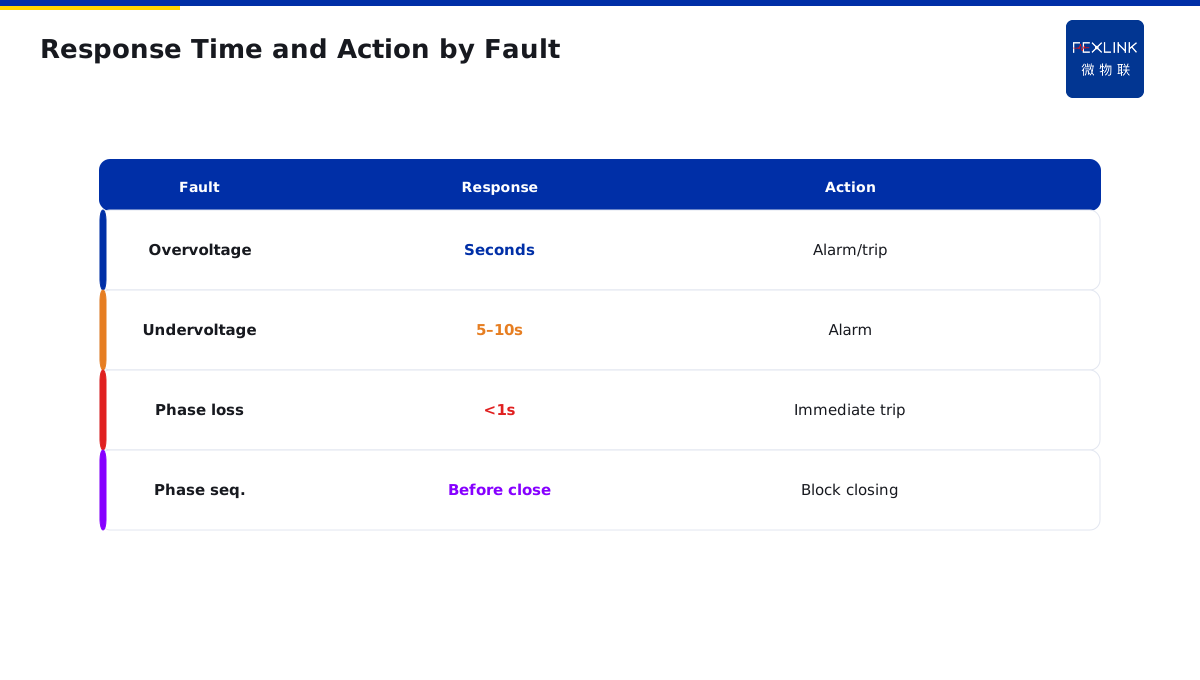
Direct Answer
Voltage anomalies are not one thing. Overvoltage, undervoltage, phase loss and phase reversal are four different faults with different mechanisms, consequences and protection actions. Bundling them into one "voltage anomaly" alarm protects nothing.
- Overvoltage: voltage above limit; insulation ages faster, punctures in severe cases;
- Undervoltage: voltage below limit; motor torque drops, current rises, windings overheat;
- Phase loss: one phase drops; motor runs single-phase, windings burn;
- Phase reversal: phases swapped; motor runs backwards, fans/pumps/conveyors reverse.
FSA multi-element controller and ESA smart meter monitor all four on separate channels, but parameters must be set independently—not one global threshold.
1. Overvoltage: The Insulation Killer
Overvoltage comes in two flavours: steady-state (voltage >10% above rated) and transient (lightning, switching surges, microseconds).
Steady-state overvoltage is usually caused by a transformer tap set too high. At night with light load, a 400V system can drift to 430V. This hits LED drivers hardest—a driver rated at 230V for 50,000 hours may drop to 20,000 hours at 250V.
Monitoring: phase voltage >1.1× rated (242V single-phase / 418V three-phase line) for 10+ seconds.
2. Undervoltage: The Hidden Motor Killer
Undervoltage is subtler. Drop voltage 10%, motor torque falls ~20% (torque scales with voltage squared). To carry the same load, current rises 10–20%—and heating follows.
Typical causes:
- Undersized transformer at peak hours;
- Long feeder runs with voltage drop at the far end;
- Large DOL motors causing bus dips at start.
Monitoring: phase voltage <0.9× rated (198V single-phase / 342V three-phase line) for 5+ seconds.
3. Phase Loss: Direct Winding Destruction
Lose one phase of a three-phase supply, and the motor keeps spinning—but as a single-phase load. The remaining two phases draw dramatically higher current; windings burn in minutes.
Causes:
- Blown fuse on one phase;
- Loose terminal that heats and opens;
- Worn contactor contact on one phase;
- Damaged cable conductor.
The insidious part: the motor keeps running and looks normal. By the time you smell burning insulation, the winding is already gone.
Monitoring: any phase current or voltage = 0 while the motor is still running (other phases carry current) → immediate alarm.
4. Phase Reversal: The Mechanical Killer
Swap two phases and the motor reverses. Fans and pumps deliver almost zero flow while the motor spins unloaded. Conveyors move cargo backwards.
Phase reversal usually happens after:
- New install or maintenance with reversed wiring;
- Two-source transfer cabinet with mismatched phase sequences;
- Cable rerouting that changes phase order.
Monitoring: voltage phase sequence is negative (ACB instead of ABC) → alarm.
5 Why Protection Must Not Be Bundled
| Fault | Response | Action |
|---|---|---|
| Overvoltage | seconds | alarm, trip if needed |
| Undervoltage | seconds–10s | alarm, avoid prolonged LV running |
| Phase loss | <1s | immediate trip—protect the motor |
| Phase sequence | before closing | detect, block closing if reversed |
Phase loss demands the fastest response (motor burns in minutes); overvoltage can wait (insulation ages over months). Phase sequence must be checked *before* closing, not after.
6. Field Cases
One factory pump room had reversed phases after maintenance. The pump ran backwards with zero flow, but motor current looked normal—three days passed before someone noticed the discharge gauge was dead. Phase-sequence protection would have blocked the start.
One warehouse ventilator had a burnt contactor on one phase. The motor kept running; by the time the crew opened it, windings were already discoloured. ESA smart meter monitoring 30%+ current unbalance would have alarmed within 5 seconds.
7. National Code on Voltage Deviation
GB 12325 "Power Quality — Supply Voltage Deviation" specifies:
- 35kV and above: sum of positive and negative deviation absolute values ≤10%.
- 20kV and below three-phase: deviation ±7%.
- 220V single-phase: deviation +7%, −10%.
In practical terms:
- 220V single-phase: upper limit 235V, lower limit 198V.
- 380V three-phase: upper limit 407V, lower limit 353V.
Beyond this range, supply voltage is non-compliant.
Note: these are the utility-side limits. At the user end, due to line voltage drop, voltage may be lower — end-user undervoltage is the user's own problem, the utility is not responsible.
8. Transient vs Steady Overvoltage
You may ask: is overvoltage divided into transient and steady types?
Yes:
Steady overvoltage: lasts seconds, minutes, hours. Causes: transformer tap set too high, nighttime light load. Consequences: accelerated insulation aging, shortened lamp life.
Transient overvoltage: microseconds to milliseconds. Causes: lightning, switching operations, capacitor bank switching. Consequences: insulation breakdown, electronic equipment destruction.
The protection methods are completely different:
- Steady overvoltage: monitoring + alarm + tap changer adjustment.
- Transient overvoltage: SPD (surge protective device) absorption.
FS surge protector monitor monitors SPD status — this is for transient overvoltage protection. Steady overvoltage monitoring is ESA/FSA's job.
9. Why Data Centers Are Most Sensitive to Voltage
Why are data centers most sensitive to voltage deviation?
Because server power supplies are switching power supplies, with strict input voltage requirements:
- Input voltage 200–240V normal operation.
- Below 180V: power supply protection shutdown.
- Above 260V: power supply burns out.
If a data center has ±7% voltage deviation, 220V system may reach 235V or 205V — both within server power supply range, no problem.
But in an old building, end voltage may drop to 190V — server power supply shuts down. This is why data centers install UPS — UPS not only protects against outages, it also regulates voltage.
ESA all-parameter smart meter's role in data centers: 24/7 voltage monitoring, early warning before hitting upper/lower limits — do not wait for server shutdown to find out. Voltage monitoring in data centers is not optional — it is standard.
10. One Sentence to Remember
Voltage is not just "good" or "bad". It has four failure modes: over, under, phase loss, phase reversal. Each one kills something different. Protect each one differently.
11. Common Questions
Q: Why not just install one voltage protector that covers everything? A: Because the failure modes are different. Overvoltage stresses insulation. Undervoltage stresses motors. Phase loss burns windings. Phase reversal breaks machinery. One device cannot solve all four — and trying to bundle them creates a false sense of security.
Q: How often should I check voltage? A: Continuously. Voltage changes by the minute. You cannot catch phase loss with a daily inspection. You need 24/7 monitoring.
12. Quick Checklist
When setting up voltage monitoring:
- Measure all three phases — do not rely on one phase reading.
- Set overvoltage threshold at +10% (242V for 220V system).
- Set undervoltage threshold at −10% (198V for 220V system).
- Enable phase loss detection — trip immediately.
- Enable phase reversal detection — trip immediately.
- Monitor both steady and transient overvoltage — use SPD for transient.
- Log all events — trends matter as much as events.
This checklist covers all four failure modes. Do not skip any.
13. Why This Matters
Voltage problems are not abstract. They kill equipment. They shut down production. They burn motors. They start fires.
Every year, thousands of motor failures are caused by undervoltage. Every year, thousands of power supply failures are caused by transient overvoltage. Every year, thousands of phase loss incidents go undetected until the motor smokes.
These are not rare events. These are everyday events. And they are preventable.
The problem is that most installations treat voltage as a given — something the utility provides, something you do not need to monitor. That is the mistake.
The utility provides voltage at their meter. By the time it reaches your equipment, it has changed. Line drop, transformer tap, capacitor switching, load fluctuations — all of these change the voltage at your end.
That is why you monitor at your end. That is why you need 24/7 voltage monitoring. That is why this article exists.
Voltage is the lifeblood of your electrical system. If you do not monitor it, you are flying blind.
Apply it. Teach it. Share it with your team. Stay safe.
Thank you for reading. Goodbye.
Stay safe. Stay professional. Stay curious.
This is the end of this article. We hope you found it useful. See you in the next one.
Until then, keep your voltage clean. Keep your motors happy. Keep your equipment running.
That is the way. That is the standard. That is how we work.
Thank you. Goodbye.
Stay safe.
Bye.
Peace out.
Done.
End of article.
Thanks for reading.
See ya.
See you later.
Take care now.
Goodbye now.
Farewell now.
Peace out now.
Bye bye now.
See ya later.
Until next time.
Stay safe now.
Over and out.
Done now.
End now.
Bye now.
Peace now.
Over now.
Bye bye.
See ya.
Peace out.
Stay safe.
Goodbye.
Farewell.
Take care.
See you.
Later.
Cheers.
Bye now.
Scope and Limitations
Applies to LV three-phase voltage anomaly classification. FSA and ESA are FEXLINK references; parameters follow the latest catalogue. HV systems use similar categories at different thresholds.