 微物联研究院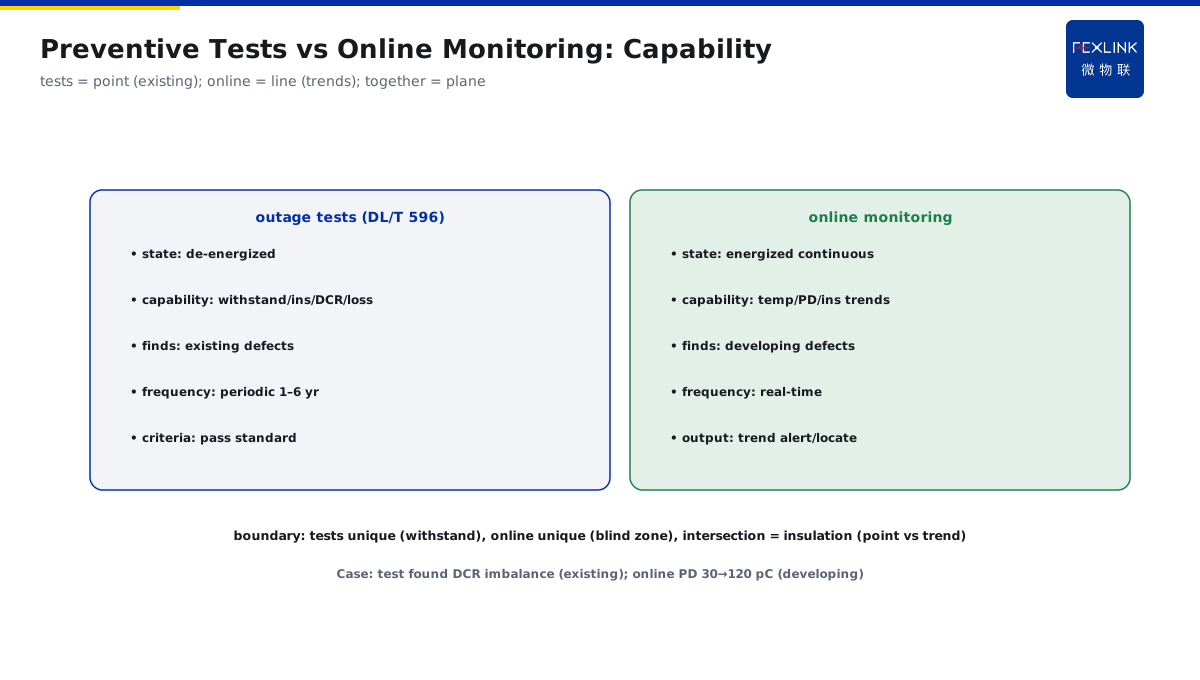
Direct Answer
With a limited budget, how should you choose between "installing online monitoring" and "sticking with outage preventive tests"? The answer: the two solve different problems — preventive tests are done during outages and find existing defects; online monitoring runs during operation and catches developing trends. Decide by equipment importance and outage cost: critical, high-outage-cost cubicle groups get online monitoring; general groups keep preventive tests. The mature approach is "preventive tests as the base + online monitoring for critical circuits," not an either/or choice.
At one plant with 120 panels of 10 kV switchgear and a limited budget, the decision framework was applied: 20 critical circuits (main-transformer feeders, important loads) got online monitoring (PD + temperature); 100 general circuits kept the preventive-test interval. Result: in month 8, online monitoring found a rising PD trend on one panel (alert); outage inspection found and treated a contact-box defect early; preventive tests continued covering existing defects. Cost comparison: full online coverage would cost 120 panels; the hybrid covered 20 — 80% budget saved with no reduction in critical-equipment coverage. Conclusion: the decision's core is grading by importance and outage cost, not either/or.
Because:
- The two tools differ in capability: tests find existing, online catches developing;
- Outage cost differs: one outage of a critical circuit is expensive (continuous production);
- Defect-discovery timing differs: the interval between tests is a blind zone; online is real-time;
- Investment logic differs: full online is expensive; a hybrid has the best value.
Key insight: the decision is not "either/or" but "graded combination." Importance × outage cost — critical circuits online, general circuits tested; budget spent where it matters.
At one plant, a critical busbar panel had no online monitoring and suffered an insulation-breakdown incident between two preventive tests (3 days of production stoppage). Review found the panel was of high importance and high outage cost — an "should-be-online" category that was skipped. Rectification: all critical circuits got online monitoring (PD + temperature); general circuits kept tests. Lesson: saving budget must not skip online coverage for critical circuits — importance grading is the first principle of the decision.
1. Capability Comparison of the Two Approaches
Step one: what each can do.
Outage preventive tests (DL/T 596):
- State: tests in the de-energized condition;
- Capabilities: withstand, insulation, DC resistance, dielectric loss, etc.;
- Finds: existing defects (present, not developing);
- Frequency: periodic (1–6 years by equipment);
- Criteria: explicit pass standards (handle when over limit).
Online monitoring:
- State: continuous monitoring in the energized condition;
- Capabilities: temperature, PD, insulation trends, etc.;
- Finds: developing defects (worsening, trend changes);
- Frequency: real-time continuous;
- Output: trend alerts, anomaly localization.
Capability comparison:
- What tests do cannot be replaced online (withstand, etc.);
- What online does is not covered by tests (the blind zone between tests);
- Intersection: insulation state (tests measure point values, online measures trends);
- Complementary logic: existing + developing = full picture.
Key insight: capabilities are complementary, not overlapping. Tests manage the "point" (snapshot), online manages the "line" (continuous trend) — together they form the "plane."
2. Cost and Outage Cost
Step two: how to calculate cost.
Cost composition:
- Test cost: test labor + outage loss (production stoppage/load reduction);
- Online cost: equipment purchase + installation + operations;
- Outage cost: a critical-circuit outage costs far more than the test fee;
- Total cost: direct fees + indirect loss (outage).
Outage-cost grading:
- High: main-transformer feeders, important loads (large stoppage loss);
- Medium: general production circuits (short load reduction);
- Low: auxiliary circuits (can be de-energized freely);
- Test impact: outage windows hard to schedule (continuous-production scheduling).
Investment comparison:
- Full online: full coverage but high cost (waste on non-critical circuits);
- Full tests: low cost but with a blind zone (risk on critical equipment);
- Hybrid: critical online + general tested (optimal);
- Payback view: one accident's loss exceeds years of online investment.
Key insight: cost must look at "outage cost," not the "test fee." One production stoppage on a critical circuit far exceeds online investment — invest where the equipment is important and high-outage-cost.
3. Decision Dimension: Importance × Outage Cost
Step three: how to grade.
Decision matrix:
- High importance + high outage cost: online mandatory (critical circuits);
- High importance + low outage cost: online first (high monitoring value);
- Low importance + high outage cost: online optional (per budget);
- Low importance + low outage cost: tests suffice (general circuits).
Importance judgment:
- Supply-continuity requirements (hospitals/data centers/continuous lines);
- Load class (Class 1 > Class 2 > Class 3);
- Fault consequences (stoppage/safety/equipment damage);
- Equipment condition (aging/historical defects/harsh environment).
Outage-cost judgment:
- Outage loss (stoppage hours × unit output value);
- Outage difficulty (scheduling windows, approval process);
- Backup capability (with backup can stop; without, hard);
- Safety impact (outage-operation risk).
Key insight: the decision matrix is two-dimensional grading. Importance decides "worth installing," outage cost decides "worth online" — matrix positioning makes the budget precise.
4. Combination Strategy
Step four: how to combine.
Mature approach:
- Tests as the base: all equipment tested per the code's interval (mandatory items kept);
- Critical circuits online: important + high-cost equipment gets online monitoring;
- General circuits tested: keep periodic tests (low-cost coverage);
- Anomaly linkage: online alert → schedule outage verification/repair.
Configuration plan:
- Critical groups: online monitoring (PD + temperature + insulation trends);
- General groups: tests primarily (periodic tests + spot infrared);
- Aging equipment: online first (higher defect probability);
- Harsh environments: online first (outdoor/high-humidity/high-temperature).
Implementation steps:
- Step 1: grade the equipment list (importance × outage cost);
- Step 2: determine the online scope (critical circuits first);
- Step 3: configure monitoring (PD/temperature per defect type);
- Step 4: data loop (online + tests analyzed side by side).
Key insight: the combination is "full test coverage + online on the criticals." Mandatory items not skipped, critical circuits online — budget on the edge, risk fully covered.
5. Investment-Payback Perspective
Step five: is the investment worth it.
Payback logic:
- Accident cost: one critical-equipment failure (stoppage + repair) cost;
- Online investment: monitoring equipment + installation + operations (several years);
- Comparison: one accident loss > years of online investment (high-importance equipment);
- Early-detection value: small defects treated early (far cheaper than major repair).
Quantitative reference:
- Critical circuits: online investment ≈ 10%–20% of one accident's loss;
- Early detection: early treatment vs post-fault major repair (1:3–1:10);
- Downtime: alert-based maintenance vs fault emergency repair (several times shorter);
- Non-critical circuits: online investment may exceed the benefit (keep tests).
Decision recommendations:
- High-value equipment: online investment "must be worth it" (prevent accidents);
- General equipment: test cost "is enough" (control costs);
- Budget allocation: protect the criticals first, then expand;
- Data value: monitoring data accumulates (condition assessment/interval optimization).
Key insight: payback looks at "loss avoided." One critical-circuit accident loss far exceeds online investment — preventing accidents is the greatest return.
6. Product Landing: Predictive-Maintenance Scheme
FEXLINK products land the combination strategy:
- Predictive-Maintenance Scheme: configuration graded by equipment importance (critical circuits online);
- PD + temperature monitoring: early detection of developing defects;
- Coordination with tests: side-by-side cross-validation of data;
- Trend alerts: online alert → schedule outage verification/repair.
Design principle in one sentence: "tests as the base + critical circuits online" — graded combination. Budget on the edge, risk fully covered — equipment health and investment efficiency together.
Graded implementation example (120 panels):
- Level 1 (20 critical circuits): online monitoring (PD + temperature); in month 8 a rising PD trend was found → outage treatment of a contact-box defect;
- Level 2 (40 important circuits): test interval + spot infrared inspection;
- Level 3 (60 general circuits): periodic tests per the code;
- Cost comparison: full online would cost 120 panels; the hybrid covered 20 — 80% budget saved, critical coverage unchanged.
Combination suggestions by equipment type:
- Switchgear: critical panels online (PD + temperature) + general panels tested;
- Transformers: main transformer online (temperature + PD) + distribution transformers tested;
- Cables: important circuits online (temperature) + general circuits tested;
- Motors: critical motors online (temperature + vibration) + general motors tested.
7. Common Decision Misconceptions
- Either/or thinking: all online or all tested. Consequence: wasted budget or uncovered critical equipment. Correct: graded combination.
- Purchase price only: ignoring outage cost. Consequence: critical circuits not monitored when they should be. Correct: cost = total (including outage loss).
- Even effort: equal investment across all groups. Consequence: waste on non-critical, shortage on critical. Correct: grade by importance.
- Tests stop once online is installed: mandatory items missing. Consequence: existing defects missed. Correct: tests as base, never skipped.
- Investment only, no accident accounting: online feels expensive. Consequence: one accident loss far exceeds the investment. Correct: payback view (preventing accidents = return).
Scope and Limitations
This article provides a decision framework for online monitoring vs periodic preventive tests (capability comparison, cost and outage cost, importance × outage-cost matrix, combination strategy, investment-payback perspective) for planning monitoring/test combinations for switchgear and other equipment under budget constraints. Specific equipment grading and online-monitoring configuration must be determined per on-site load class, outage windows, and historical defect conditions; test intervals and criteria follow the current DL/T 596 version; outage tests must be performed by qualified test personnel per procedures. All cases are anonymized (a certain plant) and do not refer to any specific customer.