 微物联研究院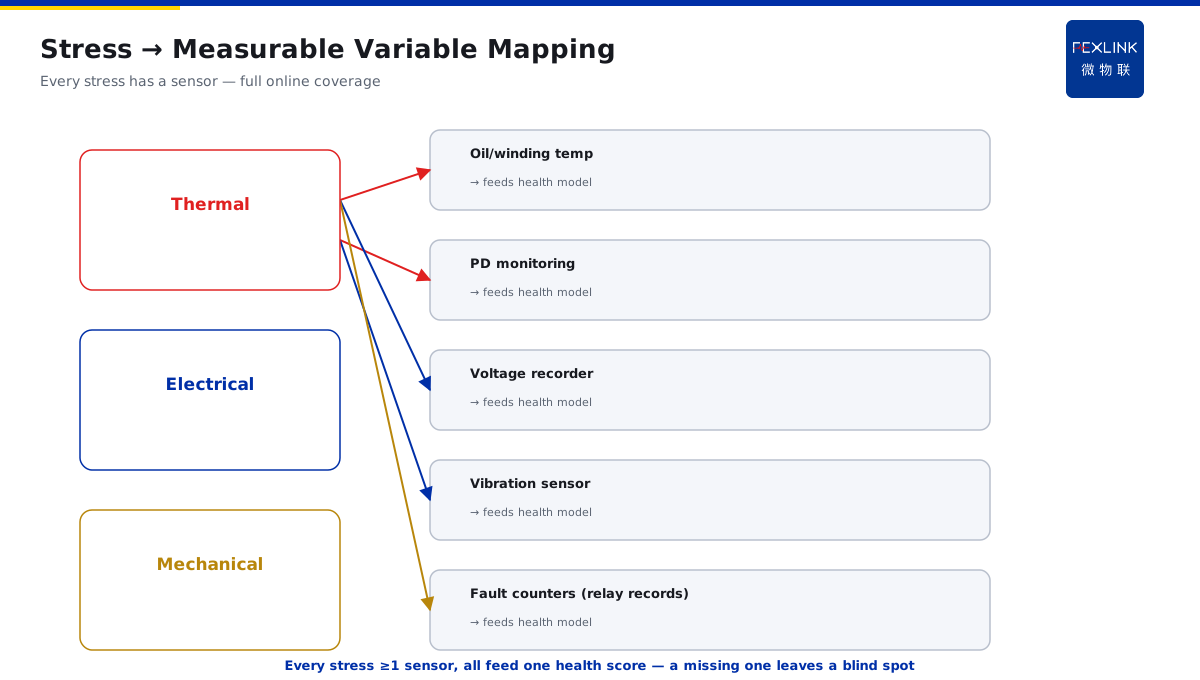
Direct Answer
Lab thermal aging data does not match field results — not because the lab is wrong, but because field has thermal, electrical, and environmental stresses all at once, and they amplify each other, not just add up.
Many engineers use lab Arrhenius models to calculate insulation life, and find actual field life is half or less. Why? Because the lab only tested thermal stress. The field has thermal + electrical + humidity + pollution + vibration, multi-factor coupling, much faster degradation.
- Thermal stress: every 8°C higher, aging speed doubles (Arrhenius);
- Electrical stress: higher voltage = stronger partial discharge = faster insulation aging;
- Environmental stress: high humidity, heavy pollution, surface moisture, tracking, faster aging;
- Coupling effect: three stresses together, not 1+1+1=3, but 1+1+1=5 or even 10.
Key insight: insulation aging is not determined by a single factor, it is the result of multi-factor coupling. Online monitoring cannot only measure temperature, must also measure electrical parameters, humidity, partial discharge, to truly fit the degradation curve.
One transformer manufacturer's lab data said insulation life is 30 years. Field unit failed after only 12 years. Why? Because the field is high temp high humidity, plus overvoltage surges. Lab was constant temp constant humidity, only thermal factor. Add electrical and environmental stress, actual life is about half of lab.
1. Three Types of Stress Mechanisms
Three types of stress, each with its own mechanism:
Thermal stress
- Temperature rises, insulation material molecular chains break;
- Follows Arrhenius model: every 8°C higher, aging speed doubles;
- This is the most basic aging factor.
Electrical stress
- Stronger electric field = more frequent partial discharge;
- Partial discharge erodes insulation material;
- Higher voltage, higher frequency, faster aging.
Environmental stress
- High humidity: insulation surface gets moist, resistance drops;
- Heavy pollution: surface contamination, shorter tracking distance;
- High vibration: insulation material fatigues, cracks.
Key: three stresses are not independent, they affect each other. High temp accelerates electrical aging, high humidity amplifies electrical stress impact, vibration makes thermal aging faster.
2. Why Stresses Couple and Amplify
Why say stresses "couple and amplify" instead of simply adding?
Example:
- Thermal alone: aging speed ×1;
- Electrical alone: aging speed ×1.5;
- Environmental alone: aging speed ×1.2;
- All three together: not ×3.7, but ×5~×10.
Why? Because:
- High temp → insulation material becomes brittle → electrical stress breaks down easier;
- High humidity → insulation surface resistance drops → electric field distribution more uneven → partial discharge stronger;
- Vibration → insulation material cracks → moisture enters → thermal aging faster.
This is why lab single-factor models do not match field — field is multi-factor coupling, not single factor.
3. Why Degradation Curve Is Nonlinear
Insulation degradation curve is not a straight line, it is "slow at first, fast later" nonlinear curve.
Why?
- Early stage: insulation material intact, degradation very slow;
- Middle stage: tiny defects start appearing, degradation slightly accelerates;
- Late stage: defects expand into channels, degradation suddenly accelerates, quickly breaks down.
This is why online monitoring matters — the late-stage acceleration segment is the warning window. If you catch it when late stage just starts accelerating, you still have time to schedule maintenance. If you wait until breakdown, it is too late.
Key: do not predict life with linear model, use nonlinear model. First 80% of life degrades very slowly, last 20% suddenly accelerates. Linear prediction overestimates remaining life.
4. Multi-Factor Model vs Single Arrhenius
Why does single Arrhenius model not match field?
Because Arrhenius model only considers temperature:
- Lab constant temp constant humidity, only thermal stress;
- Field has thermal + electrical + environmental multi-factor;
- Calculated life much longer than actual.
Multi-factor model is different:
- Considers temperature, voltage, humidity, pollution all at once;
- Uses Arrhenius × electrical factor × environmental factor;
- Calculated life closer to field reality.
FEXLINK online monitoring does multi-factor fitting:
- Measures temperature, current, voltage, partial discharge;
- Builds multi-factor degradation model;
- Predicts remaining insulation life.
Not just looking at "is temp high," but multi-factor combined, how much life is left.
5. Online Measurable Variables for Degradation
What variables can online monitoring measure to fit degradation curve?
Must-measure variables:
- Temperature (thermal stress);
- Voltage, current (electrical stress);
- Partial discharge (electrical stress intensity).
Optional variables:
- Humidity (environmental stress);
- Vibration (mechanical stress);
- Dielectric loss (direct insulation state indicator).
Key: more variables measured = more accurate degradation curve fit. Only measuring temp, can only calculate thermal aging. Add partial discharge and dielectric loss, can calculate multi-factor aging.
FEXLINK ESE power quality monitor measures voltage, current, harmonics, partial discharge. EST-22920-R measures temperature. Combine both devices' data, fit multi-factor degradation curve.
6. A Real Case
One factory, a transformer running 15 years:
- Manufacturer said life is 30 years (lab single-factor data);
- Actual online monitoring found: dielectric loss already up 40%, temp 10°C higher than normal;
- Multi-factor model calculated: remaining life only 3-5 years, not 15;
- Scheduled replacement early, no sudden shutdown.
If only trusted manufacturer's 30-year data, maybe in 2-3 years it would have suddenly failed, shutdown loss millions.
7. Three Common On-Site Mistakes
Mistake 1: only trust lab life, no online monitoring. Lab is ideal conditions, field is not. Online monitoring tells you real life.
Mistake 2: only measure temperature, not electrical parameters. Temperature is only thermal stress, electrical and environmental stress not measured, degradation curve inaccurate.
Mistake 3: use linear model to predict life. Insulation degradation is nonlinear, slow first fast later. Linear model overestimates remaining life.
8. One Sentence to Remember
Insulation aging is not single factor, it is thermal + electrical + environmental multi-factor coupling. Lab single-factor model does not match field, need online multi-factor monitoring to truly predict remaining life.
Do not just look at temperature, look at multi-factor combined degradation.
9. Common Questions
Q: Why does lab insulation life data differ so much from field? A: Because lab only tested thermal stress, field has thermal + electrical + environmental multi-factor coupling, aging much faster. Lab 30-year life may be only 15-20 years in field.
Q: Can online monitoring measure insulation life? A: Yes. Measure temperature, voltage, partial discharge, dielectric loss, use multi-factor model to fit degradation curve, predict remaining life. Not exact to the day, but tells you "how many years left," enough to schedule maintenance.
10. Why This Is Becoming More Important
Transformers used to be replaced on fixed schedules, 30 years no matter what. Now utilities want condition-based replacement — replace when actually needed, not on calendar. That saves money and avoids waste.
But condition-based replacement requires knowing actual insulation condition. Which requires multi-factor online monitoring. Which is exactly what FEXLINK provides.
Stay safe. Stay professional. Stay curious.
11. Quick Checklist
Before you trust your next insulation life prediction, run through this checklist:
- Is your model based on lab single-factor data, or field multi-factor data?
- Are you measuring only temperature, or also partial discharge and dielectric loss?
- Are you using linear prediction, or nonlinear degradation curve?
- Have you compared your equipment's actual condition to manufacturer's rated life?
- Do you know when the warning window opens, or are you waiting for breakdown?
If you answered "no" to most of these, your insulation life prediction is probably too optimistic. You will get a surprise when the transformer fails earlier than expected.
The FEXLINK platform helps you avoid this. ESE measures electrical parameters and partial discharge. EST-22920-R measures temperature. The platform combines them, builds multi-factor degradation models, and alerts you when equipment enters the warning window.
12. How to Build a Routine
A good insulation monitoring routine starts with baseline. Measure temperature, voltage, partial discharge, dielectric loss on new equipment. Record the baseline. Then track how these parameters change over months and years.
When dielectric loss starts trending up beyond baseline, you know insulation is degrading. When partial discharge starts appearing, you know electrical stress is accelerating aging. You schedule an inspection. You compare to the multi-factor model. You decide whether to plan replacement.
This is condition-based insulation management. It saves money, reduces risk, and avoids the panic of "transformer failed unexpectedly, production stopped."
Start today. Identify your oldest critical transformer. Install multi-factor monitoring. Build your baseline. Then you can make smart replacement decisions, not expensive emergency ones.
Final Thoughts
Insulation aging is the silent killer of electrical equipment. It happens slowly, then suddenly. Most equipment failures are insulation failures, caught too late.
But it does not have to be that way. With multi-factor online monitoring, you can see degradation coming. You can predict remaining life. You can plan maintenance before failure.
Do it smart. Do it early. Do it with data.
Your transformers will thank you. Your production team will thank you. Your budget will thank you. Stay safe, and keep monitoring. See you in the next article. Take care, and remember: insulation degradation tells a story — read it early.