 微物联研究院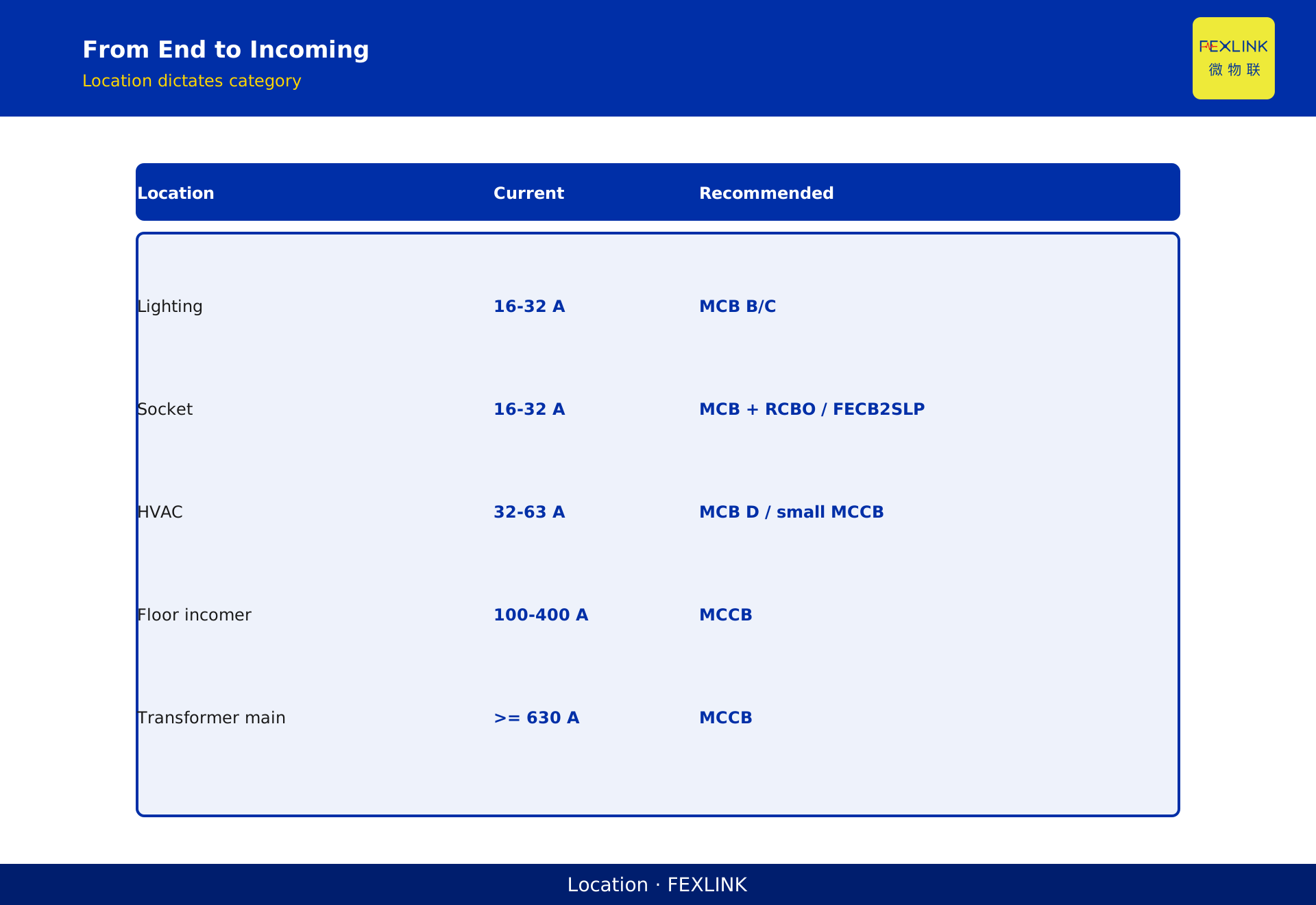
Direct Answer
The boundary between MCB and MCCB is not a gut feel of "small vs large"—it is three hard conditions calculated together: rated current, prospective short-circuit current at the location, and whether adjustable trip settings are needed. Up to 63 A, breaking 6–10 kA, end lighting/socket circuits → MCB. Above 100 A, breaking 25–50 kA, feeders/incomers needing adjustable short delay → MCCB. If any condition leans MCCB, pick MCCB; do not force an MCB to cover.
In a shopping mall renovation, the contractor used a 63 A Type C MCB for the floor distribution incomer. During welding, a ground fault shorted out; the MCB contacts exploded and the whole floor distribution burned. Post-event calculation: the prospective short-circuit current was 28 kA, but that MCB was rated only 6 kA—it should never have been there.
1. How MCB and MCCB Actually Differ
| Aspect | MCB (Miniature) | MCCB (Moulded Case) |
|---|---|---|
| Standard | GB/T 10963.1 | GB/T 14048.2 |
| Rated current | Typically ≤ 63 A | 16 A – 1600 A |
| Breaking capacity | Typically 6–10 kA | 25–50 kA, higher custom |
| Trip setting | Factory fixed (B/C/D), non-adjustable | Thermal-magnetic adjustable; electronic with short delay |
| Mounting | DIN rail, compact | Panel mount, larger |
| Typical location | End branches, lighting, sockets | Floor incomer, bus-tie, heavy feeders |
| Cost | Low | High |
2. The Three Conditions
Condition 1: rated current.
- ≤ 63 A: MCB covers it.
- ≥ 100 A: MCCB.
- 63–100 A: see the next two.
Condition 2: prospective short-circuit current Isc.
- Isc ≤ 10 kA: MCB breaking capacity is enough.
- Isc ≥ 25 kA: MCB physically cannot clear; MCCB mandatory.
- 10–25 kA: high-breaking MCB or step up to MCCB, by project criticality.
Condition 3: do you need adjustable tripping?
- End branches need no on-site setting; factory Type C is fine.
- Feeders need selectivity coordination upstream/downstream; adjustable short delay required → MCCB.
All three must point to MCB before you choose MCB; if any points to MCCB, use MCCB.
3. Typical Locations
- Lighting distribution branches: 16–32 A, low end Isc → MCB Type B/C.
- Socket circuits: 16–32 A, with residual current → RCBO MCB or FECB2SLP.
- HVAC / power branches: 32–63 A, high inrush → MCB Type D or small MCCB.
- Floor main incomer: 100–400 A, high Isc, needs selectivity → MCCB.
- Transformer low-voltage main: ≥ 630 A, needs short delay → MCCB.
4. Where Smart Products Fit
The FECB2SP smart breaker covers 1P/2P 16 A/32 A AC230 V and 3P/4P 32 A/63 A AC400 V—right in the MCB rated-current range—for end-branch smart breaking, peak current recording, and trip-time upload via RS485.
Feeder-side MCCB intelligence is usually implemented by adding the ESI digital status monitor on the circuit—monitoring switch position, trip signals, remote-change events—combined with the ESA multi-parameter smart meter. This gives end-branch smart plus feeder state monitoring, rather than one device trying to cover both ranges.
Do not try to cover MCB and MCCB ranges with a single smart product—they protect different objects, at different positions, under very different breaking stress.
5. Common Misapplications
Misapplication 1: MCB on a feeder. Rated current fits, but Isc far exceeds MCB breaking capacity; the switch explodes on a real short.
Misapplication 2: MCCB on an end circuit. Overkill, several times the cost, eats panel space, and wastes adjustable settings.
Misapplication 3: adjustable MCCB on an end circuit for selectivity. End circuits need no adjustment; a fast MCB backup is enough. Put the MCCB upstream for time selectivity.
6. Why MCB Breaking Capacity Is Low
A reader may ask: why can an MCB only break 6–10 kA, while an MCCB reaches 50 kA?
Because the structure is different:
MCB:
- Small size.
- Small arc chute.
- Contacts open slowly.
- Can only break small currents.
MCCB:
- Large size.
- Large arc chute.
- Contacts open quickly.
- Can break large currents.
During a short circuit, current is very large — thousands to tens of thousands of amps — and the arc must be extinguished in milliseconds. That requires a large arc chute.
An MCB has a small arc chute — it cannot break large currents — the arc burns through the enclosure — and the breaker explodes.
This is why feeders use MCCBs: feeder short-circuit currents are large, and MCBs cannot break them.
7. How to Quickly Choose MCB or MCCB
How do you quickly decide on site?
Three steps:
1. Check rated current:
- ≤ 63 A → MCB.
- ≥ 100 A → MCCB.
2. Check short-circuit current:
- End of line (far from transformer) → low Isc → MCB.
- Incoming (close to transformer) → high Isc → MCCB.
3. Check if settings are needed:
- End circuits need no adjustment → MCB.
- Feeders need adjustment (time selectivity) → MCCB.
All three point to MCB → choose MCB. Any one points to MCCB → choose MCCB.
8. One Sentence to Remember
MCB handles end circuits — small current, small short-circuit, no adjustment needed. MCCB handles feeders — large current, large short-circuit, adjustment needed.
Do not force an MCB into a feeder — it will explode during a short.
9. Common Questions
Q: Can a 63 A MCB be used on a feeder? A: No. Feeder short-circuit current is large (25 kA+), but MCB breaking capacity is only 6–10 kA — it cannot break the short — the breaker explodes.
Q: Can an MCCB be used on an end circuit? A: Yes, but it is wasteful. MCCBs are expensive and bulky — end circuits with small current only need an MCB.
10. A Real-Life Case
A shopping mall renovated its lighting distribution. The engineer used 63 A MCBs on the feeder to the lighting panel — they were cheaper and smaller than MCCBs.
Everything worked fine for six months. Then a short occurred on a downstream lighting circuit. The MCB feeder did not trip — it could not break the 18 kA short-circuit current at that point. The MCB enclosure melted, the arc escaped, and a small fire started inside the distribution board.
The root cause: the feeder short-circuit current was 18 kA, but the MCB breaking capacity was only 6 kA.
The fix:
- Replace all feeder MCBs with 100 A MCCBs with 25 kA breaking capacity.
- Add upstream/downstream time selectivity.
- Install FECB2SP smart breakers on the end circuits for trip records.
After the fix, similar downstream faults tripped only the local lighting circuit. The feeder MCCB stayed closed. No more board fires.
Lesson: do not force an MCB where an MCCB is needed. The feeder short-circuit current will exceed the MCB's breaking capacity — and the result is an explosion, not a clean trip.
11. How the FECB2SP Fits
The FECB2SP is a smart MCB. It covers the end-circuit range: 16 A, 32 A, 63 A. It records every trip event with peak current and clearing time.
For feeders, you still need an MCCB — the FECB2SP is not a feeder device. But the FECB2SP records give you data to verify the downstream end of the selectivity chain.
Example:
- Feeder MCCB trips — check the FECB2SP records on all downstream circuits.
- If one FECB2SP also recorded a trip at the same time — the fault was on that circuit.
- If no FECB2SP recorded anything — the fault was on the feeder itself.
This data-driven diagnosis saves hours of troubleshooting.
12. Quick Checklist
When choosing between MCB and MCCB:
- Rated current ≤ 63 A? → MCB.
- Short-circuit current at installation point > 10 kA? → MCCB.
- Need adjustable settings for selectivity? → MCCB.
- All three say MCB → choose MCB.
- Any one says MCCB → choose MCCB.
This checklist ensures you choose the right breaker for the right position. Do not save money on the wrong type — a feeder MCB that explodes costs far more than an MCCB that was installed correctly from the start.
The cost of a fire or an explosion is orders of magnitude higher than the cost of choosing the right breaker type. Choose correctly the first time.
Safety first. Cost second. The right breaker type is not an expense — it is an investment in safety.
Choose MCB for end circuits. Choose MCCB for feeders. Never mix them up.
This is the boundary that keeps your switchboard safe.
Know it. Respect it. Stay safe.
Always.
Stay safe always.
Scope and Limitations
This article applies to GB/T 10963.1 (MCB) and GB/T 14048.2 (MCCB). The three boundary conditions are typical engineering rules; specific projects must verify by fault-current calculation, upstream/downstream coordination, and manufacturer datasheets. The shopping mall mentioned is an anonymized example. FECB2SP covers the MCB end-branch range; feeder intelligence requires ESI and ESA.