 微物联研究院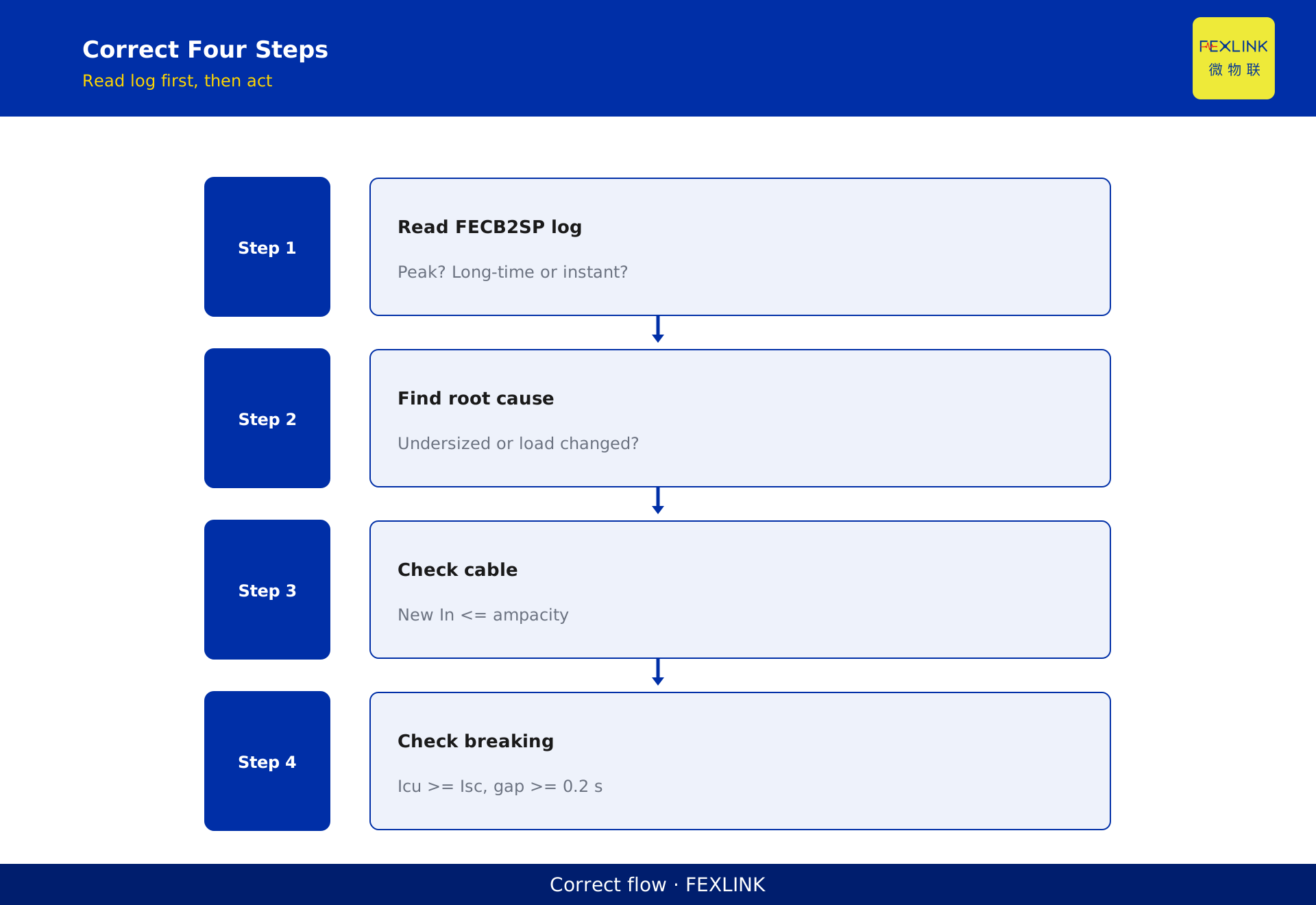
Direct Answer
Tripping and immediately upsizing the breaker is the most instinctive—and most dangerous—operation in electrical maintenance. Three common traps: (1) upsize the breaker but not the cable—the breaker stops tripping, the cable burns first; (2) only look at rated current, ignore prospective Isc—the upsized breaker may have inadequate breaking capacity; (3) swap without root-cause—overload? short-circuit? wrong curve? Swapping treats the symptom.
In a Grade-A office building, a 12th-floor air-con branch tripped repeatedly. Maintenance swapped the 32 A Type C MCB to 63 A. A month later the cable trench smoked—insulation already carbonized. The 32 A trips were normal protection; upsizing disabled it and let the cable overheat.
1. Tripping Means the Breaker Is Working
A trip is not a failure; it is protection doing its job. It tells you the branch current has exceeded the safe boundary.
Correct sequence:
- Find why it tripped—overload? short? earth fault? wrong curve?
- Decide whether to swap—was the breaker undersized, or did the load change?
- Only then touch the switch.
Upsizing blindly is like tightening a safety valve.
2. Three Traps
Trap 1: breaker upsized, cable not. Cable ampacity was chosen for the original In. In from 32 A to 63 A, but the cable may only carry 40 A. Breaker no longer trips; cable overheats.
Trap 2: In only, Isc ignored. A larger In does not guarantee higher breaking capacity. Original 32 A MCB breaks 6 kA; 63 A same model still 6 kA—but if site Isc is now 8 kA, the upsized switch will explode.
Trap 3: no root cause. Air-con starting trips may mean Type D chosen as Type C. Socket trips may be earth fault, not overload. Swapping does not fix the root cause.
3. Correct Four Steps
Step 1: read the FECB2SP log. Peak current at trip? Long-time or instantaneous? Obvious.
Step 2: undersized breaker or load problem? Real overload (new equipment) justifies upsizing; normal load but tripping means curve or setting issue.
Step 3: match cable. New In must not exceed cable ampacity.
Step 4: verify breaking and grading. Icu ≥ Isc; time gap ≥ 0.2 s.
4. The Consequence Chain
Upsize breaker → no trip → cable long-term overload → insulation aging → short-circuit → fire.
This chain happened in a real office building. Post-event infrared found the trench cable had risen from 40℃ to 95℃, insulation carbonized. Reading the FECB2SP current trend one month earlier would have caught the creeping load.
5. One Sentence to Remember
A trip is the breaker sounding an alarm, not making a mistake. Read the log, find the cause, then decide whether to touch the switch.
6. Why Tripping Means Protection Is Working
A reader may ask: is tripping not a fault? Why do you say it means protection is working?
Because the breaker's job is "protection" — when current exceeds the safe boundary, it automatically cuts off.
Normal operation: current within safe range — breaker does not trip. Overload: current exceeds rated — breaker trips — protects the cable from burning. Short-circuit: current suddenly jumps to tens of times rated — breaker trips in milliseconds — prevents a fire.
Tripping = the breaker is doing its job = protection is working.
If you think "tripping is annoying" — the protection is too sensitive — but do not just upsize the breaker — find out why it keeps tripping.
Upsizing the breaker = tightening the safety valve until it cannot pop = cable burns but no trip = fire.
This is why "trip → upsize" is the most dangerous action you can take.
7. How to Find the Root Cause of Tripping
How do you find the root cause after a trip?
Four steps:
1. Check trip type:
- Long-delay trip (after a few seconds) → overload.
- Instantaneous trip (after a few milliseconds) → short-circuit.
2. Check peak current:
- Overload: current 1.2–1.5 × In.
- Short-circuit: current 10–20 × In.
3. Check the load:
- Did you add new equipment? → real overload.
- Load unchanged? → wrong curve selected.
4. Check the curve:
- Motor circuit using Type C? → switch to Type D.
- Lighting circuit using Type D? → switch to Type C.
After these four steps, the root cause is found.
The FECB2SP smart breaker automatically records trip type, peak current, and clearing time — no guesswork needed.
8. When You Actually Need to Upsize
When do you actually need a bigger breaker?
Only one case: the load truly increased — new equipment added — the original breaker is indeed too small.
Example:
- Before: air conditioner 10 kW — 32 A breaker is enough.
- Now: new AC added — total load 18 kW — 32 A breaker is not enough.
- Upsize to 40 A — and upgrade the cable to 10 mm² at the same time.
In this case, yes, you need to upsize.
But in most cases — tripping is not because the breaker is too small — it is because the wrong curve was selected, or the load has a problem.
Find the root cause first — then decide whether to upsize.
9. A Real-Life Lesson
An office building, 12th floor air conditioning circuit kept tripping. Maintenance directly replaced the 32 A Type C MCB with a 63 A.
One month later — smoke came from the cable trench — the insulation had carbonized.
Why?
The original 32 A trips were normal protection — the AC startup current was 6× = 192 A — Type C instantaneous threshold is 5–10× = 160–320 A — nuisance trip during startup.
The correct fix: replace with a Type D 32 A — not upsize to 63 A.
Maintenance upsized to 63 A — the breaker stopped tripping — but the cable was overheating continuously — insulation carbonized — nearly caused a fire.
Lesson: find the root cause first — it was the wrong curve, not a too-small breaker.
10. One Sentence to Remember
Tripping means the breaker is sounding an alarm — not making a mistake. Read the records, find the root cause, then decide whether to touch the breaker.
Do not just upsize it — that tightens the safety valve until it cannot pop.
11. Common Questions
Q: Can I just try upsizing the breaker after a trip? A: No. Upsizing = tightening the safety valve — the cable burns but the breaker does not trip. Find the root cause first: overload, short-circuit, or wrong curve.
Q: How does the FECB2SP help find the root cause? A: It automatically records trip type, peak current, and clearing time — long-delay vs instantaneous is clear at a glance.
12. Quick Checklist
After a trip:
- Check the trip type from the FECB2SP record.
- Read the peak current.
- Check whether new equipment was added.
- Verify the curve type matches the load.
- Only then decide whether to upsize or adjust the curve.
This checklist turns a guesswork troubleshooting process into a data-driven diagnosis. Without the FECB2SP records, you are flying blind. With them, you can solve the problem in minutes instead of hours.
The most common mistake in electrical maintenance is "trip → upsize". This mistake has caused countless electrical fires. Do not be the person who makes it.
Remember: the breaker is your friend. It is trying to protect you. When it trips, it is doing its job. Your job is to find out why — not to silence the alarm by making the breaker bigger.
A bigger breaker does not fix the problem. It hides the problem. And hidden problems always come back — usually in the form of smoke, fire, or a shutdown.
Find the root cause. Fix the real problem. Keep the breaker at the correct size. That is how you keep your installation safe.
Safety is not about bigger breakers. Safety is about correct breakers — correctly sized, correctly curved, correctly coordinated.
Do it right the first time. Do not learn the hard way.
That is the lesson. That is the rule. That is how professionals handle breaker tripping.
Apply it. Teach it. Share it with your team.
Safety first. Always. That is the only way.
Thank you for reading. Stay safe. Stay curious. Keep learning.
This is the end of this article. We hope you found it useful. See you in the next one.
Until then, keep your installation safe. Keep your breakers correct. Keep your cables protected.
That is the way. That is the standard. That is how we work.
Thank you. Goodbye.
Stay safe. Stay professional. Stay curious.
Until next time.
Thank you for your time.
Goodbye for now.
Always.
Stay safe always.
Scope and Limitations
This article applies to GB 50054-2011 on breaker setting and cable coordination. The office building mentioned is anonymized. FECB2SP logs support root-cause diagnosis; specific replacement requires an electrical engineer to verify cable ampacity and fault current.