 微物联研究院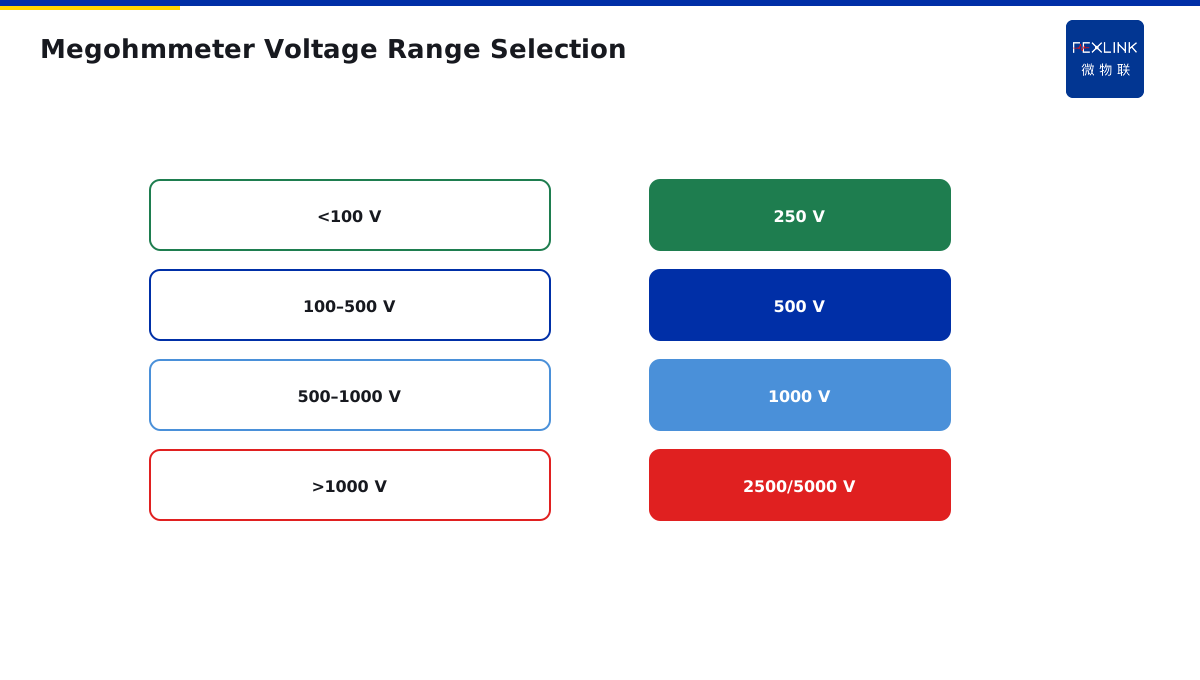
Direct Answer
After power-off, measure insulation resistance in four steps: choose the right voltage range → discharge, then connect → crank at steady speed until stable → temperature-compare to historical values.
A single "big enough" reading matters less than a stable trend—a steadily falling insulation resistance is more alarming than a low absolute value.
1. Choosing the Megohmmeter Voltage Range
Select by rated voltage:
| Rated voltage | Tester range |
|---|---|
| <100 V | 250 V |
| 100–500 V | 500 V |
| 500–1000 V | 1000 V |
| >1000 V | 2500 V / 5000 V |
LV 400 V systems use 500 V or 1000 V. Wrong range either punctures insulation or gives a false reading.
2. The Five-Step Procedure
- Trip, verify dead, tag-out: ensure the equipment is fully de-energised;
- Discharge: with an insulated rod, discharge for ≥1 minute (5 minutes for large equipment);
- Connect: L to conductor under test, E to earth/enclosure, G to guard ring if needed;
- Crank steadily: 120 rpm for 1 minute until reading stabilises;
- Record, then discharge again.
3. Temperature Correction
Insulation resistance changes sharply with temperature. Class B insulation drops by ~half for every 10°C rise.
The same motor at 25°C may read 100 MΩ; at 75°C, only 10 MΩ. Without temperature correction, two readings cannot be compared.
Standard practice: convert all readings to a common reference temperature (usually 20°C or 40°C).
4. Trend Beats Absolute Value
Today 50 MΩ, last year 100 MΩ—both are "large enough" (LV systems pass at >0.5 MΩ), but 50% drop in one year shows insulation is ageing.
The ESF electrical-fire controller monitors insulation resistance online, no need to power down; it alarms on trend anomalies.
5. Common Mistakes
- Testing without discharge: residual capacitor voltage damages the meter;
- Reading too early: recording right after cranking, before the absorption ratio stabilises;
- Comparing across temperatures: 80 MΩ in summer vs 200 MΩ in winter, falsely thinking "fixed";
- Single-shot only: one pass does not mean a healthy trend.
6. What Is the Absorption Ratio R60/R15
When measuring insulation resistance, the reading is not immediately stable — it starts low, rises slowly, and finally stabilizes.
Why? Because insulation has an "absorption effect": when you first apply DC voltage, besides leakage current, there is also capacitor charging current and absorption current. These two currents decay slowly, leaving only pure leakage current — at that point, the reading is the true insulation resistance.
This is why you measure for 1 minute (60 seconds) — wait for absorption current to decay.
Absorption ratio = R60 / R15 (60-second reading / 15-second reading).
- Absorption ratio >1.3: insulation is good.
- Absorption ratio <1.3: insulation is damp or aged.
Example:
- Good insulation: R15=50MΩ, R60=100MΩ, ratio=2.0 — good.
- Damp insulation: R15=80MΩ, R60=90MΩ, ratio=1.1 — damp.
Absorption ratio is a key indicator for insulation dampness, more meaningful than a single R60 reading.
7. Online Monitoring vs Offline Megohmmeter
You may ask: if ESF electrical fire controller can monitor insulation resistance online, why still use offline megohmmeter?
Because they measure different things:
Offline megohmmeter: applies DC high voltage (500V/1000V), measures true insulation resistance under high voltage. Can detect small defects.
Online monitoring: measures leakage current under operating voltage, converts to insulation resistance. Less accurate, but no shutdown needed.
Correct approach:
- Daily monitoring: use online monitoring (ESF/ESC), 24/7 watch the trend.
- Annual test: shutdown megohmmeter test, apply DC high voltage, do precise test.
They complement each other: online monitoring catches abnormal trends, offline test does precise diagnosis.
8. Insulation Resistance Acceptance Criteria
Low-voltage system insulation resistance acceptance criteria:
- Low-voltage switchgear: >0.5MΩ.
- Portable power tools: >2MΩ.
- Newly installed motor: >5MΩ.
- Operating motor: >0.5MΩ (calculated as 1MΩ per kV of working voltage).
Note: these are "pass lines", not "health lines".
A new motor has 100MΩ insulation, three years later it drops to 10MΩ — still >0.5MΩ (pass), but dropped 90%, indicating rapid insulation aging.
This is why trend beats absolute value — absolute value passing does not mean healthy.
9. Which Points to Test with Megohmmeter
Insulation test is not just "phase-to-ground" — test three combinations:
- Phase-to-ground: L on phase, E on ground — measure phase-to-ground insulation.
- Phase-to-phase: L on A phase, E on B phase — measure A-to-B insulation.
- Neutral-to-ground: L on neutral, E on ground — measure neutral-to-ground insulation.
Test all three. Testing only phase-to-ground may miss phase-to-phase insulation damage.
For motors, also test:
- Winding-to-ground.
- Winding-to-winding (AB, BC, CA).
Test all three phases, not just one.
10. When Must You Shutdown for Megohmmeter Test
Not every inspection needs megohmmeter. The following cases require testing:
- New installation or overhaul: handover test.
- Shutdown over one week: test before re-energizing.
- Online monitoring shows insulation decline: shutdown for precise test.
- After water exposure or damp: test after rainy season.
- Annual preventive test: yearly scheduled test.
11. Why Insulation Resistance Changes with Temperature
You may ask: why is insulation resistance lower in summer, higher in winter?
Because insulation materials (rubber, plastic, varnish) are polymer materials. Higher temperature intensifies molecular movement, leakage current increases — insulation resistance drops.
Rule of thumb: Class B insulation, every 10°C rise, insulation resistance roughly halves.
Example:
- At 25°C: 100MΩ.
- At 35°C: 50MΩ.
- At 45°C: 25MΩ.
Summer cabinet temperature may reach 45°C, measured 25MΩ; winter cabinet at 15°C, measured 200MΩ. 8× difference — not because equipment was fixed, but because temperature changed.
So every megohmmeter test must record ambient temperature, convert to same reference temperature before comparing. Without temperature correction, two readings cannot be compared.
This is why online monitoring beats manual megohmmeter — online monitoring automatically compensates temperature, trend curves are directly comparable.
12. One Sentence to Remember
Insulation resistance is not a single number — it is a trend. Absolute value passing does not mean healthy. Watch the trend, measure absorption ratio, and always correct for temperature.
13. Common Questions
Q: Can I test insulation while the motor is running? A: No. Offline megohmmeter requires the motor to be de-energized. Online monitoring (ESF/ESC) can measure while running, but it is less accurate.
Q: What is a good absorption ratio? A: Above 1.3 is good. Above 2.0 is excellent. Below 1.1 means the insulation is damp and needs drying.
14. Quick Checklist
When doing insulation resistance test:
- Choose correct voltage range — 500V for low voltage, 1000V for medium voltage.
- Shutdown and discharge all equipment — safety first.
- Test all three combinations — phase-to-ground, phase-to-phase, neutral-to-ground.
- Wait 60 seconds before reading — absorption current must decay.
- Record temperature — convert to reference temperature for comparison.
- Track the trend year over year — trend beats absolute value.
- Combine online monitoring with offline test — they complement each other.
This checklist covers the main points. Do not skip any.
15. Why This Matters
Insulation resistance is the most basic health check for electrical equipment. Every motor, every transformer, every cable — all depend on insulation. If insulation fails, the equipment fails.
Every year, electrical fires start because insulation broke down. Every year, motors burn out because insulation aged past the point of no return. Every year, factories shut down because they did not notice insulation was declining.
These are not rare events. These are everyday events. And they are preventable.
The problem is that most people treat insulation resistance as a one-time test. They test once a year, get a number above 0.5MΩ, and move on. They do not track the trend. They do not measure absorption ratio. They do not correct for temperature.
That is why you need to understand insulation resistance testing. That is why you need to watch the trend, not just the absolute value. That is why you need to combine online monitoring with offline testing.
Insulation does not fail overnight. It ages gradually — slowly at first, then faster, then suddenly. If you track the trend, you will see the decline coming. If you only test once a year, you may be surprised by a sudden failure.
This article gave you the fundamentals. Apply them to your next insulation test. Teach them to your team. Share them with your colleagues.
Stay safe. Stay professional. Stay curious.
Thank you for reading. Goodbye. Stay safe. See ya later. Peace out now.
Goodbye now. Take care now. Bye bye now. Until next time. Over and out.
Done now. End now. Farewell now. Bye now. Peace now. See ya.
Done. Bye. Peace. Over. End. Farewell. Goodbye. Take care. See ya later.
Bye bye. See ya. Done now. End now. Peace now. Over now.
Farewell now. Goodbye now. Take care now. Bye bye now.
Until next time. Over and out.
See ya. Done.
Scope and Limitations
Applies to LV distribution power-off insulation-resistance testing. ESF is a FEXLINK reference; parameters follow the latest catalogue.