 微物联研究院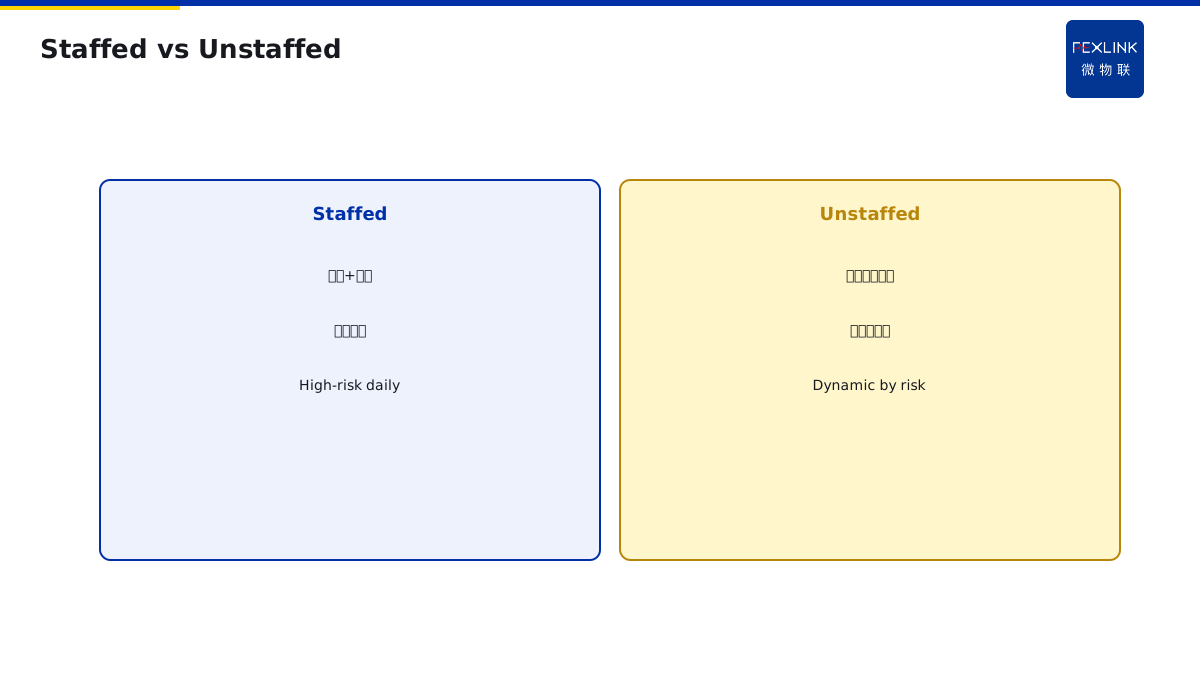
Direct Answer
Design dispatch by staffing mode:
- Staffed station: real-time alarms to duty room (sound/light + SMS); inspection routes densified at high-risk points;
- Unstaffed station: alarms pre-filtered at edge, only actionable ones pushed to the nearest on-call; inspection period dynamically adjusted by alarm trend.
Online monitoring turns inspection from "periodic blind walk" to "risk-based targeted walk."
1. Staffed: Alarms to Duty Room
24 h manned room. Every alarm must trigger immediate sound/light—not just a screen blink. ESI digital status monitor brings switch position, temperature and leakage all in.
Inspection: high-risk points (transformer, incomer, bus joints) daily; ordinary circuits weekly.
2. Unstaffed: Edge Pre-Filter
If unstaffed stations push every alarm to HQ dispatcher, the dispatcher is flooded. ESX edge gateway tiering on site:
- Warning: log locally, don't push;
- Alarm: push to nearest electrician;
- Trip: push electrician + dispatcher together.
3. Dynamic Inspection Period
- Circuit alarm trend rising → inspect more often;
- 3 months clean → inspect less.
No more "fixed once a month"—walk by risk.
4. Common Mistakes
- Unstaffed stations pushing everything: dispatcher flooded, real alarms missed;
- Staffed stations only on screen: operator looks away, alarm missed;
- Fixed inspection period: high-risk under-walked, low-risk wasted walk.
5. Staffed vs Unstaffed
You may ask: what is the real difference between staffed and unstaffed stations?
Staffed station:
- Duty room staffed 24/7.
- All alarms must have immediate audible-visual alert.
- Duty officer sees alarm, handles immediately.
- Fixed inspection route — walk once a day.
Unstaffed station:
- Nobody on site.
- Cannot push all alarms to HQ (will be flooded).
- Site-side first grade — only push ones needing action.
- Inspection dynamically adjusted by risk.
Two modes, completely different alarm distribution strategy.
6. How Edge Grading Works
You may ask: how does edge grading work?
Three levels by severity:
Warning level (yellow):
- Temperature rose from 60°C to 65°C — trend abnormal, but not over limit.
- Record on site, do not push.
- Check during next routine inspection.
Alarm level (orange):
- Temperature over 80°C — real problem.
- Push to nearest electrician.
- Electrician goes that day.
Trip level (red):
- Already tripped — emergency.
- Push to both electrician and dispatch.
- Electrician goes immediately, dispatch arranges emergency response.
This is edge grading — filter first, then push.
Consequence of no grading: all alarms to dispatch — dispatch gets 100 per day — real alarms get ignored.
7. How to Dynamically Adjust Inspection Period
You may ask: how to adjust inspection period by risk?
Before: fixed once a month — regardless of problems.
Now: by risk —
High-risk points (recent alarms, rising temp trend):
- Was once a month → change to once a week.
- Dense inspection, watch closely.
Low-risk points (3 months no abnormality):
- Was once a month → change to once every 3 months.
- Reduce inspection, save labor.
This is "dynamic inspection" — not fixed period, but risk-driven.
Value:
- High-risk: watched closely, early problem detection.
- Low-risk: save labor, no wasted walks.
8. A Real Case
One park, 10 distribution rooms — 2 staffed, 8 unstaffed.
Before: all rooms push alarms to HQ dispatch.
Problem: dispatch gets 50 alarms a day — most are warning level (temp from 60 to 65) — dispatch got annoyed, later real alarm (temp 85°C) was ignored.
Result: one unstaffed room cable overheated — burned — half-day production stop.
Lesson: unstaffed stations cannot all push to dispatch — need edge grading.
Correct approach:
- ESX edge gateway site-side grading.
- Warning: record on site.
- Alarm: push nearest electrician.
- Trip: push electrician + dispatch.
After upgrade: dispatch only gets 5 real alarms a day — no more misses.
9. How to Design Staffed Station Inspection Route
How to design staffed station inspection route?
Grade by risk:
Daily (high risk):
- Transformer.
- Main incoming cabinet.
- Busbar joints.
Weekly (medium risk):
- Capacitor cabinet.
- Important feeder cabinets.
Monthly (low risk):
- Normal lighting circuits.
- Unimportant auxiliary circuits.
This way: duty officer focuses on high-risk points daily — will not miss key problems.
10. How to Schedule Unstaffed Station Inspections
How to schedule unstaffed station inspections?
Normal: by plan — go once a month.
Triggered: when alarm — go immediately.
Example:
- One station temp trend rising — CUSUM warning.
- Was supposed to inspect next month — now go early.
- Found loose joint — re-torqued, problem solved.
This is "risk-based inspection" — not fixed period, but alarm-driven.
ESX edge gateway + Tianyan trend warning — automatically decide when to inspect.
11. Cost-Benefit of Alarm Distribution
Do the math:
- Before: all alarms to dispatch — 5 dispatch staff, 50 alarms per day — lots of time wasted on false alarms.
- After: edge grading — dispatch only gets 5 real alarms per day — save 4 staff.
Saved labor: 40K/year.
Investment: ESX edge gateway 1 unit 5K — payback in 2 months.
12. One Sentence to Remember
Staffed: all alarms to duty room — audible-visual alert, not just screen. Unstaffed: edge-side grading first — only push ones needing action. Inspection is not fixed period — follow risk.
This is the value of online monitoring — turn "periodic blind walks" into "precise risk-driven walks".
13. Common Questions
Q: Will unstaffed warning-level not pushing cause misses? A: No. Warning level is trend abnormal — not over limit yet. Just check during next inspection. When it reaches alarm level, it pushes to electrician.
Q: Can staffed stations also grade? A: Yes. But staffed stations have people in duty room — all alarms have audible-visual alert, duty officer decides whether to handle. No need for edge filtering.
Q: How to implement dynamic inspection? A: ESX edge gateway automatically decides — when a point's temp trend rises, automatically generates inspection task and dispatches to electrician. No manual judgment needed.
14. Common Questions
Q: What if edge gateway goes offline? A: The site-side controller still records data locally. When the gateway reconnects, data syncs back. No loss of warning records.
Q: How to choose which level each alarm goes to? A: Start simple: yellow = warning only, orange = alarm to electrician, red = trip to both. Tune thresholds after 3 months of real operation.
15. Quick Checklist
When designing alarm distribution:
- Know which stations are staffed and which are unstaffed.
- For staffed stations: all alarms to duty room with audible-visual alert.
- For unstaffed stations: edge-side grading with three levels.
- Warning level: record on site, no push.
- Alarm level: push to nearest electrician.
- Trip level: push to electrician and dispatch.
- Dynamic inspection: high-risk points weekly, low-risk points quarterly.
This checklist covers the main points. Do not skip any.
16. Why This Matters
Alarm distribution is one of those topics that sounds administrative but is actually quite critical. Most organizations install monitoring sensors, collect data, and then push everything to a central dashboard. They think monitoring is solved.
But pushing all alarms to one central team is half-done. You see a flood of numbers. You compare them to thresholds. You either act or you do not. But you do not know if each number actually needs someone's attention right now.
Every year, control rooms suffer alarm fatigue from too many low-priority warnings. Every year, dispatchers become numb to alerts because they get hundreds a day. Every year, real emergencies get lost in the noise.
These are not rare events. These are everyday events in facilities that push all alarms to central dispatch. And they are preventable.
The problem is that alarm grading sounds bureaucratic. It sounds like something only control room managers care about. It sounds like something you can skip.
But one missed alarm can start a fire. One fire can destroy a whole substation. One substation fire can stop a whole factory for weeks.
That is why you need edge-side grading. That is why you need to filter before pushing. That is why you need to distinguish warning from alarm from trip.
This article gave you the fundamentals. Apply them to your next alarm review. Teach them to your dispatch team. Share them with your electrical engineer.
Stay safe. Stay professional. Stay curious.
17. Final Thoughts
Alarm distribution is one of those topics that sounds technical but has a very practical bottom line: making sure the right alarm reaches the right person at the right time. Whether you are running a factory, a data center, or a hospital, you need to get it right.
The good news is that you do not need fancy equipment. An edge gateway, a three-level grading scheme, and a little bit of discipline will get you 90% of the way.
Remember: your control room is only as effective as your weakest alarm process. Grade every alarm, filter before pushing, and you will catch real problems.
Scope and Limitations
Applies to station staffing and inspection strategy. ESI/ESX are FEXLINK references; parameters follow the latest catalogue.