 微物联研究院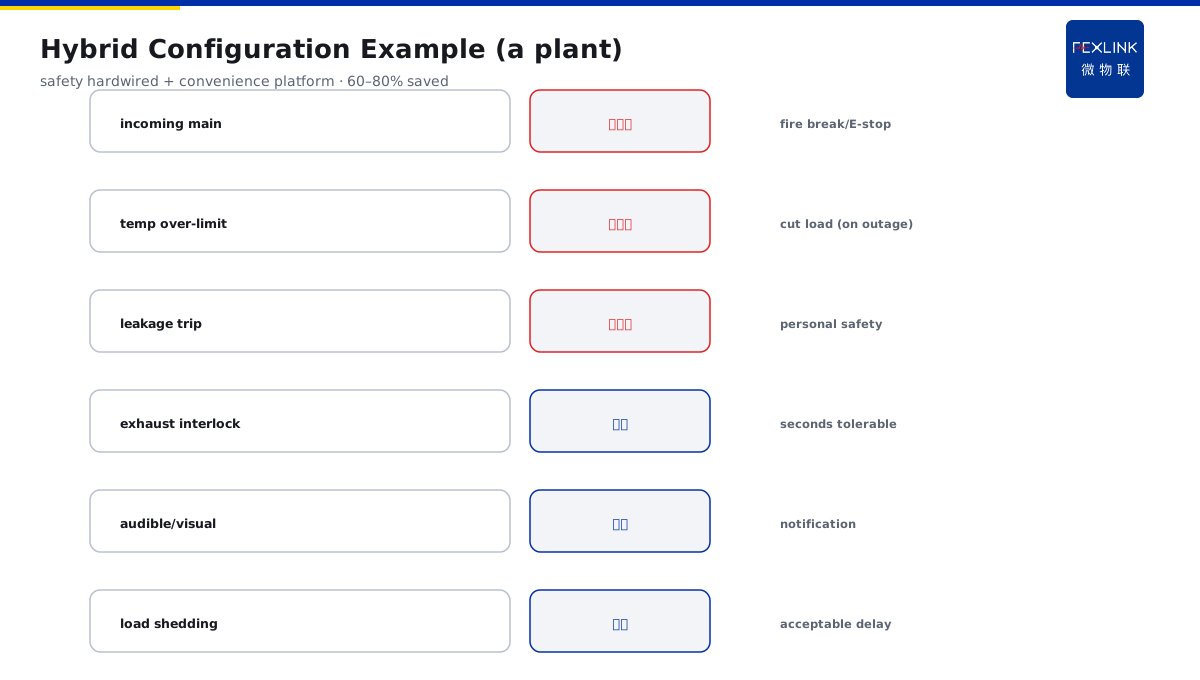
Direct Answer
You are torn between hardwired interlocking and platform-based remote alarming — afraid of over-design but also of insufficient safety redundancy. What is the criterion? The answer: judge by whether the failure consequence can tolerate waiting for the network response — personal-safety and fire-spread consequences require hardwiring (it must act even when the network is down); actions that tolerate second-level response (exhaust fans, notifications, load shedding) can use the platform; spend the limited budget on the few circuits that "must act even when the network is down," rather than hardwiring every circuit.
At one plant's fire-interlocking retrofit: the fire alarm and circuit-breaking loops were hardwired (relay direct output, not through the network); exhaust fans and audible/visual notifications used platform interlocking. During a network-outage drill: hardwired loops acted as usual (cut the affected circuits); platform loops were delayed (executed after the network recovered) — verifying the design intent. Conclusion: hardwiring governs "must act," the platform governs "can wait." The decision's core is grading by failure consequence — only circuits that must act even when the network is down get hardwired; the rest go through the platform, precise budget with no waste.
Because:
- Hardwiring is "reliable even when the network is down": no network dependency, millisecond response;
- Platform interlocking "depends on the network": fails when the network is down, second-level response;
- Consequence grading: personal safety/fire spread = must hardwire; exhaust/notification/shedding = platform can tolerate;
- Budget logic: hardwiring is expensive (cables + terminals + commissioning); give it only to circuits that "must act."
Key insight: "must act even when the network is down" is the only reason to hardwire. Grade by failure consequence — a few circuits hardwired, most via the platform; safety and cost both achieved.
At one plant, all interlocking was made platform-based to save hardwiring cost. During a network fault that coincided with a distribution-cabinet temperature over-limit, the platform interlock did not execute (network down); manual response was delayed by minutes. Rectification: the temperature over-limit interlock was changed to hardwired (direct trip/load cut); exhaust and notifications stayed on the platform. Lesson: do not save where hardwiring is required — for circuits that "must act even when the network is down," the platform cannot substitute.
1. Response and Reliability Comparison of the Two Approaches
Step one: what are the characteristics of each.
Hardwired interlocking:
- Principle: relay contact direct output (not through the network);
- Response: millisecond level (relay action time);
- Reliability: no network dependency (acts even when the network is down);
- Cost: high (cables, terminals, commissioning);
- Applicable: personal safety, fire breaking, etc.
Platform remote interlocking:
- Principle: the platform issues commands → actuators act;
- Response: second level (network transmission + command processing);
- Reliability: network-dependent (fails when the network is down);
- Cost: low (reuses network + platform);
- Applicable: exhaust, notifications, load shedding, etc.
Comparison points:
- Response speed: hardwired milliseconds vs platform seconds;
- Network dependency: hardwired none vs platform dependent;
- Action certainty: hardwired certain vs platform depends on the network;
- Cost: hardwired high vs platform low.
Key insight: hardwired = reliable even when the network is down + millisecond; platform = network-dependent + second-level. The reliability difference is the root of the decision.
2. Decision Criterion: Consequence Tolerance
Step two: how to judge whether to hardwire.
Consequence grading:
- Personal safety (electric shock/fire injuring people): must hardwire;
- Fire spread (uncontrolled spread if cutting is late): must hardwire;
- Equipment damage (sustained over-temperature/overload): hardwire preferred;
- Production impact (load shedding/stoppage): platform can tolerate;
- Notification type (audible/visual/SMS): platform suffices.
Tolerance judgment:
- Ask "can you accept no action when the network is down":
- Cannot accept (safety/fire): hardwire; - Can accept (production/notification): platform;
- Ask "is a few seconds' delay fatal":
- Fatal (fire/shock): hardwire; - Not fatal (exhaust/shedding): platform.
Judgment formula:
- Consequence severity × network-failure probability = risk;
- High risk (unacceptable): hardwire;
- Low risk (acceptable): platform.
Key insight: "must act even when the network is down" is the watershed. Circuits that cannot accept no-action-on-outage get hardwired; those that can wait go to the platform — consequence tolerance decides the investment.
3. Which Circuits Must Be Hardwired
Step three: specifically which circuits.
Must hardwire:
- Fire breaking: fire-interlocking cuts the affected circuits;
- Temperature over-limit trip: critical equipment over-temperature direct cut;
- Leakage/insulation-fault trip: personal-safety related;
- Emergency-stop circuits: must act under any condition;
- Over-limit trip: protective action cannot wait for the network.
Platform-applicable:
- Exhaust interlock: temperature/smoke triggers exhaust (second-level tolerable);
- Audible/visual notification: alarm indication (notification nature);
- Load-shedding strategy: cutting non-critical loads (acceptable delay);
- SMS/email: notifying operations (asynchronous);
- Reports/records: post-analysis (no real-time requirement).
Grading example:
- Cabinet temperature over-limit: hardwire (cut load);
- Exhaust start: platform (second-level tolerable);
- Audible/visual alarm: platform (notification nature);
- Emergency stop: hardwire (must act under any condition).
Key insight: hardwiring goes to "safety-critical," the platform to "operational convenience." Grade by circuit nature — safety class hardwired, convenience class platform.
4. Cost Differences
Step four: where the money differs.
Hardwired cost composition:
- Cables (independent wiring per circuit);
- Relays/terminals (per circuit);
- Construction/commissioning (on-site wiring + testing);
- Later maintenance (terminal tightening, circuit testing).
Platform-interlock cost composition:
- Network reuse (no extra cables);
- Platform functions (software configuration);
- Actuators (shared with hardwiring);
- Configuration/commissioning (platform logic setup).
Cost comparison:
- Hardwired: hundreds to thousands of yuan per circuit (depending on distance);
- Platform: low marginal cost (reuses the existing network);
- All-hardwired vs hybrid: hybrid saves 60%–80% of wiring cost;
- Budget logic: spend on the few circuits that "must act."
Key insight: hardwiring is "high per-circuit cost," the platform is "low marginal cost." Hardwiring every circuit is waste — configure only the critical ones; most of the budget is saved.
5. Typical Configuration Example
Step five: what is the most reasonable configuration.
Example scenario (a plant's distribution system):
- Incoming main breaker: hardwire (fire breaking/emergency stop);
- Temperature over-limit circuit: hardwire (cut load);
- Leakage-trip circuit: hardwire (personal safety);
- Exhaust interlock: platform (second-level tolerable);
- Audible/visual notification: platform (notification nature);
- Load-shedding strategy: platform (acceptable delay).
Configuration principles:
- Safety-critical circuits: hardwire (must act even when the network is down);
- Convenience circuits: platform (act when the network is available);
- The two complement each other: hardwiring guarantees the bottom line, platform expands coverage;
- Periodic testing: regular action tests on hardwired circuits (reliability verification).
Acceptance points:
- Network-outage test on hardwired circuits (verify no network dependency);
- Platform-interlock delay test (verify second-level response);
- Circuit-list check (correct grading);
- Redundancy check (dual channels for critical circuits).
Key insight: the typical configuration is "safety hardwired + convenience on the platform." Clear grading, tested and verified — interlocking is both reliable and economical.
6. Product Landing: Digital Electrical Intelligent Supervision System
FEXLINK products land interlocking grading:
- ESF Electrical-Fire Monitoring & Control Device (relay output): hardwired breaking for fire/temperature over-limit;
- Platform interlocking: exhaust/notification/load-shedding strategies;
- Circuit-list management: hardwired/platform grading labels;
- Interlock testing: periodic test records (reliability verification).
Design principle in one sentence: "hardwiring guarantees the bottom line, the platform expands coverage." Circuits that must act even when the network is down get hardwired — safety has a fallback, budget is not wasted.
Common scenario Q&A:
- Q: For temperature over-limit interlocking, is a platform trip enough? A: Not recommended for critical equipment — when the network is down the platform fails and temperature keeps rising; hardwiring cuts the load directly and is more reliable.
- Q: How much does full hardwiring cost? A: Billed per circuit (cables + terminals + commissioning); full hardwiring is several times the hybrid cost; configure only the "must-act" circuits.
- Q: Is platform interlocking completely unreliable? A: No — with the network normal, second-level response suffices; it only fails when the network is down, so safety-critical circuits cannot depend on it.
- Q: Do hardwired circuits need maintenance? A: Yes — periodic action tests (prevent contact oxidation/circuit breaks), with test records in the maintenance ledger.
- Q: How do I present this investment to leadership? A: Explain that the few "must-act-even-when-the-network-is-down" circuits protect the safety bottom line, and the rest use the platform to save budget — safety and cost both win.
7. Common Decision Misconceptions
- All-platform to save cost: all interlocking via the platform. Consequence: safety circuits do not act when the network is down. Correct: hardwire safety-critical circuits.
- All-hardwired for safety: hardwiring every circuit. Consequence: wasted cost (convenience circuits do not need it). Correct: grade by consequence.
- Construction cost only: ignoring network-outage risk. Consequence: save small money, take a big risk. Correct: include reliability value in the decision.
- Hardwired without testing: installed and ignored. Consequence: contact oxidation/circuit breaks unknown. Correct: periodic action tests.
- Grading undocumented: configured by feel. Consequence: unclear circuit attribution (hardwire-required circuits on the platform). Correct: manage a graded circuit list.
Scope and Limitations
This article provides a decision framework for hardwired interlocking vs platform-based remote alarming (response/reliability comparison, consequence-tolerance criterion, circuits that must be hardwired, cost differences, typical configuration example) for distribution-system interlock design, fire-interlock retrofit, and budget allocation. Specific circuit grading must be determined per on-site safety requirements, process continuity, and code requirements; design and construction of hardwired circuits must comply with applicable electrical and fire codes; interlock testing must be performed by qualified personnel per procedures. All cases are anonymized (a certain plant) and do not refer to any specific customer.