 微物联研究院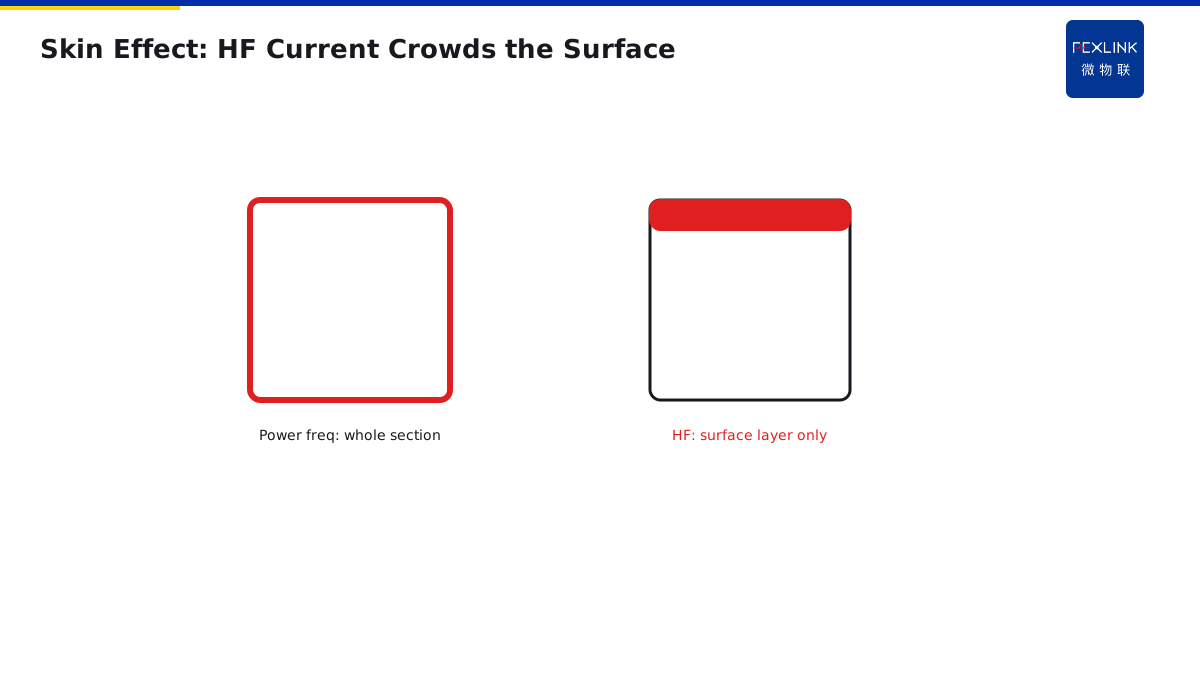
Direct Answer
Cable heating is determined by total RMS current including all harmonics, not just the fundamental. Fundamental within limit ≠ no overheating.
On rectifier / VFD / LED-heavy circuits, harmonics produce skin-effect and proximity-effect losses, and triple-N harmonics add on the neutral. Cable temperature must be judged by total RMS and THDi.
1. Why It's Hot Though Fundamental Is Fine
Suppose fundamental is 80 A on a 100 A-rated cable (20% margin looks fine). But 3rd harmonic 30 A and 5th harmonic 15 A ride along.
Total RMS = √(80²+30²+15²) ≈ 87 A—near full load. Skin effect further reduces effective cross-section, so actual heating exceeds an 87 A 50 Hz current.
2. Skin Effect
High-frequency current crowds near the conductor surface—the center is effectively unused. Higher frequency → smaller effective area → higher resistance → more heat.
At 50 Hz skin effect is mild; above 300 Hz (6th harmonic) it becomes significant.
3. Neutral Triple-N Harmonics
Balanced three-phase systems should have zero neutral current. But 3rd harmonics are in-phase across three phases and add on the neutral—neutral current can exceed phase current.
That is why, in VFD-heavy buildings, the neutral is hotter than the phases.
4. How to Judge
ESE power-quality monitor gives directly:
- Total RMS Irms;
- THDi (total current distortion);
- Per-order harmonics.
When THDi > 15%, cable sizing must be derated.
5. Common Mistakes
- Looking at fundamental meter only: fundamental 80 A seems fine; total RMS 95 A is the real story;
- No neutral temperature sensing: triple-N makes N the hottest;
- No harmonic derating: VFD circuits need cable cross-section × 1.5.
6. What Skin Effect Really Means
You may ask: skin effect sounds abstract, can you explain in plain language?
Simply put: high-frequency current does not like the center of the wire, it likes the surface.
Why? Because high-frequency current creates its own magnetic field, and that magnetic field creates eddy currents in the wire center — eddy currents "push" current to the surface.
Result: no current in the wire center, only on the surface — effectively the wire is thinner.
Higher frequency = more "pushing" = smaller effective cross-section.
Example:
- 50Hz (power frequency): skin effect weak, whole cross-section useful.
- 300Hz (6th harmonic): skin effect noticeable — effective cross-section only 70%.
- 1500Hz (30th harmonic): skin effect strong — effective cross-section only 30%.
Wire gets thinner — resistance increases — heat increases.
This is why harmonic-rich circuits heat up more than fundamental calculations predict.
7. Why Triplen Harmonics Add in the Neutral
You may ask: balanced three-phase has no neutral current, why do triplen harmonics appear?
Because triplen harmonics are "in phase" across all three phases.
Fundamental (50Hz): three phases 120° apart — when A-phase positive half-cycle, B-phase negative half-cycle — neutral currents cancel.
Triplen harmonic (150Hz): three phases in phase — when A-phase positive half-cycle, B-phase also positive half-cycle — neutral currents add.
Result: neutral current = sum of three-phase triplen harmonic currents.
Example:
- Phase triplen harmonic current 20A.
- Neutral triplen harmonic current = 20A × 3 = 60A.
Neutral 60A — hotter than phase!
This is why LED lighting and VFD-heavy buildings frequently have neutral overheating — triplen harmonics add.
8. How to Find Cable Harmonic Derating Factor
You may ask: for harmonic-rich circuits, how much to upsizing cable?
Per GB/T 14549 "Public Grid Harmonics":
| THDi | Derating Factor |
|---|---|
| <10% | 1.0 (no upsizing) |
| 10–20% | 0.9 (upsize 1.1×) |
| 20–40% | 0.8 (upsize 1.25×) |
| >40% | 0.7 (upsize 1.4×) |
Example:
- VFD circuit THDi = 30%.
- Derating factor 0.8.
- Originally selected 50mm² cable, now select 50/0.8 = 63mm².
This is why VFD circuit cables must be upsized — not wasteful, but harmonic derating.
9. Why LED Lighting Needs Special Attention
You may ask: isn't LED energy-saving? Why does it produce harmonics?
Because LED power supplies are switch-mode power supplies — switch-mode = rectifier bridge + capacitor — rectifier bridge produces harmonic current.
One LED lamp (10W) has small harmonics, but 1000 LED lamps in one building — total harmonic current is huge.
Modern office buildings have dense LED lighting — neutral triplen harmonics often exceed phase.
This is why new buildings have more neutral overheating than old buildings — old buildings used incandescent (pure resistive, no harmonics), new buildings use LED (switch-mode, harmonics).
10. Why VFD Circuits Need Upsized Cables
Why do VFD circuits need specially upsized cables?
Because VFDs are rectifier + inverter — rectifier bridge produces large harmonic currents.
VFD output to motor cable:
- Fundamental 50Hz.
- Also PWM carrier (several kHz).
- Skin effect very pronounced.
So VFD-to-motor cable:
- Cross-section upsized 1.5×.
- Use shielded cable (reduce radiated interference).
- Keep length short (reduce distributed capacitance).
These are special cable selection requirements in harmonic environments.
11. How to Detect Cable Harmonic Overheating
How do you know if your cables are harmonic-overheating?
Three signals:
- Cable temperature abnormally high: current within rating, but cable at 60°C — may be harmonics.
- Neutral hotter than phase: triplen harmonic addition.
- THDi > 15%: power quality monitor shows.
ESE power quality monitor directly measures THDi — above 15%, consider cable derating.
Do not wait until cable burns — by then it is too late.
12. A Real-Life Lesson
One new office building had LED lighting throughout. After one year of operation, neutral line frequently overheated and tripped.
Inspection: phase current 60A (cable rated 100A, looks fine), but neutral current 80A — triplen harmonic addition.
Original design selected cable by fundamental — phase 100A enough, neutral also 100A. But triplen harmonics pushed neutral to 80A — near full load.
Lesson: in LED-dense buildings, neutral line must be upsized — cannot rely on old experience "balanced three-phase means no neutral current".
Correct approach: LED circuit neutral cross-section upsized to 1.5–2× phase.
13. One Sentence to Remember
Cable heating is not just about fundamental current — harmonics cause skin effect and triplen neutral overload, so upsizing depends on THDi, not just RMS.
14. Common Questions
Q: Does harmonic heating affect all cable types equally? A: No. Larger diameter cables are more affected by skin effect. Small wires (under 10mm²) have minimal skin effect even at higher frequencies.
Q: Can I fix neutral overheating by adding a bigger neutral wire? A: Yes, but that is a band-aid. The real fix is to reduce harmonics at the source — add passive filters or active filters at the VFD or LED power supply inputs.
15. Quick Checklist
When selecting cables for harmonic environments:
- Measure THDi — if below 10%, no upsizing needed.
- If THDi 10–40%, upsize by derating factor.
- For LED-heavy buildings, upsize neutral to 1.5–2× phase.
- For VFD circuits, use shielded cable and keep runs short.
- Monitor cable temperature — if hotter than expected, suspect harmonics.
This checklist covers the main points. Do not skip any.
16. Why This Matters
Cable harmonic heating is one of the most underrated problems in modern electrical systems. As buildings get more LED lighting, more VFDs, more switch-mode power supplies, harmonics are everywhere. Yet most engineers still size cables by fundamental current only.
Every year, cables overheat and cause fires because no one accounted for harmonics. Every year, neutral lines burn out because triplen harmonics were never measured. Every year, engineers scratch their heads — "current is fine, why is the cable so hot?"
These are not rare events. These are everyday events in modern buildings. And they are preventable.
The problem is that harmonics are invisible. You cannot see them with a clamp meter — you need a power quality analyzer. You cannot feel them — the cable just gets hotter than it should. You cannot guess them — you have to measure.
That is why you need power quality monitoring. That is why you need to know THDi. That is why you need to derate cables in harmonic environments.
Cable fires are serious. A neutral line overheating can start a fire that burns down a whole floor. An undersized cable can fail at the worst possible moment.
This article gave you the fundamentals. Apply them to your next cable sizing project. Teach them to your team. Share them with your colleagues.
Stay safe. Stay professional. Stay curious.
17. Final Thoughts
Cable harmonic heating is one of those topics that sounds simple but has many layers. Skin effect, triplen harmonics, derating factors — each one matters. Skip one, and your cables will overheat.
The good news is that once you measure THDi, everything else follows. You know whether to upsize, by how much, and where.
Remember: your cables are the blood vessels of your electrical system. If they overheat, everything suffers. Size them right, and they will serve you safely for decades.
Scope and Limitations
Applies to cable heating under harmonic-rich conditions. ESE/FSE are FEXLINK references; parameters follow the latest catalogue.