 微物联研究院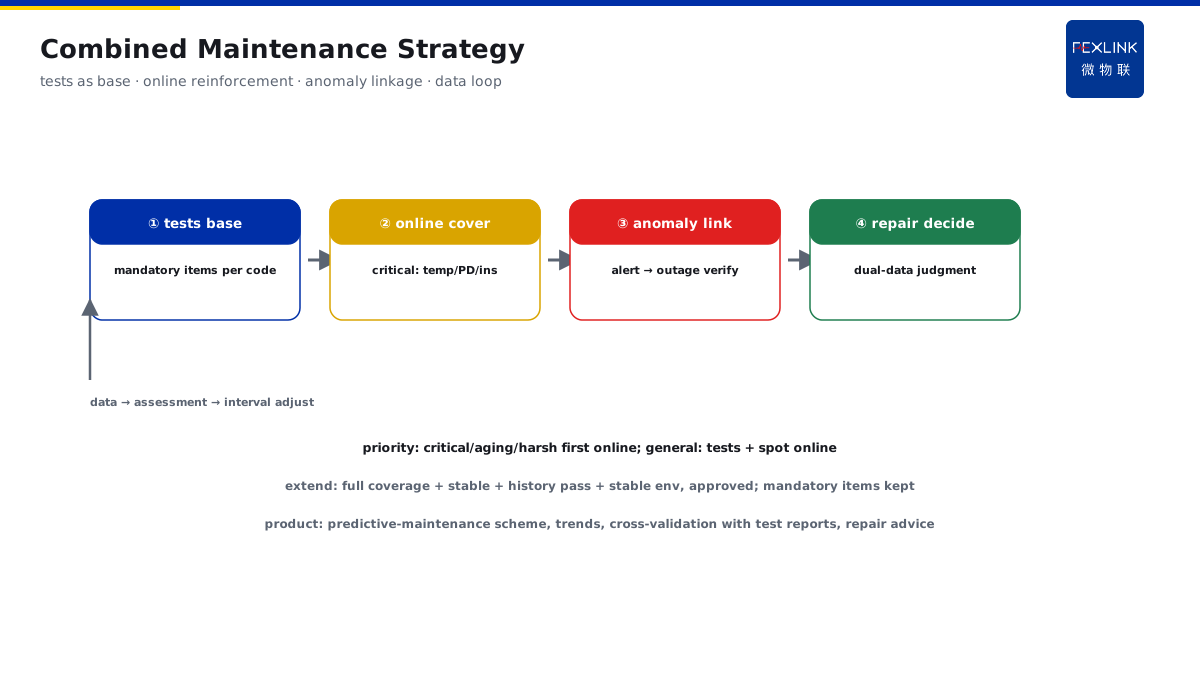
Direct Answer
Periodic outage testing per the preventive-test code is costly, and there is concern that online monitoring cannot replace it. How should the two relate? The answer: DL/T 596 specifies the items and intervals of periodic preventive tests for electrical equipment — a periodic check in the de-energized state; online monitoring is continuous observation in the energized state. They are complementary: preventive tests find existing defects, online monitoring tracks developing trends; qualified online-monitoring data can serve as a reference for extending test intervals, but cannot replace mandatory preventive-test items.
At one plant, a 10 kV transformer followed the DL/T 596 interval for preventive tests and also had online monitoring. A preventive test found winding DC-resistance imbalance over limit (2.1%, standard 2%) and it was handled per the code; the online curve over the same period was smooth (no step change). Cross-analysis: the preventive test found an "existing defect" (a joint loosening that already existed); online monitoring did not trigger because the defect had not yet produced a measurable change — each tool covers its own segment. Conclusion: preventive tests + online monitoring in parallel gives more complete defect discovery. DL/T 596 and online monitoring are complementary: preventive tests find existing defects during outages, online monitoring catches trend step-changes during operation — together they form complete equipment health management.
Because:
- Preventive tests are periodic checkups: systematic items and fixed intervals in the de-energized state;
- Online monitoring is real-time supervision: continuous trend observation in the energized state;
- Defect forms differ: existing defects (joint loosening) are found by tests, developing defects (PD growth) are caught by online;
- Decision split: tests decide "whether to repair," online decides "when to repair."
Key insight: DL/T 596 and online monitoring are not substitutes but complements. Outages find existing defects, operation catches trends — both in parallel give the full health picture.
At one power plant's GIS: preventive tests per the DL/T 596 interval, plus online PD monitoring. Test data were normal, but online PD rose slowly for three consecutive months (from 30 pC to 120 pC), triggering an alert; at the next maintenance window the equipment was de-energized and metal particles were found on a spacer surface — the test could not catch it (outage test items are insensitive to this kind of developing defect), while online monitoring detected it early. The two tools each cover one segment: tests find problems that "already exist," online monitoring finds problems that are "developing" — together nothing is missed.
1. Items and Intervals of the DL/T 596 Preventive-Test Code
Step one: what the code governs.
Positioning of the code:
- DL/T 596, Preventive Test Code for Electric Power Equipment;
- Specifies items, intervals, and criteria for periodic preventive tests;
- Covers transformers, breakers, instrument transformers, cables, GIS, and other major equipment;
- A periodic check in the de-energized state (scheduled inspection).
Typical intervals:
- Transformer: winding DC resistance, insulation resistance, dielectric loss (1–3 years);
- Breaker: circuit resistance, operating characteristics (1–3 years);
- Cable: insulation resistance, DC withstand (1–3 years);
- GIS: SF6 gas, circuit resistance, withstand (3–6 years).
Nature of test items:
- Outage tests: the equipment must be taken out of service;
- Test conditions: standard conditions (voltage, temperature, humidity controlled);
- Clear criteria: each item has an explicit pass standard;
- Result handling: over-limit items are scheduled for treatment (repair/replacement).
Limitations of tests:
- Long intervals: the gap between two tests is a blind zone;
- Outage cost: critical equipment is hard to de-energize (continuous production);
- Instantaneousness: a snapshot at the test moment (trends unseen);
- Item limits: insensitive to developing defects (PD growth).
Key insight: DL/T 596 is the outage checkup code. It sets items, intervals, and criteria — finds existing defects, but the gap between tests is a blind zone.
2. Division of Labor Between Online Monitoring and Tests
Step two: how the two tools divide work.
Positioning of online monitoring:
- Continuous observation in the energized state (real-time data);
- Measured quantities: temperature, PD, insulation, current, etc.;
- Trend analysis: catching change trends (developing defects);
- Early-warning capability: early anomaly detection.
Division logic:
- Tests: find existing defects (present, not yet developing);
- Online: find developing defects (currently worsening);
- Tests: define items and criteria (pass standards);
- Online: define trend thresholds (rate-of-change alerts).
Complementary scenarios:
- Test pass + online normal: healthy;
- Test pass + online abnormal: developing defect (online detects first);
- Test abnormal + online normal: existing defect (test detects first);
- Both abnormal: defect already developed (handle immediately).
Data relationship:
- Online data cannot directly replace test items;
- Online trend anomaly → schedule an outage test/repair for verification;
- Test results calibrate online thresholds (validation);
- Analyze both data sets side by side (cross-validation).
Key insight: the division is "existing vs developing." Tests find existing, online catches developing — cross-validation leaves no defect missed.
3. Can Online Data Extend Test Intervals
Step three: can outages be reduced.
Policy basis:
- Condition-based maintenance: good equipment state allows adjusted intervals;
- Online-monitoring data is an important input to condition assessment;
- Qualified online monitoring can serve as a reference for extending intervals;
- But it cannot replace mandatory test items (per the code).
Conditions for extending:
- Online monitoring covers key quantities (temperature/PD/insulation, etc.);
- Long-term data stable (no abnormal trends);
- Historical tests consistently pass;
- Stable operating environment (no overload/harsh conditions).
Notes:
- Extension requires approval (condition assessment + expert review);
- Conservative for critical equipment (do not extend lightly);
- Restore the original interval when monitoring fails/data is missing;
- Extension ≠ cancellation (still perform minimum items per interval).
Key insight: extension is a conditional adjustment. Good state, full monitoring, stable data — extension may be referenced; mandatory items remain non-replaceable.
4. Mandatory Test Items That Cannot Be Replaced
Step four: which items must be done during outages.
Non-replaceable items:
- Winding DC resistance (transformer): contact-state judgment;
- Insulation resistance/dielectric loss (accurate measurement requires outage);
- DC withstand/leakage current (cable insulation strength);
- Breaker operating characteristics (mechanical-state verification);
- Circuit resistance (contact state);
- SF6 gas analysis (GIS insulation-medium state).
Why non-replaceable:
- Measurement requires outage conditions (accuracy requirements);
- Test energization (withstand) is possible only in the de-energized state;
- Criteria are based on standard test conditions;
- Online measurements ≠ test items (different quantities).
What online monitoring supplements:
- Operating temperature trends (rise deterioration);
- PD development trends (early insulation degradation);
- Load-health correlation (operating-condition effects);
- Alert + localization (narrow the repair scope).
Key insight: mandatory items are non-replaceable. Tests requiring outage conditions can only be done by preventive testing; online monitoring supplements operational trends — the two do not swap.
5. Combined Maintenance Strategy
Step five: what combination is most reasonable.
Combination strategy:
- Tests as the base: mandatory items per the code's intervals;
- Online coverage: online monitoring on critical equipment;
- Anomaly linkage: online anomaly → schedule outage verification/repair;
- Data accumulation: both data sets accumulated side by side (historical comparison).
Critical equipment first:
- Important-load circuits (high outage cost) get online monitoring first;
- Aging equipment (higher defect probability) first;
- Harsh environments (outdoor/high-humidity/high-temperature) first;
- General equipment: tests primarily + point online monitoring.
Maintenance decisions:
- Online trend normal + test pass: maintain per interval;
- Online alert: advance the schedule (do not wait for the interval);
- Test over-limit: handle per criteria;
- Both abnormal: immediate outage repair.
Key insight: the combination is "tests as the base + online as reinforcement." Mandatory items not skipped, critical equipment online, anomaly-linked repairs — a closed-loop health-management loop.
6. Product Landing: Predictive-Maintenance Scheme
FEXLINK products bring DL/T 596 into daily operation:
- Predictive-Maintenance Scheme: online monitoring of critical equipment (temperature/PD/insulation);
- Trend analysis: early detection of developing defects;
- Side-by-side with test reports: cross-validation (existing + developing);
- Maintenance recommendations: online alert → schedule outage verification/repair.
Design principle in one sentence: "tests find existing, online catches developing" — dual-track. Code checkups + real-time supervision — full equipment health visibility.
7. Common Misconceptions in Interpretation
- Treating online monitoring as a substitute: no tests once online is installed. Consequence: mandatory items missing (existing defects missed). Correct: tests as base + online reinforcement.
- Tests only, no trends: at ease once tests pass. Consequence: developing defects missed between tests. Correct: online monitoring fills the blind zone.
- Extending without basis: extending with incomplete data. Consequence: equipment state out of control. Correct: condition assessment + approval + conservatism.
- Isolating the two data sets: no cross-validation. Consequence: information silos (incomplete defect judgment). Correct: side-by-side analysis (tests calibrate online).
- Flat outage-cost view: all equipment hard to de-energize. Consequence: critical equipment unmonitored. Correct: grade by importance (critical circuits get online first).
Scope and Limitations
This article provides a framework for interpreting the complementary relationship between the DL/T 596 preventive-test code and online monitoring (test items and intervals, division of labor, conditions for extending intervals, non-replaceable mandatory items, combined maintenance strategy) for planning preventive testing and online monitoring, budget decisions, and maintenance-strategy design. Specific test intervals and criteria follow the current DL/T 596 version and the clauses for the equipment type; extending test intervals must be approved per condition-based-maintenance regulations; outage tests must be performed by qualified test personnel per procedures. All cases are anonymized (a certain plant / a certain power plant) and do not refer to any specific customer.