 微物联研究院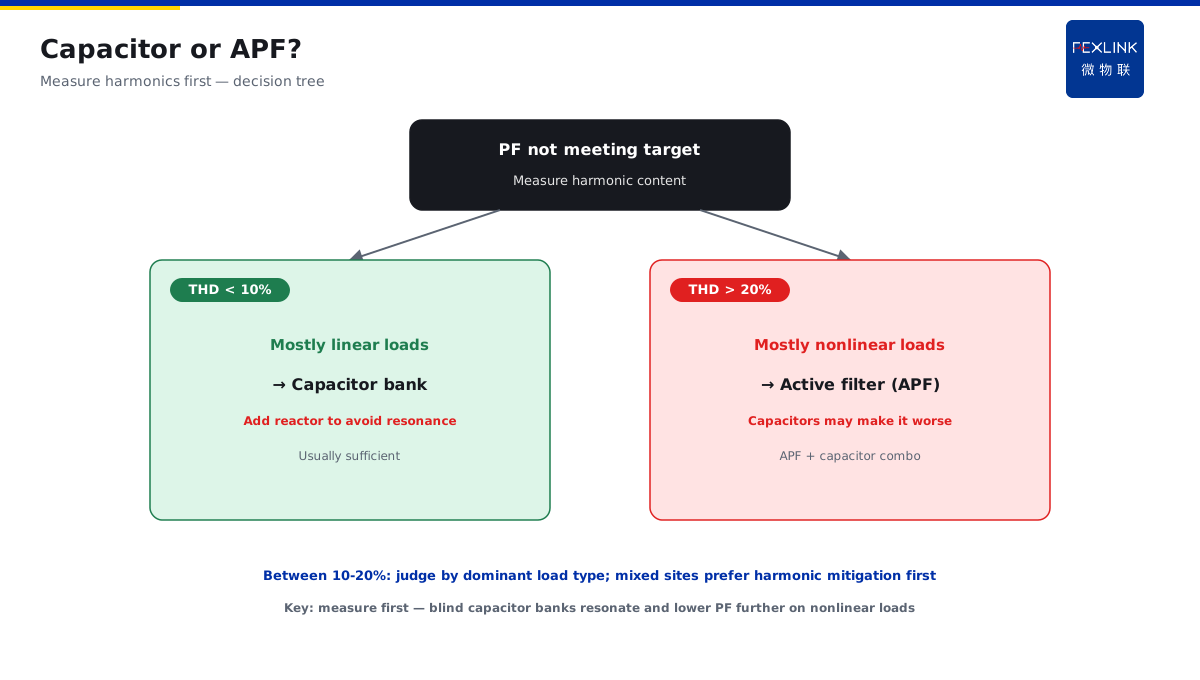
Direct Answer
Displacement factor (cosφ₁) and true power factor (PF) — both called "power factor" on the meter, but with harmonics they differ a lot:
- Displacement factor (cosφ₁): only looks at fundamental voltage vs fundamental current phase difference — answers "is fundamental VAR large?";
- True power factor (PF): total active / total apparent — answers "is overall energy efficiency high?"
Key insight: capacitor banks compensate displacement factor, not true power factor. With harmonics, displacement factor can be 0.95 but true PF only 0.8 — this is the root cause of "compensation making it worse."
At one factory, after capacitor bank was installed, displacement factor on the meter rose from 0.82 to 0.96 — looked great. But the electricity bill still showed PF penalty, fine still charged. Owner said "did the capacitor bank work at all?"
Later power quality test found: the factory has lots of VFDs and UPS, 5th harmonic current 32%, 7th harmonic current 18%. No matter how high displacement factor is compensated, harmonic current is still there, apparent power still inflated, true PF still low.
1. Definition Difference Between Two Power Factors
Many people think "power factor is just cosφ," but that is only displacement factor.
Displacement factor cosφ₁
- Fundamental only: fundamental voltage vs fundamental current phase difference cosine;
- Formula: cosφ₁ = P₁ / S₁ (fundamental active / fundamental apparent);
- Answers: how much fundamental reactive power;
- Compensation: add capacitor bank.
True power factor PF
- Everything: total active / total apparent;
- Formula: PF = P / S (total active / total apparent);
- Answers: overall energy utilization efficiency;
- Compensation: capacitor bank + active filter.
Key difference: displacement factor only cares about fundamental, true PF cares about all harmonics.
2. How Harmonic Current Inflates Apparent Power
Why do displacement factor and true PF differ so much with harmonics?
Because:
- Apparent power S = √(P² + Q² + D²) (D = harmonic distortion power);
- Displacement factor cosφ₁ = P / √(P² + Q²) (without D);
- True power factor PF = P / S = P / √(P² + Q² + D²).
When harmonic current is large, D is big, S gets inflated. P unchanged, S bigger, PF lower.
Example:
- Fundamental active P = 800 kW;
- Fundamental reactive Q = 400 kvar;
- Harmonic distortion D = 500 kvar.
Displacement factor cosφ₁ = 800 / √(800² + 400²) = 0.894 (looks OK). True power factor PF = 800 / √(800² + 400² + 500²) = 0.785 (non-compliant).
Gap of 0.11 — caused by harmonics.
3. Why Capacitor Banks Can Make It Worse
Owners have seen this: after capacitor bank installed, displacement factor goes up, but true PF goes down.
Why?
Because capacitor bank and harmonics create parallel resonance:
- Grid has inductance (transformer, lines);
- Capacitor bank is capacitance;
- Inductance + capacitance = resonant circuit.
When resonance frequency lands on a harmonic, that harmonic current gets amplified several times or even dozens of times — apparent power inflates even more, true PF even lower.
This is the root cause of "compensation making it worse": not that capacitor bank is useless, but capacitor bank is amplifying harmonics.
4. Which PF Is Used for Billing
Most practical question: which power factor does the electricity bill use?
Answer: true power factor PF.
The utility tariff meter measures total active and total apparent, and computes true power factor. No matter how high you compensate displacement factor, if true PF is non-compliant, fines still apply.
This is why many factories "installed capacitors but still fined" — they compensated displacement factor, utility bills true PF.
5. When to Use APF Instead of Just Capacitors
When should you use Active Power Filter (APF) instead of just adding capacitors?
Use capacitors when:
- Harmonic current < 10%;
- Linear loads (motors, heating);
- Displacement factor < 0.9.
Use APF when:
- Harmonic current > 20%;
- Nonlinear loads (VFDs, UPS, rectifiers);
- Capacitor bank installed but "making it worse";
- True PF not improving.
Simple rule: linear loads get capacitors, nonlinear loads get APF.
FEXLINK ESE power quality monitor helps you decide whether to add capacitors or APF:
- Measures displacement factor and true PF;
- Measures each harmonic current content;
- Detects "compensation making it worse" resonance.
Measure first, then decide. Do not blindly add capacitors.
6. A Real Case
One electronics factory, lots of VFDs:
- Original: displacement factor 0.82, true PF 0.75, monthly fine 8000 RMB;
- After capacitor bank: displacement factor rose to 0.96, true PF dropped to 0.70 (resonance amplified harmonics);
- After APF: displacement factor 0.95, true PF rose to 0.94, fine disappeared.
Owner said: if we had done power quality test first, we would not have wasted money on that capacitor bank.
7. Three Common On-Site Mistakes
Mistake 1: only looking at displacement factor. High displacement factor does not mean high true PF. With harmonics, they differ a lot.
Mistake 2: blindly adding capacitors. When harmonics are large, adding capacitors = amplifying harmonics, compensation makes it worse.
Mistake 3: capacitor bank without reactor. Even if you add capacitors, you must series a reactor to suppress resonance. Plain capacitor bank directly connected to grid easily resonates with harmonics.
8. One Sentence to Remember
Displacement factor cares about fundamental, true PF cares about all harmonics. Capacitor bank compensates displacement factor, APF compensates true PF.
Measure harmonics first, then decide what to install — do not blindly add capacitors.
9. Common Questions
Q: How do I know if my load is linear or nonlinear? A: Look at main equipment. Motors, heating, lighting = linear. VFDs, UPS, switch-mode power supplies = nonlinear. If you have nonlinear loads, test harmonics.
Q: Can ESE power quality monitor measure both power factors? A: Yes. ESE measures displacement factor and true power factor simultaneously, plus each harmonic current content. Tells you directly "add capacitor or install APF."
10. Why This Is Becoming More Important
Factories used to be all motors, heating, linear loads. Low displacement factor just meant lots of reactive power, add capacitors and done.
Not anymore — VFDs, UPS, switch-mode power supplies, LED drivers, these nonlinear loads keep growing. Harmonic currents keep growing, the gap between displacement factor and true PF keeps widening.
The old era of "add capacitor and solved" is over. Now you must test harmonics first, then decide what to install. This is why ESE power quality monitors matter more and more — they help you figure out "capacitor or APF," instead of spending money blindly.
Stay safe. Stay professional. Stay curious.
11. Quick Checklist
Before you install any power factor correction equipment, run through this checklist:
- Do you have any nonlinear loads (VFDs, UPS, rectifiers, LED drivers)?
- Have you measured harmonic current content in the last 12 months?
- Is your capacitor bank fitted with a series reactor?
- Do you know the difference between displacement factor and true PF?
- Are you being fined for low PF on your electricity bill?
If you answered "yes" to question 1 but "no" to question 2, you are flying blind. You are spending money on power factor correction without knowing whether you need capacitors, APF, or both.
The ESE power quality monitor gives you all five answers in one installation. It sits on your incoming feeder, samples voltage and current continuously, and computes both power factors plus each harmonic. You can see the data on screen, or on the cloud platform.
12. How to Build a Routine
A good power quality routine is not about fixing things once. It is about measuring continuously. Install ESE, set thresholds, and let the platform watch for you. If true PF starts dropping, you get an alert. If harmonic current starts rising, you get an alert. If the capacitor bank starts resonating, you get an alert.
This is condition-based power quality management. You do not wait for the monthly bill to tell you something is wrong. You see it in real time, you fix it early, you avoid the fine.
Start today. Pull your last electricity bill. Check the PF number. Then ask yourself: do I know if that number is displacement factor or true PF? If you do not know, that is your first project. Stay safe.
Final Thoughts
Power factor is one of those topics that sounds simple but has a very practical bottom line: money. Every month you pay a penalty, that is money gone. Every kilowatt of wasted capacity, that is equipment you cannot use.
Get it right. Measure first. Compensate smart. Stay safe.
Good luck, and stay safe.
Remember: your electricity bill is not just a bill. It is a report card on how well you manage your electrical system. Read it carefully. Act on it early. And always, always measure before you spend.
Stay safe. Stay smart. Stay ahead of the curve.
See you in the next article.
Take care. Bye.
Goodbye.
Bye bye now.